life 120 - ch.6-8
 Call Kai
 Learn
Learn Practice Test
 Spaced Repetition
 Match
Match Flashcards
 Knowt Play
1/64

There's no tags or description
Looks like no tags are added yet.
Name | Mastery | Learn | Test | Matching | Spaced | Call with Kai | Chat |
|---|
No analytics yet
Send a link to your students to track their progress
65 Terms
chemical reactionsn
drive the processes of life
are always occurring
harvests energy and uses it for work
metabolism
totality of chemical reactions in an organism
metabolic pathways
multistep reaction that starts with certain reactant and ends with certain product
each step is catalyzed by an enzyme
two types of metabolic pathways
anabolic: requires energy, builds complex reactions
catabolic: releases energy, turns complex reactions into simpler ones
energy
the capacity to cause change
kinetic energy
energy based on motion
thermal energy
type of kinetic energy that is focused on the random movement of atoms/moleculesth
heat
thermal energy is transferred from one object to another
potential energy
energy that matter posses based on its location/structure
chemical energy
potential energy available for release in chemical reactionn
thermodynamics
the study of energy tranformations
laws of thermodynamics
energy can not be created or destroyed; it can only be transformed and transferred
every transformation and transfer of energy increases the entropy of the universe
entropy
disorder in a system
without additional energy input, systems gravitate towards disorder
free energy
portion of system’s ability to do work
amount of free energy is dependent on composition and the arrangement of components of an object
free energy steps
free energy is at its peak, but is unstable and has higher capacity of work
free energy is released, less stable, released energy is used to do work
free energy is decreased, is more stable, and has less capacity of work
exergonic reactions
net loss of energy, negative, spontaneous/downhill reaction
endergonic reactions
gain of energy, positive, nonspontaneous/uphill reaction
spontaneous reaction
reaction that is energetically favorable/exergonic
how does a cell perform chemical reactions that are not energetically favorable?
favorable reaction drive the abilities of unfavorable reactions
ATP is used to help drivee unfavorable reactions
ATP hydrolysis
releases free energy that can be used to do work
ATP + H2O —> ADP + P1 + Energy
reaction coupling
allows cells to use energy from ATP hydrolysis to drive energetically unfavorable reactions
ATP regulation cycle
see image

catalyst
chemical agent that speeds up a reactione
enzyme
protein catalyst
enzymes allow reactions to occur on the time scale necessary for life processes
transition state
high energy state where molecules are able to react
some reactions occur slowly even if they’re favorable
activation energy
energy needed to reach transition state
enzymes can lower activation energy, creating alternative/faster pathways without changing level of free energy
created by thermal energy and molecular collisions
substrate
a reactant molecule
an enzyme’s active site allows enzymes to be very specific for a single reaction
catalytic cycle of an enzyme
substrate binds to active site
substrate is held in active site by weak interactions
substrates are coverted to products
products are spit out
active site is empty and ready for more substrates to enter
positive regulation
enzyme binds to other factors or is modified in order to reactivate
negative regulation
enzyme activity is blocked by an inhibitor
competitive inhibitor
binds to an active site and prevents substrate from getting in
noncompetitive inhibitor
binds to a different location of an enzyme, altering the shape of the enzyme’s active site
chemical equilibrium
reached when rate of forward reaction is equal to rate of reverse reactions
concentrations of reactants and products remain essentially stable
chemical reactions proceed in both directions
one direction is often more energetically favorable
over of matter and energy flow

cellular respiration
includes aerobic and anaerobic respiration, but it’s mainly aerobic
we will focus on sugar glucose
cellular respiration formula
C6H12O6 + 6 O2 —> 6 CO2 + 6 H2O + energy (ATP + heat)
cellular respiration is ____ to combusion
similar
combustion formula
CH4 + 2 O2 —> 2 CO2 + 2 H2O
reactions of cellular respiration are kept in a ______
non-equilibrium state
oxidation-reduction reactions
chemical reactions based on the transfer of electrons
oxidation
losing electrons
reduction
gaining electronsox
oxidation agent
causes oxidation, gains electrons
reduction agent
causes reducing, loses electron
electron transfer during methane combustion
carbon is oxidized because it has less of a share of electrons
oxygen is reduced because it has a greater share of electrons
reaction proceeds to the right because electrons are at a low energy level when they are closer to oxygen
CH4 becomes oxidized into CO2
2 O2 becomes reduced into 2 H2O
electron transfer during cellular respiration
electrons in reactants have a higher energy state than electrons in products
overall reaction is broken down into a series of redox reactions
reaction driven to the right for the same reason as methane combustion
C6H12O6 is oxidized into 6 CO2
6 O2 is reduced into H2O
NAD+
functions as a high energy electron shuttle during cellular respiration
disaccharide
nicotinamide is nitrogenous base
NAD+ reduction into NADH ads an extra hydrogen to nicotinamide base
NADH maintains electrons in a high energy state for use later in cellular respiration
ATP is generated in two different ways
substrate level phosphorylation
oxidative phosphorylation
substate level phosphorylation
enzyme transfer a phosphate group from a molecule to ADP
( phosphate + substrate —> ADP ) —> product + ATP
occurs during glycolysis and citric acid cycle
o
oxidative phosphorylation
redox reactions of the electron transport chain are coupled to addition of free phosphate to ADP
occurs during last stage of respiration
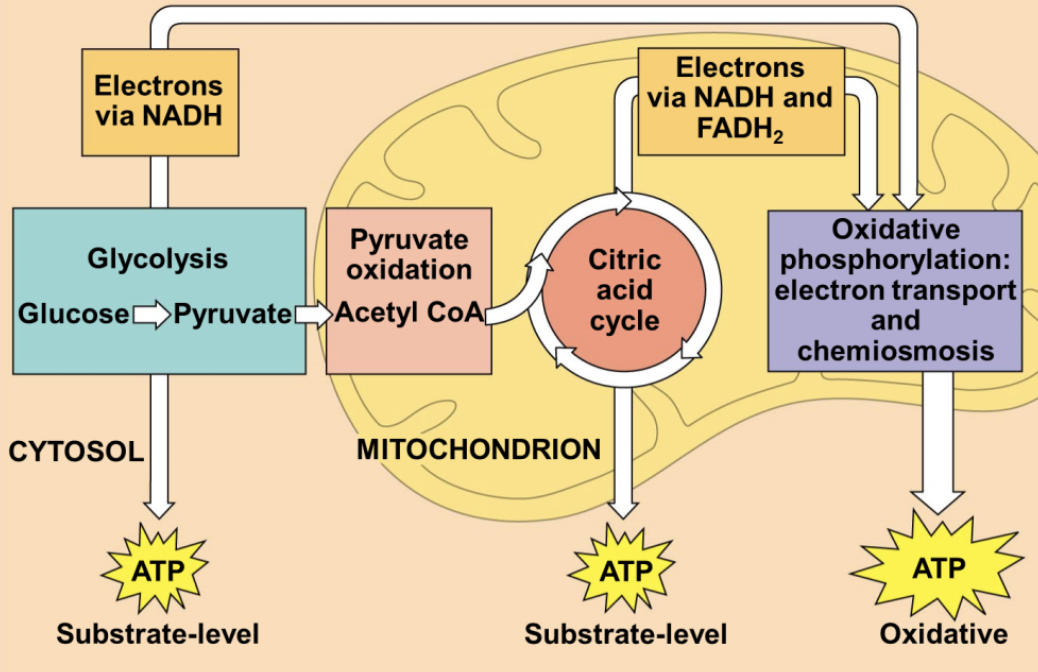
overview of cellular respiration

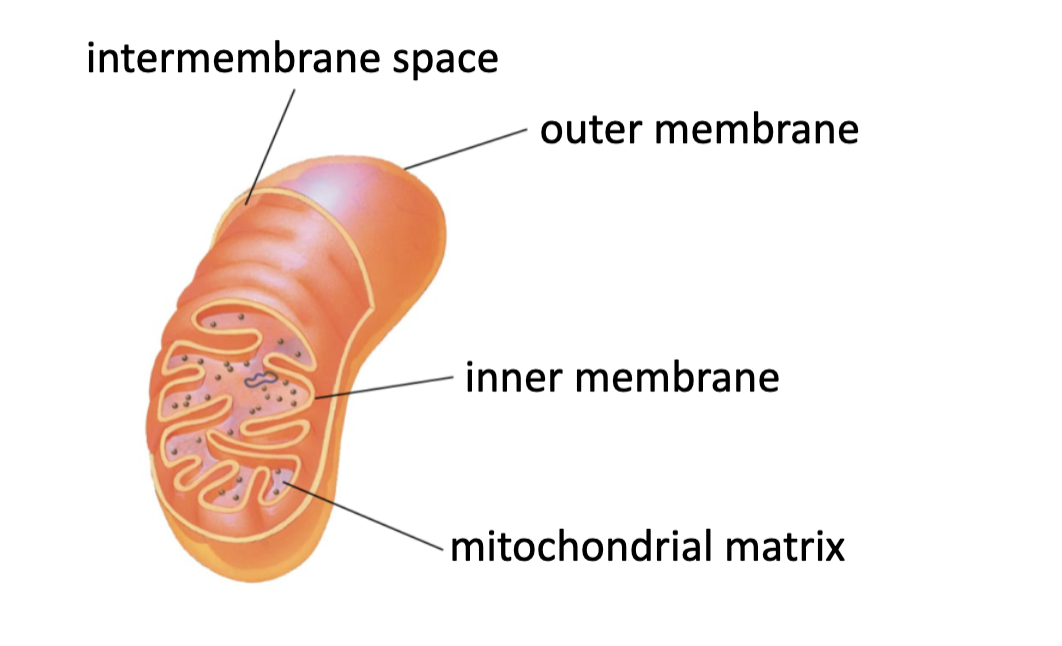
mitochondrial anatomy
glycolysis
sugar splitting in cytosol
glucose (6c) is oxidized into two pyruvate (3c)
energy investment phase
2 ATP used
energy payoff phase
4 ATP reformed
2 NADH formed
citric acid cycle
pyruvate enters mitochondria
pyruvate is oxidized into acetyl CoA
1 CO2 released
1 NADH formed
acetyl CoA enters CAC and is coupled to oxaloacetate
sequentially oxidized
2 CO2 released
3 NADH formed
1 ATP formed
1 FADH2
oxaloacetate reformed
oxidative phosphorylation (electron transport chain)
energy harvested from NADH and FAD2
high energy electrons transferred down ETC in a series of redox reactions
energy released coupled to the movement of H+ across membrane
generates an H+ concentration gradient
oxygen serves as final electron acceptor
chemiosis
proton diffuse across inner mitochondrial membrane
ATP synthase
couples proton movement to ATP formatin
blocking one reaction inhibits __________
upstream and downstream reactions
ATP production in the absence of oxygen
oxygen is the terminal electron acceptor of the ETC
without oxygen, a cell uses other means to generate ATP
anaerobic respiration
some bacteria use a different molecule as the terminal electron acceptor
fermentation
bacteria, yeast, and other cells
glycolysis produces ATP and NADH, NADH recyled back to NAD+
NADH is recycled to NAD+ by transferring electrons to pyruvate or a pyruvate derivative
this removes pyruvate and replenishes the pool of NAD+ allowing glycolysis to continue
exercise and cellular respiration
ATP is rapidly consumed by muscles during exercise
the body must replenish ATP supplies in order to continue
cellular respiration is thus critical to sustained exercise
during exercise
breathing rate and heart rate increase
dilation of blood vessels in muscle tissue
glucose release from glycogen stores
after training
heart muscle becomes stronger
increased red blood cell count
increased blood vessel density
artificial methods
erythropoetin and blood doping to increase red blood cell count