Time Series All weeks
 Call Kai
 Learn
 Practice Test
 Spaced Repetition
 Match
 Flashcards
 Knowt Play
1/7

There's no tags or description
Looks like no tags are added yet.
8 Terms
McLeod Li test purpose
When the ARMA(p,q) specification is correct, Q converges in distribution to the Chi Squared test with K -p-q df.
Tests for autocorrelation in the squared residuals. Because it is looking for dependence in the variance.
Null hypothesis: Squared residuals are uncorrelated
Reject the null when our X² > Critical Value.
Or if the pvalue is smaller
Results are significant when our value is less than the critical value and the p-values are large
McLeod Li formula
Ljung Box Test:
If the ARMA(p,q) specification is correct Q is distributed as X² stat with k-p-q df
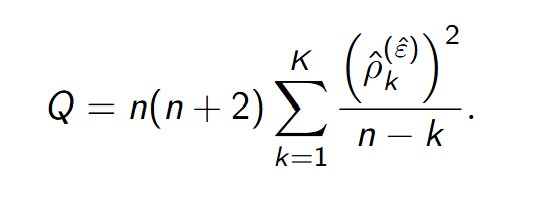
Ljung Box Test
Null Hypothesis: No autocorrelation between the residuals all autocorrelations up to lag k equal 0
Reject when our value is larger than X² or for a small p-value
GARCH vs ARCH Model
Arch(q) adds q previous Y² terms and GARCH(p,q) adds p lagged conditional variance terms
Residuals of GARCH
Estimated Conditional Standard Deviation

Standardised GARCH residuals
If the GARCH model is correct Et hats are iid
However Q of a GARCH model is not X² K-p-q
Li and Mak derived something else (don’t look at this)

ARMA GARCH models
Choose u and v from ARMA(u,v) from looking at the ACF/PACF.
If the arma(p,q) specification is correct then then Q is chi squared
Mcleod li test
If it rejects the null - fails test of no autocorrelation
Then you examine p and q in the GARCH Model from the ACF and PACF of the squared residuals of the ARMA(u,v)
Estimate the ARMA and GARCH(p,q) parameters together by maximum likelihood estimation