Cumulative Trauma Disorder: Hand Fractures & Finger Sprains and Deformities
 Call Kai
 Learn
 Practice Test
 Spaced Repetition
 Match
 Flashcards
 Knowt Play
1/37

There's no tags or description
Looks like no tags are added yet.
38 Terms

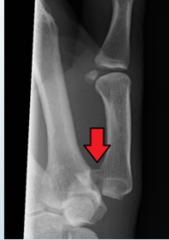
Boxer's fx (Metacarpal)
occurs when there's a volar displacement at the head of the MC.
Bennett's fx (Metacarpal)
an avulsion fx on the ulnar side of the 1st MC base and an
interarticular comminuted fx of the CMC joint.

Rolando's fx (Metacarpal)
an interarticular comminuted fx of the CMC where it makes a T/Y shape fx pattern.
Metacarpal fx conservative management
- not one program or splint proven superior
- should the wrist be included?
- if the adjacent finger should be included?
- do you include the IP joints?
Metacarpal fx conservative management: orthosis
splinting: MPs need to be in at least 60 degrees of flexion
Metacarpal fx surgical management
- early motion of adjacent joints is important;
- minimize MP tightness and maximize extensor tendon excursion - have the patient do MP flexion while flexing and extending the IPs;
- start scar massage 1-2 days after the sutures are removed; - use clinical reasoning to decide on splint design
Proximal Phalanx (P-1)
PIP joint extensor lag is due to adhesions of extensor tendons to bone and shortening of proximal phalanx secondary to the fracture angulation.
Proximal Phalanx (P-1): Non-operative
- closed, nondisplaced, or min. Displaced - buddy taping or splinting to adjacent digit; splint: wrist free, strap can be released to allow IP flexion and then strap back into splint for more protection;
- allowed controlled active motion of the IP joints with MP flexed;
- control edema
Proximal Phalanx (P-1): Non-operative Orthosis
wrist free, strap can be released to allow IP flexion and then strap back into splint for more protection
Proximal Phalanx (P-1): Post-operative
- same splint consideration as with non-op;
- early motion is based on clinical reasoning
Proximal Phalanx (P-1): Post-operative exercise
MP flexion with IP movement, isolate the IPs for FDS and FDP excursion
Middle Phalanx (P-2)
tendency for extensor tendon lag and PIP joint flexion contracture
Middle Phalanx (P-2): Non-operative
- many treated with closed reduction and cast or splint;
- early mobilization with mobilization orthosis, with physician approval; splint: dorsal finger-based to hold IP joints in extension; if patient is very active - hand based splint might be needed
Middle Phalanx (P-2): Non-operative Orthosis options
- dorsal finger-based to hold IP joints in extension;
- if patient is very active - hand based splint might be needed
Middle Phalanx (P-2): Post-operative
- do controlled movement of the IPs;
- scar management
Middle Phalanx (P-2) Post-operative Orthotic Options
- finger based orthosis to position IPs in extension
- might need static progressive or dynamic orthosis if contracture develops
Distal Phalanx (P-3)
watch out for extensor lags!
- tuft fx
- jersey finger
- mallet finger
Tuft fx
closed non-displaced shaft fractures
Tuft fx treatment
- clamshell splint,
- may be able to early controlled movement,
- may need desensitization
Jersey finger
avulsion fracture of the FDP and the volar, distal phalanx
Mallet finger
the extended digit is forcibly flexed and the extensor tendon avulses a piece of the dorsal, distal phalanx
Mallet finger treatment
- K wire or splint.
- Immobilized 6-8 weeks with another 4 weeks at night.
- Timeline varies.
- Monitor extension lag
PIP fractures therapy: non-operative
- may do active flexion and controlled extension, starting with the DIP and slight PIP.
- Do for 2-4 weeks while gradually increasing movement; splint removed when clinically healed and activity level allows
PIP fractures: Non-operative Orthosis
simple fx: dorsal based orthotic immobilization with the PIP in 0-25 degrees of flexion (depends on injury)
PIP fractures: Post-operative
- complex fx: K-wire traction might be needed;
- volar plate surgery needs a dorsal blocking finger-based orthosis
Boutonniere deformity: Non-operative
- if the patient can passively extend the PIP than non-op tx with PIP immobilization in extension may be indicated;
- this is for approx. 6 weeks;
- MP and DIP are free, encourage AROM of the MP and DIP; it is very important to do DIP flexion exercises of the ORL;
- when PIP movement is allowed, flexion is limited to 30-40 degrees and gradually increased 10-15 degree per week as long as PIP extension is maintained;
- some emerging use of the relative motion extension orthosis
Boutonniere deformity: operative treatment
- zone III extensor tendon injury;
- therapy protocol is determined with surgeon;
- short arc of motion protocol - if patient is a good candidate
Swan neck deformity: non-operative treatment
orthosis that positions the PIP in slight flexion
Swan neck deformity: operative treatment
- may be done with other reconstructive procedures;
- post op protection orthosis with PIP in 30 degrees of flexion, can be a dorsal blocking orthosis;
- this is common in RA
PIP injuries: Collateral ligament
main restraints on deviation forces
PIP injuries: Volar plate
below the PIP joint, fibrocartilaginous, prevent PIP hyperextension
PIP injuries
Tendons help with PIP stability
PIP dislocation
the position of the middle phalanx at the time of injury will determine treatment
PIP Dislocation : volar dislocation
central slip injury, so PIP flexion should be limited
PIP dislocation: dorsal dislocation
VP injury, so PIP extension should be limited
Thumb MP Joint Injuries: Skier's thumb (Gamekeeper's)
MP injury of the UCL
Thumb MP Joint Injuries: Non-operative
- if a partial tear- hand based thumb spica with IP free for 2-4 weeks;
- after this AROM, but wear thumb spica between exercises; - A/AROM at 6 weeks; light lateral pinch may be started early but tip pinch not until cleared (8 weeks)
Thumb MP Joint Injuries: ORIF
- UCL may be reattached MP joint may be pinned;
- thumb spica cast or orthosis for 4 weeks, then pin removed;
- then AROM of CMC and MP is done;
- lateral pinch is done sooner than tip pinch