Dynamic Earth Exam #1
 Call Kai
 Learn
 Practice Test
 Spaced Repetition
 Match
 Flashcards
 Knowt Play
1/75

There's no tags or description
Looks like no tags are added yet.
76 Terms
If plants suddenly disappeared from Earth, which cycle would be affected?
Water, Carbon, and Oxygen Cycles
Mineral
A naturally occuring, inorganic, solid substance having a definite chemical composition and a crystal structure.
A Mineral Cannot be…
Manufactured, liquid or gas, bio-organic, random composition, and randomly arranged molecules.
Is ice a mineral?
Yes
Rock-Forming Minerals
Commonly encountered at the Earth’s surface. MOSTLY silicate minerals
Silica Tetrahedron
a molecule with a strong bond between silica (Si) and oxygen (O) atoms. STs from chain-like compounds by sharing an oxygen atom with a neighboring tetrahedron.
Crystal Structure
The way atoms are arranged in a mineral, the pattern of the bonds between STs defines silicate mineral groups
Felsic (silicate mineral)
Aluminum
Higher Si
Light color
common in granites
relatively low density (2.8 g/cm)
Mafic (silicate mineral)
Magnesium
Iron
Lower Si
Dark color (green, black)
mostly UNcommon in granites
Higher density (3.3 g/cm)
Nonsilicate Minerals
Everything else that is not based on the Si tetrahedron
Oxide Minerals
Oxygen anion is bonded to cations (positive ions), typically metallic.
Economic Importance: Many metal ores (iron, titanium, chromium) are oxide minerals.
Sulfide Minerals
Sulfide anion is bonded to metallic cations.
Economic Importance: Many metal ores (copper, zinc, nickel) are sulfide minerals.
Sulfate Minerals
Sulfate anion is a major building block
often associated with evaporitic conditions
Halide Minerals
Natural salts that form when halogen elements like chlorine, fluorine, and bromine combine with metallic elements like sodium, potassium and calcium.
Often associated with evaporitic conditions
Carbonate Minerals
carbonate ion is the basic building block for these minerals
common mineral formed at earths surface
Phosphate Minerals
phosphate ion is the basic building block for these minerals
common biomineral
Native Minerals
Naturally occurring substances made of a single chemical element rather than a chemical compound
Pure and rare (native gold, silver, diamond)
The most common rock forming minerals on Earth (making up >90% of Earth’s crust) are which group?
Silicate Minerals (e.g. Quartz and Feldspar)
Which of the following is NOT a silicate mineral?
Calcite
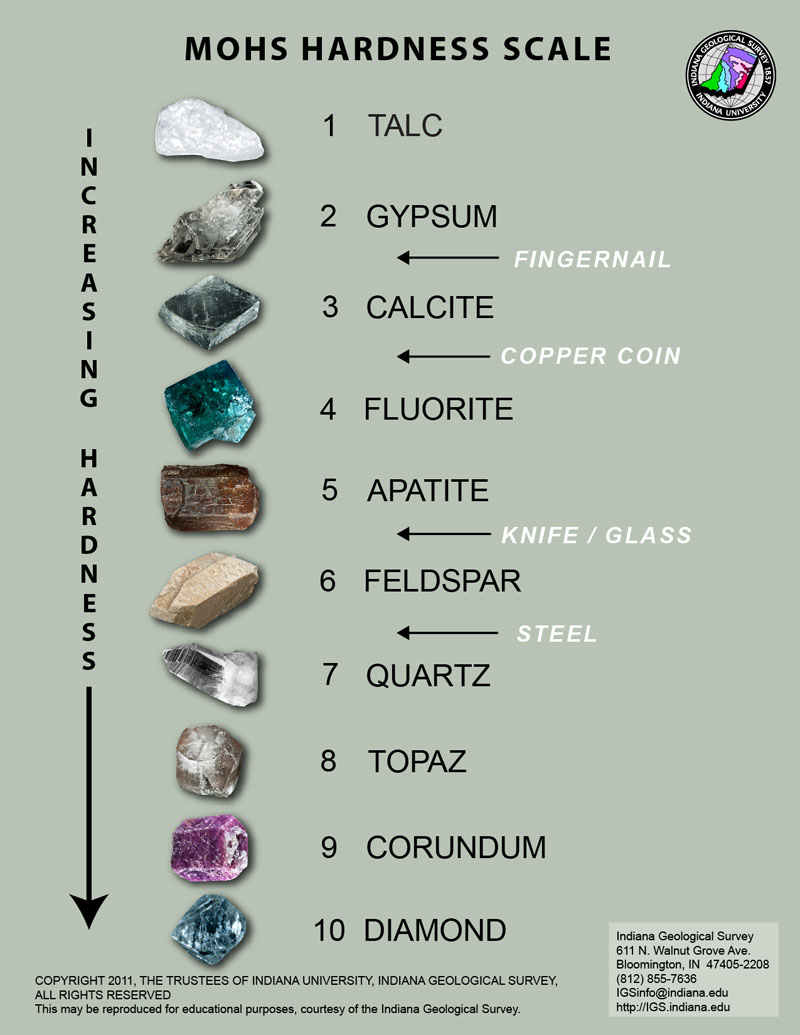
Hardness
Ease with which a mineral surface can be scratched
related to the strength of chemical bonds
Moh’s Scale of Hardness
Cleavage
Tendency of some crystals to split along plane surfaces
occurs along planes in which bonding is weak
Angler and the number of planes are indicative of specific minerals
Color and Streak
Color can be variable due to trace impurities or oxidation
Streak color is often less ambiguous
Crystal Habit
Shape in which an individual crystal (or aggregate of such crystals) grows
Fracture
Tendency for a crystal to break along irregular surfaces
Luster
The way in which the surface of a mineral reflects light
Density
Mass per unit volume
Magnetism
Does the mineral generate a magnetic field
Crystallization
process in which atoms of a gas or liquid join in a proper chemical proportion and crystalline arrangement to form a solid substance.
Formation of Minerals
Atoms/Ions become available
Elements are present in a melt, solution, gas or solid rock.
Physical or chemical conditions change
Temp, pressure, water content or chemical composition changes makes the mineral stable or unstable
Atoms/ions combine
The appropriate elements chemically bond in specific proportions
Their arrangement is controlled by chemical properties and crystal structure
Nucleation occurs
a small, stable cluster of atoms forms - the nucleus of a crystal
Crystal growth occurs
additional atoms or ions attach to the growing crystal in an organized pattern
Mineral becomes part of a rock
minerals may accumulate or grow together with other minerals to form an igneous, sedimentary, or metamorphic rock
Rocks
Made up of one or more minerals
Igneous Rocks
Form from crystallization of molten material (magma or lava)
Extrusive Igneous
Lava (mix of rock, melt and gases) erupts on the surface
Intrusive Igneous
Magma (mix of rock, melt and gases) cools and solidifies (Pluton) beneath
the surface
The sedimentary Cycle
Weathering (in sand) → Transport (past shelf down the slope in water) → deposition (on the ocean floor) +Lithification
Metamorphic Rocks
undergo a change in form due to the action of high heat, high pressure, or chemical activity. No complete melting!
The Rock Cycle
All rock classes are able to undergo natural processes to convert to another rock class.
Interactions involve lithospheric (plate tectonics) and climate systems
Igneous Rocks - Textures
Texture depends on rate of cooling …
Glassy - no crystal structure
Aphanitic - crystals are small
Phaneritic - crystals seen with naked eye
(slower cooling from glassy → phaneritic)
Porphyritic - visible crystals together with much finer matrix ( two timescales of cooling)
Pyroclastic - fragments of rock blown out of volcano fusing together
Igneous Rocks - Phaneritic Texture
Course, slow cooling, intrusive

Igneous Rocks - Aphanitic Texture
Fine, fast cooling, extrusive

Igneous Rock Chart

Magmatic Differentiation by Partial Melting
Magma Consists of 3 components:
Liquid portion = melt
Solids = any crystallized minerals (mostly silicates)
Volatiles = dissolved gasses in melt, including water vapor, carbon dioxide, and sulfur dioxide
Fractional Crystallization
a uniform parent magma can lead to rocks of varying composition due to crystallization (and removal) of minerals with distinctive composition
Partial Melting
of rocks leads to a magmatic composition distinctive from the original rock source
How to Melt Rock
Adding Heat
Reducing Pressure (lowers melting temp)
Adding Volatiles (such as water which lowers melting temp = flux melting)
Sedimentary Rocks
rocks that form when sediments are deposited, compacted, and cemented together, or when minerals precipitate from water.
Weathering
refers to all the destructive processes that change the physical and chemical characteristics of rocks at Earths surface
Physical (or mechanical)
the physical breakdown of large rocks into smaller rocks
Abrasion
Frost wedging
Exfoliation
Root wedging
Insolation Weathering (Thermal expansion and contraction)
On a daily cycle, rock surface expands during day time more than the interior when heated by the sun → increased vibrational amplitude between atoms → creating stresses → small cracks → granular disintegration.
Chemical Weathering
Chemical changes and breakdown of a rocks composition die to exposure to the atmosphere and water
dissolution
hydrolysis
oxidation
variable resistance water
Transport
The movement of solid particles (sediment), typically die to a combination of gravity, and/or the movement of the fluid in which the sediment is entrained
The ability of a medium to carry sediments depends on its velocity and viscosity
Deposition
the geological process in which sediments, soil and rocks are added to a landform or land mass
Lithification
Turns sediment into rock
Clastic Sedimentary Rock
A sedimentary rock made from pieces of pre-existing rocks and minerals (“clasts”) that have been weathered, eroded, transported, deposited, and lithified together
Shale
Sandstone
Conglomerate
Breccia
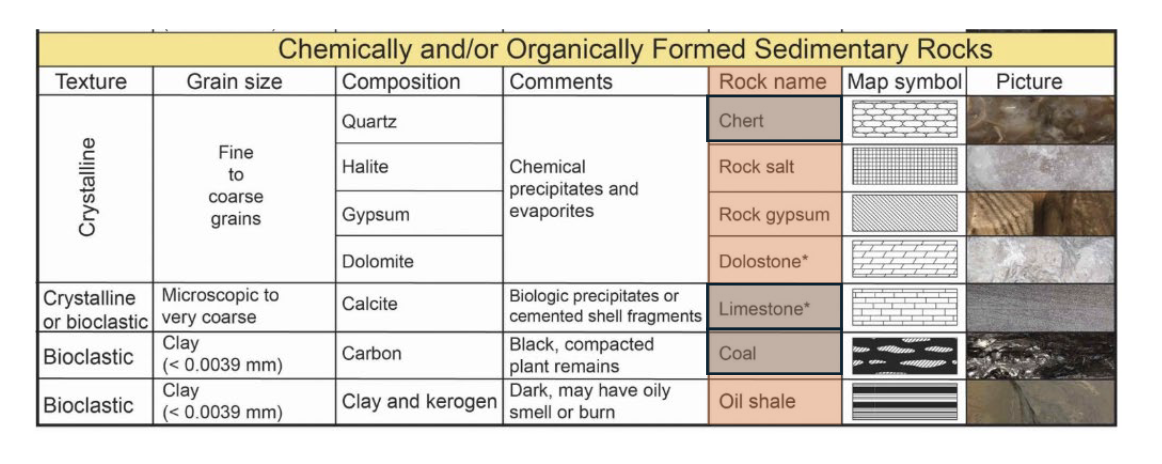
Non-Clastic Sedimentary Rock
A sedimentary rock that forms from the precipitation of minerals out of
water or from the accumulation of organic matter (rather than from pieces of pre-existing rock fragments)
Chert
Rock Salt
Coal
Chert nodule with sponge fossil
Grain Size - How large are the grains?

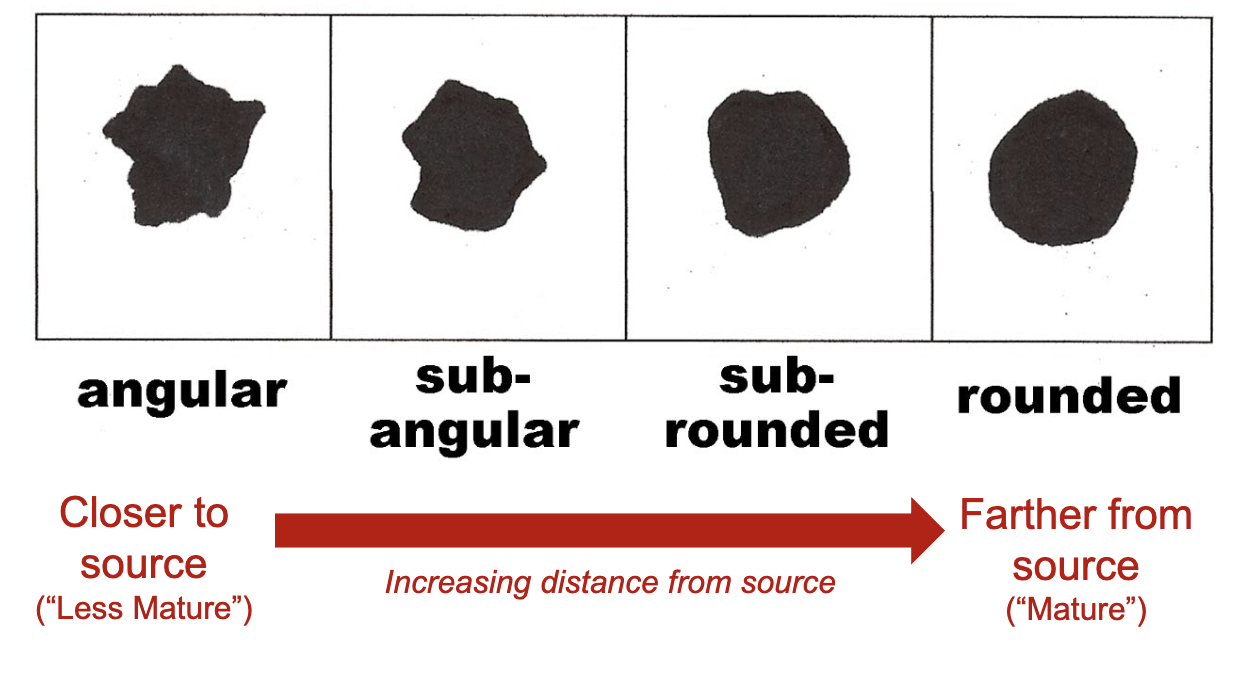
Texture - grain size, roundness, sorting

Roundness - How round or angular are the grains?
Sorting - Are all the grains the same size?

Classification or non-clastic sedimentary rocks
Depositional Environment
refers to all the environmental factors (physical, chemical, and biological) under which sediment is deposited
Two Important Factors
Distance to source
Transport energy
Metamorphic rocks
undergo a change in form due to the action of high heat, high pressure, or chemical activity. No complete melting!
Metamorphic Temperature
As temperature rises, chemical reactions increase, some minerals become unstable and new minerals form.
Metamorphic Pressure
At high pressures, minerals can change phase to a denser packing of molecules.
Metamorphic Chemical Changes
High pressure and temperature that leads to changes in mineral structure can also mobilize volatiles (e.g. water, CO 2 ) creating pore spaces which serves as a pathway for atoms that leads to changes in crystal structure.
Contact Metamorphism
involves alterations of rocks near igneous intrusions; effects are localized
Regional Metamorphism
involves alterations of rocks that occur across very broad areas; mountain building, burial at great depths
Foliation
parallel alignment of mineral crystals in a rock
develops perpendicular to the direction of stress (pressure)
Non-Foliated
rocks have no preferred fabric to the grains
No foliation because the calcite has no favored dimension
Grade
is the intensity of metamorphism a rock experienced and primarily reflects the temperature and pressure of formation

Slate
Foliated, very fine grained
Phylite
Foliated, Fine grained with a silky sheen
Schist
Strongly foliated, medium coarse grained
Gneiss
Foliated (banded), coarse grained
Marble
Non-foliated, crystalline
Quartizite
Non-foliated, crystalline
What does metamorphism need?
Change in Temperature (to drive chemical reactions)
Change in Pressure/Stress
Change in Fluids
Time