physics (midterm) sort of
 Call Kai
 Learn
Learn Practice Test
 Spaced Repetition
 Match
Match Flashcards
 Knowt Play
1/218

There's no tags or description
Looks like no tags are added yet.
Name | Mastery | Learn | Test | Matching | Spaced | Call with Kai | Chat |
|---|
No analytics yet
Send a link to your students to track their progress
219 Terms
In direct DR what does the storage capacitor collect?
it collects the positively charged atom from the electron hole pair (charged pair). charge remains there until the signal is read by the switching action of the TFT .

in direct DR high voltage is applied to the surface before exposure. The top electrode is ______ charged. meaning the negative electrons from the charge pair is attracted to it.
top electrode is positively charged. electrons from electron pair created by the x-rays striking IR are attracted to the top electrode

in Direct DR there is no scintillation phosphor. instead the x-ray beam interacts with _____ ______ which acts as capture and coupling element.
amorphous selenium (a-Se)
with a-Se as a direct dr process x-rays are converted directly into a ______ ________
electronic signal
in direct DR the a-Se is sandwiched between charged electrodes the top is positively charged and the bottom is negatively charged. this is called _____ ______
bias voltage
in this form of digital radiography x-rays interact with the IR that has just had a high voltage charge applied. it interacts directly with a-Se atoms. these atoms release electrons and a _____ _____ is created.
charged pair. (or electron hole pair)
this is a photoconductor meaning it conducts light or x-rays.
-it enhances electrical conductivity of a material
-holds a charge on its surface that can be read by TFT.
a-Se (amorphous selenium)
in Indirect DR with Csl and GdOS x-rays are converted to _____ then to _____ ______
light then to an electrical signal
in Indirect DR where CsI or GdOS is the capture element this is the coupling element which is a contact layer.
amorphous silicone (a-Si)
non crystalline form of silicone. painted on the TFT.This is photovoltaic meaning that it produces electricity from light. this converts the light from CsI or GdOS by creating a charge which is stored in the storage capacitor of the DEL. once the charge reaches required amount TFT releases electrical charge.
amorphous silicone (a-Si)
In indirect and direct radiography image receptors are made of a matrix of these. similar to pixels but not the same. each has a light sensitive face of a-Si with capacitor and TFT embedded. they have three layers
contact layer (a-Si)
storage capacitor
TFT
Detector element (DEL)

in indirect DR with CsI and GdOS. a large portion of a DEL (book says pixel) is covered by the TFT, storage capacitor, and electronic components and wires that are not sensitive to the light emitted from the CsI phosphor. (conductors, capacitors, and TFT) the percentage that is sensitive to x-ray is called the ____ _____
fill factor
Fill factor is approximately ____ percent so ____ percent of the x-ray beam does not contribute to the image
80 percent, 20 percent.

if we reduce our DEL size to improve spatial resolution, what happens to the fill factor and to patient dose?
our fill factor decreases. and patient dose increases. (we can’t change size of storage capacitor or TFT so fill factor decreases) (and to maintain signal strength we must increase intensity so dose goes up)
spatial resolution in digital radiography is limited by what?
pixels. (we can not take an image of something smaller than a pixel)
what are advantages of CsI and GdOS indirect dr? disadvantage?
CsI has a high capture efficiency so it is highly sensitive. resulting in lower patient dose. (cesium 55, iodine 53 so photoelectric capture is high)
but large portion of DEL is covered by electronic components that are not sensitive to light from CsI
a-Se if about ____ um thick
200
produces electricity from light
photovoltaic
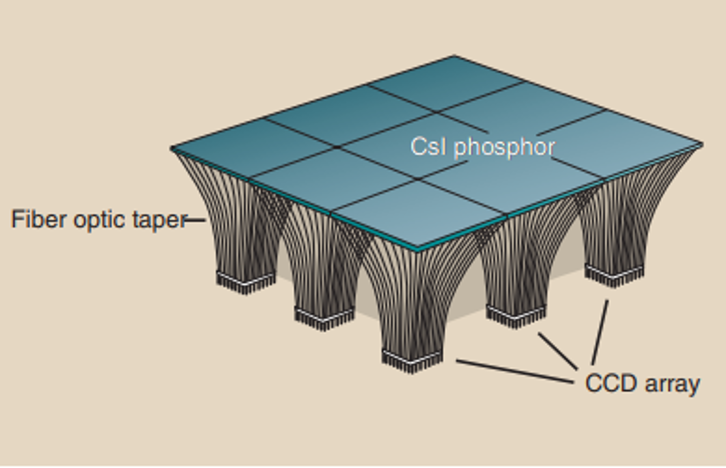
in this indirect DR x-rays are turned into light than an electrical signal. the light is transmitted through fiber optic bundles to a Charged-coupled device.
Indirect digital CsI (cesium iodide)
this is a scintillator it gives off fluorescent light when exposed to radiation
cesium iodide (CsI)
this is a silicone based semiconductor made up of light sensitive pixels. it has high sensitivity, wide dynamic range, and is small.
charge-coupled device (CCD)
CsI/CCD indirect advantages
high capture efficiency (high sensitivity to light, lower patient dose)
4 decades of response (10,000) shades of gray (book says 5) so wide dynamic range
very small
short exposure compared to SPR
5lp/mm good spatial resolution
CsI/CCD disadvantages
a challenge to create a seamless image at the edge of each CCD. missing information (pixel values) are interpolated.

CsI “tiles” are larger than the CCD array so when light is transferred through fiber optic bundles information is missing!
what does CMOS stand for
complimentary metal oxide semiconductor (she says its interchangeable with CCD)
how many decades of radiation response does screen film have? how many visible shades of gray?
3 decades (od 0-3) 30 shades of gray perceivable to human eye.
how many decades of radiation response for CCD (from book and powerpoint)
5 orders (book) 4 (powerpoint) if 5 0-100,000 and it can be visualized via post processing.
this measures 1-2 cm but pixel size is 100×100 um
charge-coupled device
this was developed by CT vendors to facilitate patient positioning and imaging volume. still used today for scout images (AP and LAT). the patient lays still and is moved through the gantry. Tube and detector array are both fixed.
Scanned projection radiography
in the 1980’s and 90’s this was repurposed for dedicated chest radiography units. it had prepatient collimators that collimated beam to a fan, and post patient collimators.
Scanned projection radiography
SPR disadvantages
scanning motion took several seconds so motion blur occured. even if patient can hold their breath the heart is beating. and the chest has high subject contrast so reducing scatter did not really help. (we use high kVp to get low contrast reducing scatter defeats the purpose of that)
SPR “advantages”
collimation to fan reduced scatter
lower patient dose
contrast improvement
detector array- a scintillation phosphor for SPR that is married to a linear array of CCD’s through a fiber optic light path.
sodium iodide NaI or cesium iodide CsI
SPR is reemerging as?
DRT digital radiographic tomosynthesis
digital radiography is best described by three elements. which are?
capture, couple, collection
this element in digital radiography catches or absorbs x-ray photons. it gives off or emits light or electrons (PSP, CsI, NaI, GdOS, a-Se)
capture element
this element in digital radiography transfers x-ray generated light or electrons to the collection element. (lens, fiber optics, contact layer, a-Se)
coupling element
collects light photons or electrons. light collected by CCD, photodiode, or electrons collected by TFT.
collection element

know this

computed radiography is a form of? ______ ______
Digital radiography
Any image acquisition process that produces an electronic image that can be viewed and manipulated on a computer
digital imaging
how did digital imaging first begin?
in the 1970’s with CT and MRI
when was computed radiography introduced?
in 1981 by Fuji.
in radiography _____ ______s are analog information that needs to be converted to digital
x-ray photons
this represents changing values as continuously variable physical quantities.
Analog
this assigns a discrete numeric value to each frequency. (like a 1, or 0) limited by pixel size
digital
this is an example of indirect digital radiography. But not all indirect radiography is this.
computed radiography
this type of digital radiography has to go analog to digital. converts x-rays to light, then to electrons
indirect digital
this type of digital radiography has detectors that convert x-rays to electrons
direct digital radiography
similarities with CR and DR
have x-ray sensitive IR
decrease processing time
both use digital technology
differences with CR and DR
DR has improved workflow
DR has higher quality images instantaneously
DR is 2-3x more dose efficient
You can re-expose in DR right away instead of having to read and process first.
film is not limited by ___ ___
pixel size
computed radiography has a cassette and a reader. while other indirect radiography may use a capture element and convert x-rays to light then to electrons it does not have a _____
a reader.
in computed radiography the response to x-ray interaction are?
electrons trapped in a higher energy metastable state, in the IR.
CR and film both produced a ______ ______ that was made visible via processing
Latent image
this looks similar to a film/screen cassette. it is a lightweight plastic backed with aluminum. Has no intensifying screen, and has antistatic material. Houses the storage phosphor screen, which then houses the Photostimulable phosphor
CR cassette
BaFBr:Eu or BaFI:Eu
barium flourohalide with europium
Barium Flourohalide with europium emits light similar to a scintillator following x-ray interaction. But this also emits light some time later when exposed to another light source. this process is called _____ _____
photostimulable Luminescence PSL
what are the layers of a storage phosphor screen?
protective layer
phosphor layer
reflective layer
base
antistatic/conductive layer
lead (she didn’t have it on powerpoint)

White plate made out of Barium Flourohalide within the cassette
Responsible for capturing the x-rays as they exit the patient
contains the Photostimulable phosphor (active layer) and several other layers
appears white due to small PSP particles 3-10 um that scatter light
storage phosphor screen

three qualities of storage phosphor screens. (they are _______ stable etc)
mechanically stable
electrostatically protected
fashioned to optimize intensity of stimulated light
this layer of the storage phosphor screen is thin tough clear plastic that protects the phosphor
protective layer

this layer of the SPS is made of photostimulable phosphor. the phosphor traps the electrons during exposure. phosphor is barium fluorohalide with europium. x-rays hit the phosphor and produce ionization.
active layer/ phosphor layer

this layer of the SPS sends light into a forward direction. when released in the cassette reader. may be black to reduce the spread of stimulating light. and to reduce the escape of stimulated light. (some detail is lost in the process anyway)
reflective layer

this layer in the SPS is semi rigid material that gives support and strength. everything is coated on this
base layer
this layer in SPS absorbs static electricity since it can cause artifact
anti-static/conductive layer

imaging plate in CR is back with this to reduce backscatter x-rays. improving contrast resolution of the IR
lead (?)
some storage phosphor screens have phosphors with ______ filaments. this increases the absorption of x-rays and reduces the spread of stimulated emission.
linear filament
the scattering of light excessively. linear filaments in CR can limit this
turbid
this is the beam that leaves the patient. in CR it leaves patient and enters the cassette interacting with the electrons in europium barium flourohalide. stimulates the electrons in the PSP crystals, electrons become trapped.
remnant beam
trapped signal in PSP can remain for hours or days. and never completely loses the signal nor can PSP screen ever be completely erased. but IP plate should be read soon after exposure since latent image can fade and CR signal loss is objectionable after ____ hours
8 (idk what her vs the book means to be honest)
this is present in PSP in very small amounts. it is called the activator and is responsible for the storage property of the PSL. this keeps electrons trapped in metastable state. (she says last part but idk if europium keeps them trapped, or the PSP and europium just helps)
Europium
when an x-ray beam exposes a PSP, energy transfer (compton and photoelectric interactions) sends electrons into an excited metastable state. but ____ percent or ____ of the electrons will return to ground state immediately and this results in a prompt emission of light.
50 percent, .5
During the process of making the latent image visible, some signal is lost as a result due to
turbid
The imaging plate moves through the reader and the scanning mechanism moves across the imaging plate. This process is known as
translation
this is not based on wet chemistry. instead it is mechanical, optical, and like a computer module
cr reader
when a drive mechanism moves the IR constantly along the long axis of the IR this is called.
slow scan

while the IR is being transported a rotating polygon or oscillating mirror will deflect the laser beam back and forth across the IR. this is known as.
Fast scan
cr reader scans plate in CR with this zig zag pattern
raster pattern
PSL is the process of stimulating the PSP with monochomatic finely focused beam of infrared laser. with ____-_____ um diameter (or according to book 70 um)
50-200 um
as laser beam intensity increases, intensity of emitted signal ________. and as the laser penetrates it ______ with the PSP thickness
Signal intensity increases with laser, and spread increases with PSP thickness.
as red laser travels to rotating or oscillating mirror it spreads. beam shaping optics keeps ____, ____, ____, and _____ of the laser constant (•Focuses beam to <100 um)
size, shape, speed, and intensity.

•Red laser light is emitted at approximately ___ eV which is necessary to energize the trapped electrons. Extra energy allows the trapped electrons to escape the active layer, where the emit blue light at an energy of ___ eV as they relax into lower energies
2 eV, 3 eV
the ____ of the laser beam in CR determines spatial resolution of the system
diameter. (principle determinant)
helium neon laser causes metastable electrons to return to their ground state with a emission of ____ wavelength light that is ___ violet. through this the latent image is made visible
shorter wavelength. Blue violet
in cr reader imaging plate and laser move at constant speed to avoid misinterpretation of information. fluctuations in velocity can result in _____ artifacts.
banding.
laser requires constant power source to prevent ____ ____ because if laser intensity increases so does our signal intensity. could lead to lighter or denser image
output fluctuations.
optical ____ can be oscillating, or polygon. laser hits this after beam shaping optics (could also have one after) and it then is sent to surface of imaging plate
optical mirror

before photodetection occurs in CR the emitted light passes through this. which filters out the long wavelength stimulating light (noise), from the emitted light. (signal)
improves SNR
improves contrast resolution
optical filter
emitted light (blue violet) is _____. stimulating (red laser) is _____-
emitted= signal stimulating=noise
when laser in CR stimulates electrons to return to their ground state and light is emitted and latent image is made visible some signal is lost due to?
scattering of emitted light
collection efficiency of the photodetector
_____ are the light detectors of choice for CR
photodiodes
receives the light and converts to electrical signal (in CR)
photodetector (or photodiode)
stimulation in CR does not transition all metastable electrons to ground state. some remain in metastable state. if latent image remains ghosting can occur. But the process of reading the image returns most of the electrons to a lower energy state and effectively removes the latent image. but to erase plate it is ______ with _____ to remove electrons still present after the reading.
flooded with white light
CR is
•Extremely sensitive to _____radiation
•CR plates should be erased at least once a week
•IR should be erased before use if the last time of erasure is unknown
scatter
laser light used to stimulate PSP is _____ with a _____ wavelength
monochromatic, long (solid state laser)
emitted light in cr is ______ with a _____ wavelength.
polychromatic, short
4 principle characteristics of digital imaging
spatial resolution (2.5-5 lp/mm screen film was 10 lp/mm) determined by beam diameter, phosphor layer thickness and pixel size thinner closer crystals spatial resolution is better.
contrast resolution dependent on number of pixel values or bits per pixel
noise usually occurs with low ir exposure
artifact can be mechanical, or dust in cassette for CR
screen film IR response function

has OD range of 0-3. only 3 visible shades of gray. under or overexposure would make image unacceptable

CR IR response function
has wide exposure latitude, and greater dynamic range. 100, 000 gray levels, and all can be seen with window and leveling. mAs matters for exposure to ir but we can make similar images with very different mAs.
CR vs Film
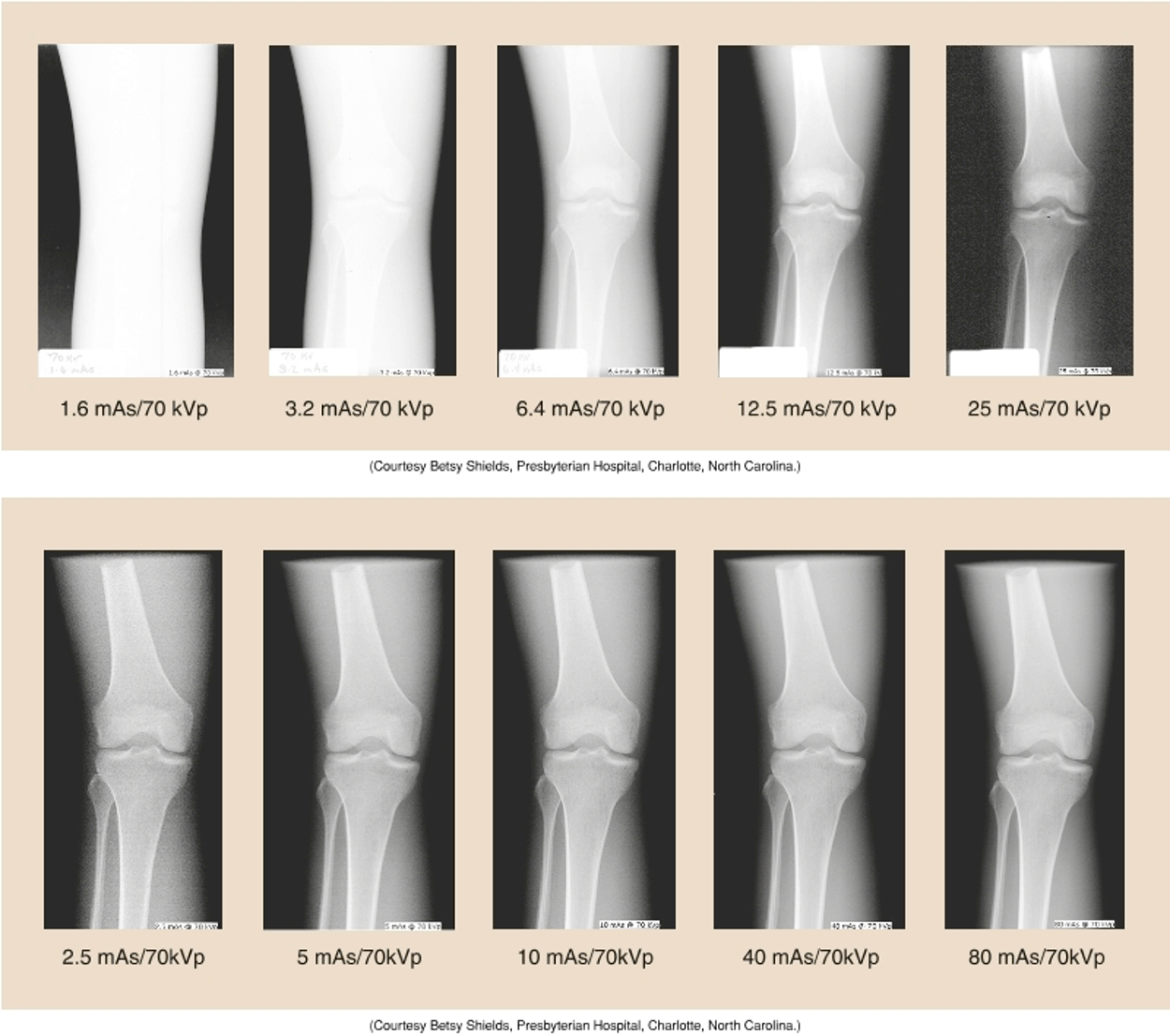
-CR has wide exposure latitude (can make higher kvp images with lower kvp lowering patient dose)
-greater dynamic range 100,000 gray levels, can be seen via window and level (film OD is 0-3 30 visible grays)
-film does have better spatial resolution though it was not limited by pixel