chan: lec 6 pt 2
 Call Kai
 Learn
 Practice Test
 Spaced Repetition
 Match
 Flashcards
 Knowt Play
1/34

There's no tags or description
Looks like no tags are added yet.
35 Terms
What type of enzyme is telomerase, and what provides its template?
reverse transcriptase: uses RNA template to synthesize DNA
make telomeres
replicate terminal sequences (telomeres) of linear chromosomes during development
telomeres
1000 or more repeats of G-rich sequence on 3’ends of each chromosome
TTAGGG in humans (50% G)
inverese relationship btw age & telomeric length
as person ages: telomeres lengthen deceases
most human somatic cells lac active telomerase to carry its activity
telomeres get shorter & shorter till run out —> cell death
telomerase catalysis
telomerase RNA (3”—> 5’) base-pairs its template w/ single-stranded 3’ overhang of DNA
polymerize: telomerase adds DNA bases (dGTP & dTTP) into 3’ end to base-match template
translocate: telomerase shifts fwd along it's RNA template to ad dmore repeats
after telomeres synthesized by telomerase
Standard lagging-strand machinery (Pol α, RNase H1, FEN1, Pol δ, DNA ligase) synthesizes the matching strand, leaving a short 3' overhang at the tip.
:

Why do telomeres need protective "capping" proteins
shield chromosome ends so they are mistaken for broken DNA
keep ends from getting glued together into tangled, snapping chromosomes.
What happens to uncapping as telomeres shorten
Spontaneous uncapping increases as telomeres shorten
leading to chromosome instability (such as end-to-end fusions and chromosome breakage during division
how is telomerase related to aging and cancer
90% of cancer cells reactivate telomerase
telomerase is rational drug target for cancer treatment
reactivating telomerase in healthy cells “high” reverse aging
mutagens
agents that damage DNA —> mutations —> cell death
mutation: a perm change in DNA sequence
produced in cells or abosrobed from env
carcinogens
when mutagens cause cells from normal to cancerous
cigarette smoking & mutagens
cigarette smoking —> burning of tobacco produces different carcinogens (benzo[a]pyrene) —> bases damage —> abnormal cell growth —> lung cancer
benzo[a]pyrene forms a bulky DNA adduct
benzo[a]pyrene: present in anytging you cook
smoked food
unreactive itslef
in lungs, CYP oxidize —> benzo [a]pyrene diol expoide
highly reactive epoxide electrophile
2-amino guanine of DNA can nuc attack —> form a covalent DNA adduct —> bulky distortion in DNA
DNA adduct
structure formed when a reactive chemical or metabolite becomes covalently attached to a nucleotide/base in DNA
DNA damage that can distort the helix and cause mutations
what is melanemas
skin cancer due to thymine dimers
occur freq & usually repaired
mismatches & DNA damage produces thousands of potentially mutangenic
damages occur in each cell every day —> DNA repair is important
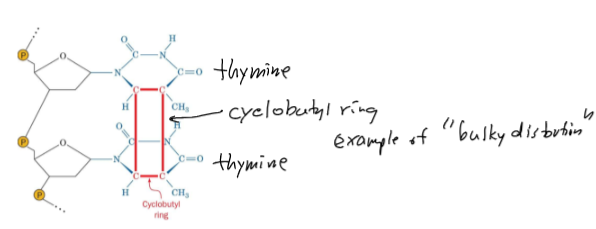
thymine dimers
UV-light induce cross linking btw two adjacent thymines on same DNA strand-
make a cyclobutyl ring
bulky distortion
3 major spontaneous DNA damages (small distortion)
deamination
depurintaion & depyrimidination
oxidation
demamination
adenine (6-amino) —> hypoxanthine (6-oxo)
cytosine (4-amino) —> uracil (4-oxo)
guanine (2-amino) —> xanthine (2-oxo)
100 bases/cell/day
depurintaion & depyrimidination
hydrolysis of glycosidic bond rel purine & pyrimidine bases
no more base present
10,000 base/cell/day
oxidation
ex: at C8 position of purine
forms 8-oxo-guanine
8-oxo0adenine
DNA repair by BER
base excision repair (BER)
repair of small distortion
damaged bases are removed & replaced
DNA glycosylases
a group of enzymes performing BER
recognize damage & create apurinic or apyrimidinic sites “AP” sites
one glycolyase —> recognize uracil
another glycolyase —> recognize 8-oxo-guanine
BER process
DNA glycosylase rec damage & create “AP” site
AP endonuclease
short-pacth BER
5’—>3’ exonuclease to remove damage
DNA pol replicate one reaction
DNA ligase finish repair
long-patch BER, more than 1 nt
FENI action create gap
DNA poly fill gap
DNA ligase finsh repair
DNA repair by NER
nucleoide excision repair (NER)
inv repair of bulky distortion
pyrimidine dimers, DNA adducts, benzo[a]pyrene cov att to guanine
major defense against DNA damages by sunlight & tobacco smoke in humans
NER process
damge (bulky distortion) is detected
endonuclease cut damage strand on both sides (5’ and 3’)
helicase: unwind DNA around bulky distortion after incision
DNA pol: syn DNA strand
DNA ligase: seal strand
DNA repair by MMR
mismatch repair (MMR) occur during DNA rep
not damage, just inc base pairing
in bacteria: newly synthesized strand is not methylated (parental strand is)
MutS & MutL change mismatch on unmethylated strand
human: defect of MMR (mutation on MutS & MutL homologs) —> inc cancer risk
how to detect new strand in human DNA for MMR repair
Scan for PCNA
PCNA binds on pol Delta & parenteral strand in orientation specific manner
DNA repair by homologous recombination
recombination repair
DNA is susceptible to double-strand breaks bc radiation or oxidative damage
use undamaged DNA to repair demaged (double strand break) DNA
can be repaired by non-homologous end joining
better to use undamaged DNA to repair the damged
process
nucleases trim (resect) the 5' ends of the broken strands back, leaving single-stranded 3’ overhangs on each side
BRCA1 and BRCA2 help load and regulate RAD51 onto the single-stranded 3' DNA overhangs
RAD51 drive strand invasion and pairing with the homologous template
Holliday junction: ross-shaped four-way DNA intermediate formed during strand exchange/recombination
inv replication using undamaged strand to repair
PARP = poly(ADP-ribose) polymerase
family of enzymes that detect DNA damage
unregulated in cancer cells that have BRCA1 & BRCA 2 mutation
parp inhibitor: anti-cancer drug
Olaparib
ind w/ mutant bRCA 1 or BRCA 2 gene (1 good copy instead of 2)
80% lifetime risk of getting cancer —> prostate, pancreatic cancer
by 70 y.o, BRCA1 mutation gives
57% breast cancer
40% ovarian cancer
DNA recombination by transposition
direct transposition: inv movement of transposons from one location to another
replicative transposition: ransposon remains at its original site & a copy of it is inserted at a new location
occurs rarely (one in every 10^4-10^7 cell division)
occurs in bacteria only
transposons may carry waht
an antibiotic resistance gene
transposon Tn3 contains b-lactamase that degrades ampicilin
one mech transposition inv replication

DNA recombination caused by retroviral infection
involves reverse transcription
retroviral reverse transcriptase uses retroviral RNA genome as template to make ds0dna
this enzyme has dif active site envy than DNA pol
no proofread
enzyme is rational drug target fro HIV treatment
what happens when incorporate ds-DNA containing retroviral genome to human genome
—> cancer, AIDS
zidovudine
retrovial reverse transcriptase inhibitors
thymidine analog