TEAS The Scientific Method and Designing an Experiment SE
 Call Kai
 Learn
 Practice Test
 Spaced Repetition
 Match
 Flashcards
 Knowt Play
1/53

There's no tags or description
Looks like no tags are added yet.
54 Terms
🔬 Scientific Method — SUPER EASY
Think of it like:
Question → Learn → Guess → Test → Look → Decide → Tell
Step | Easy meaning | Think… |
|---|---|---|
1. Problem | Ask a question | ❓ What do I want to know? |
2. Research | Learn about the question | 📚 What do I already know? |
3. Hypothesis | Make an educated guess | 💭 What do I think will happen? |
4. Experiment | Test your guess | 🧪 Let's test it! |
5. Observe | Look at the data/results | 👀 What happened? |
6. Conclusion | Decide what the results mean | ✅ Was my guess supported? |
7. Communicate | Tell others what you found | 📢 Share the results! |
⭐ The order to memorize
P → R → H → E → O → C → C
Problem → Research → Hypothesis → Experiment → Observe → Conclusion → Communicate
Try this:
“Please Read Harry’s Experiment, Observe, Conclude, Communicate.” 😂
🧪 The parts of an experiment
This is VERY important for the TEAS.
Independent variable =
what YOU change
Think:
I change it.
Example: You want to see if the amount of sunlight affects plant growth.
You change the amount of sunlight.
➡ Independent = sunlight
Dependent variable =
what you MEASURE
Think:
It DEPENDS on what I changed.
You measure how tall the plant grows.
➡ Dependent = plant growth
⭐ Easy trick:
Independent = I change
Dependent = Data I measure
Control group =
the normal comparison
The control group doesn't get the special change.
Example:
🌱 Plant A → normal sunlight = control
🌱 Plant B → extra sunlight = experiment
You compare them to see whether the extra sunlight made a difference.
Question:
Does the amount of sunlight affect how fast a plant grows?
1⃣ Problem
What am I asking?
→ Does sunlight affect plant growth?
Question:
Does the amount of sunlight affect how fast a plant grows?
2⃣ Research
What do I learn first?
→ Learn about plants and sunlight.
Question:
Does the amount of sunlight affect how fast a plant grows?
3⃣ Hypothesis
What do I predict?
→ "If a plant gets more sunlight, then it will grow faster."
Question:
Does the amount of sunlight affect how fast a plant grows?
4⃣ Experiment
How do I test it?
→ Give plants different amounts of sunlight and measure their growth.
Independent variable: amount of sunlight ☀
Dependent variable: plant growth 📏
Control: plant with normal sunlight 🌱
5⃣ Observe
What happened?
→ Look at the measurements.
6⃣ Conclusion
What did I learn?
→ Decide whether the results support the hypothesis.
7⃣ Communicate
Tell people!
→ Share the results so other scientists can understand or repeat the experiment.
🚨 One important TEAS correction
Your notes say:
"State whether the hypothesis is rejected or accepted."
For the TEAS, it's safer to think:
Supported or not supported.
Scientists generally don't prove a hypothesis 100% true from one experiment. They use the results to determine whether the evidence supports the hypothesis.
🧠 LAST-MINUTE TEAS CHEAT SHEET
Problem = ❓ Question
Research = 📚 Learn
Hypothesis = 💭 Prediction
Experiment = 🧪 Test
Observe = 👀 Look at data
Conclusion = ✅ Decide what results mean
Communicate = 📢 Share
Variables:
Independent = I change it
Dependent = I measure it
Control = normal comparison
🧪 Experiment = "Let's test it!"
Our question is:
Does the amount of sunlight affect how fast a plant grows?
So we have 3 plants:
🌱 Plant A: normal sunlight
🌱 Plant B: lots of sunlight
🌱 Plant C: very little sunlight
Then we watch them and measure how much they grow.
Now let's figure out the 3 important parts:
☀ 1. Independent variable = what YOU change
You are changing the amount of sunlight each plant gets.
So:
Independent = sunlight
🧠 Think: "I control/change this."
📏 2. Dependent variable = what you MEASURE
After changing the sunlight, you measure:
How tall did each plant grow?
So:
Dependent = plant growth
🧠 Think:
"It DEPENDS on what I changed."
The plant's growth depends on how much sunlight it received.
🌱 3. Control group = the NORMAL one
The control is your normal comparison.
So let's say the normal amount of sunlight for a plant is 6 hours.
🌱 Plant A → 6 hours = CONTROL
🌱 Plant B → 10 hours = testing more sunlight
🌱 Plant C → 2 hours = testing less sunlight
The control helps you ask:
"What happens normally?"
Then you can compare the other plants to it.
⭐ SUPER EASY WAY TO REMEMBER
experiment
Independent
I change it.
☀ Sunlight
Dependent
I measure it.
📏 Plant growth
Control
Normal comparison.
🌱 Normal sunlight
🔥 TEAS TRICK
If a question says:
"Researchers change X to see if it affects Y."
Usually:
X = Independent
Y = Dependent
Example:
Researchers change the amount of water to see if it affects plant growth.
Water = Independent 💧
Plant growth = Dependent 🌱
Scientific Reasoning — SUPER EASY
There are 2 types:
🔵 Inductive = BOTTOM → UP
You look at specific examples and figure out a general pattern/rule.
🔴 Deductive = TOP → DOWN
You start with a general rule and use it to figure out a specific answer.
🔵 INDUCTIVE REASONING
Think:
I SEE → I NOTICE A PATTERN → I MAKE A GENERAL RULE
You start with small/specific observations and move toward a big/general conclusion.
Example:
You observe:
🌱 Plant #1 gets sunlight → grows
🌱 Plant #2 gets sunlight → grows
🌱 Plant #3 gets sunlight → grows
You think:
"Plants probably need sunlight to grow."
You went from specific observations → general idea.
🧠 Memory trick:
INDUCTIVE = IN the details first.
Or remember:
🔵 INDUCTIVE = "I notice!"
You notice several things and then make a general conclusion.
🔴 DEDUCTIVE REASONING
Now go the opposite direction.
You start with a general rule and use it to figure out something specific.
Example:
General rule:
Plants need sunlight to grow.
You have a specific plant:
🌱 "This plant isn't getting sunlight."
You can predict:
"This plant probably won't grow well."
You went:
GENERAL → SPECIFIC
⭐ THE BIGGEST MEMORY TRICK
Think of a funnel:
🔵 INDUCTIVE
Specific → General
🔽🔽🔽
Many little observations
↓
One big conclusion
BOTTOM → UP
🔴 DEDUCTIVE
General → Specific
🔽
One big rule
↓
Specific prediction
TOP → DOWN
🧠 EASIEST WAY TO REMEMBER
INDUCTIVE = UP
I see specific things → go UP to a general idea.
DEDUCTIVE = DOWN
Start with a general idea → go DOWN to a specific prediction.
So memorize:
🔵 INDUCTIVE = UP = Specific → General
🔴 DEDUCTIVE = DOWN = General → Specific
🔢 Let's do the examples from your notes
Example 1:
Fall → Winter → Spring → ?
You recognize the pattern:
🍂 Fall
❄ Winter
🌸 Spring
☀ Summer
You used inductive reasoning because you looked at specific examples and recognized the pattern.
Example 2:
4 → 8 → 12 → ?
You notice:
4 + 4 = 8
8 + 4 = 12
12 + 4 = 16
Answer:
16
🎯 TEAS: HOW TO TELL THEM APART
Ask yourself:
"Am I looking at examples and finding a pattern?"
➡ INDUCTIVE 🔵
Specific → General
"Am I starting with a rule and applying it to one situation?"
➡ DEDUCTIVE 🔴
General → Specific
🚨 TEAS CHEAT SHEET
inductive vs deductive
🔵 Inductive | 🔴 Deductive | |
|---|---|---|
Direction | Bottom → Up | Top → Down |
Starts with | Specific observations | General rule |
Ends with | General conclusion | Specific conclusion |
Think | Find a pattern | Apply a rule |
Memory | INDUCTIVE = UP | DEDUCTIVE = DOWN |
INDUCTIVE finds the rule. DEDUCTIVE uses the rule.
🧠 Example 1 —
You observe:
Monday: The store was busy.
Tuesday: The store was busy.
Wednesday: The store was busy.
You conclude:
The store is usually busy during the week.
this is?
🔵 INDUCTIVE
Why? You looked at specific days → made a general conclusion.
🧠 Example 2
You know:
All mammals breathe air.
A dog is a mammal.
Therefore:
A dog breathes air.
🔴 DEDUCTIVE
Why? You started with a general rule → applied it to a specific example.
🧠 Example 3 —
You see:
🐦 Bird #1 has feathers.
🐦 Bird #2 has feathers.
🐦 Bird #3 has feathers.
You conclude:
Birds have feathers.
🔵 INDUCTIVE
Specific birds → general idea about birds
🧠 Example 5
You notice:
🌱 Plant A grows faster with sunlight.
🌱 Plant B grows faster with sunlight.
🌱 Plant C grows faster with sunlight.
You conclude:
Sunlight helps plants grow.
🔵 INDUCTIVE
You observed several examples and found a general pattern.
🧠 Example 6
You know:
Plants need water to survive.
You have a plant that isn't receiving water.
You predict:
The plant will eventually have trouble surviving.
🔴 DEDUCTIVE
You started with the general rule and applied it to one specific plant.
🧠 The BIG memory trick
If you forget everything else on the TEAS, remember:
🔵 INDUCTIVE = FIND
You FIND a pattern.
Specific → General
Example:
I see 2, 4, 6, 8 → I find the pattern → next is 10.
🔴 DEDUCTIVE = APPLY
You APPLY a rule.
General → Specific
Example:
All mammals breathe air → dogs are mammals → dogs breathe air.
⭐ Say this in your head:
"INDUCTIVE finds. DEDUCTIVE applies."
A student notices that every time she studies before a test, she gets a higher score. She concludes that studying helps improve test scores.
Inductive
A scientist knows that all metals conduct electricity. Copper is a metal. Therefore, copper conducts electricity.
Deductive
A researcher observes that three different plants grow faster when given more water. She concludes that plants generally grow faster with more water.
Inductive
Scientists know that humans need oxygen to survive. Jordan is a human. Therefore, Jordan needs oxygen to survive.
Deductive
.
You notice:
2, 4, 6, 8, 10...
You recognize the pattern and predict the next number is 12.
A. Inductive
🧪 Designing an Experiment — SUPER EASY
Think:
"I change something → I see what happens → I compare it to normal."
1⃣ Independent Variable = I CHANGE IT
This is what the researcher changes on purpose.
🧠 Memory trick:
INDEPENDENT = I control/change it
Example:
You want to know if more water makes plants grow faster.
You give plants different amounts of water.
💧 Water = Independent variable
Because YOU change the amount of water.
📊 Graph:
Independent = X-axis
🧠 Remember:
X = Independent
2⃣ Dependent Variable = I MEASURE IT
This is what you watch or measure to see what happened.
Using our plant example:
You change the amount of water 💧
Then you measure how tall the plants grow 📏
🌱 Plant growth = Dependent variable
Why?
Because the growth depends on the amount of water.
📊 Graph:
Dependent = Y-axis
🧠 Easy trick:
Y = Dependent
So:
X = IndependentY = Dependent
⭐ The easiest example EVER
Imagine:
Does drinking more water affect how long a person can exercise?
You change:
💧 Amount of water
You measure:
🏃 How long they exercise
Therefore:
Independent = water → YOU CHANGE IT
Dependent = exercise time → YOU MEASURE IT
3⃣ Treatment Group =
GETS THE CHANGE
The treatment group is the group that receives the thing you're testing.
Example:
You want to test a new fertilizer 🌱.
🌱 Group A → gets the new fertilizer
🌱 Group B → doesn't get it
Group A is the:
➡ Treatment group
Because it gets the treatment.
🧠 Memory trick:
Treatment = gets the TEST
4⃣ Control Group =
NORMAL COMPARISON
The control group is your normal/baseline group.
It does NOT receive the treatment you're testing.
Example:
You're testing a new fertilizer.
🌱 Group A → new fertilizer = Treatment
🌱 Group B → normal conditions = Control
Then you compare them:
"Did the fertilizer actually make a difference?"
🧠 Memory trick:
CONTROL = COMPARISON
The control gives you something normal to compare against.
🧪 Put EVERYTHING together
Let's say we're testing a new fertilizer.
🌱 Treatment group
Gets the new fertilizer.
🌱 Control group
Does NOT get the new fertilizer.
🧪 Independent variable
The fertilizer — what you change.
📏 Dependent variable
The plant growth — what you measure.
📊 Graph
X-axis → Independent
Y-axis → Dependent
🧠 QUICK VISUAL
Think:
YOU CHANGE → YOU MEASURE → YOU COMPARE
💧 Independent
⬇
🌱 Dependent
⬇
⚖ Control
Or:
I CHANGE → I MEASURE → I COMPARE
Independent → Dependent → Control
💊 5⃣ What's a PLACEBO?
This sounds scary, but it's easy.
A placebo is a fake treatment.
Example:
Researchers are testing a new medicine.
💊 Group A → gets the real medicine
💊 Group B → gets a fake medicine (placebo)
The people receiving the placebo think they may be getting the treatment, but they're actually getting the fake one.
Why do researchers do this?
To see whether people improve because of the actual medicine or because they believe they're receiving treatment.
That's called the:
Placebo effect
🧠 Memory trick:
PLACEBO = FAKE
Think:
"Placebo = pretend treatment."
🎯 TEAS CHEAT SHEET
Term | SUPER EASY meaning | Memory trick |
|---|---|---|
Independent | What you change | I change |
Dependent | What you measure | Depends on it |
Treatment group | Gets the treatment | Gets the test |
Control group | Normal comparison | Control = compare |
Placebo | Fake treatment | Placebo = fake |
X-axis | Independent | X = Independent |
Y-axis | Dependent | Y = Dependent |
🚨 THE 7 THINGS TO MEMORIZE
Independent
👉 I CHANGE
Dependent
👉 I MEASURE
Treatment
👉 GETS THE TEST
Control
👉 NORMAL COMPARISON
Placebo
👉 FAKE TREATMENT
X-axis
👉 INDEPENDENT
Y-axis
👉 DEPENDENT
🧠 DRYMIX — SUPER EASY
Break it into two sides:
🔵 D R Y = DEPENDENT
D = Dependent
R = Responding
Y = Y-axis
So:
DEPENDENT = RESPONDS = Y
The dependent variable is what responds to the change and what you measure.
🔴 M I X = INDEPENDENT
M = Manipulated
I = Independent
X = X-axis
So:
INDEPENDENT = MANIPULATED = X
The independent variable is what you manipulate/change.
⭐ DRYMIX
Just remember:
DRY = DEPENDENT
D = Dependent
R = Responding
Y = Y-axis
MIX = INDEPENDENT
M = Manipulated
I = Independent
X = X-axis
🚨 THE FASTEST TEAS TRICK
When you see an experiment, ask:
"What did they CHANGE?"
➡ Independent
➡ X-axis
"What did they MEASURE?"
➡ Dependent
➡ Y-axis
🧠 One sentence:
"I change X, and Y responds."
That's basically DRYMIX in plain English. 🔥
🧪 First: What is a control group?
A control group =
the NORMAL group.
That's it. Think:
🟢 CONTROL = NORMAL = COMPARISON
The control group is there so researchers can say:
"What happens normally?"
Then they compare the treatment group to it.
🌱 Super easy example
Let's say scientists want to know:
Does a new fertilizer make plants grow taller?
They have two groups:
🌱 Group A — Treatment
Gets the new fertilizer.
🌱 Group B — Control
Does NOT get the new fertilizer.
After a few weeks:
🌱 Treatment plant = 15 inches
🌱 Control plant = 10 inches
Now scientists can compare:
"The fertilizer plants grew 5 inches taller than the normal plants."
That's why we need the control group.
🧠 So what does "baseline" mean?
Baseline =
the normal starting point you compare against.
Think of it like a starting line 🏁.
You need a starting line to know how far someone ran.
The control group is like the starting line for the experiment.
Control:
"This is what normally happens."
Treatment:
"This is what happens when we add/change something."
Then:
COMPARE THEM!
⭐ What does "establishes a baseline measure" mean?
Let's translate the fancy science words:
"Establishes"
= sets
"Baseline"
= normal starting point
"Measure"
= something you can compare
So:
"Establishes a baseline measure" = gives you a normal group to compare your results to.
🧪 Another example: Medicine
Scientists want to know if a new medicine lowers headaches.
💊 Treatment group
Gets the real medicine.
🟢 Control group
Doesn't get the real medicine.
Then researchers compare:
Treatment group: Did headaches decrease?
Control group: What happened without the medicine?
If both groups improve, maybe the medicine wasn't the reason.
If the treatment group improves more, the medicine may actually be helping.
💊 What is a placebo?
A placebo = fake treatment.
For example:
💊 Treatment group → real medicine
💊 Control group → fake pill/placebo
The fake pill looks like the real medicine, but it doesn't contain the actual treatment.
Why?
Because researchers want to see:
Did the medicine actually cause the improvement, or did people improve because they thought they were getting medicine?
Which best describes a control group?
C. The group used as a normal comparison
Control = normal comparison
"The control stays normal so I have something to compare the treatment to."
Term | Think |
|---|---|
Independent | 🖐 I CHANGE |
Dependent | 📏 I MEASURE |
Treatment | 🧪 GETS THE TEST |
Control | 🟢 NORMAL COMPARISON |
Placebo | 💊 FAKE TREATMENT |
🔬 1. Empirical Evidence =
REAL evidence
= evidence you get from observing or experimenting.
Think:
👀 Observe + 🧪 Experiment = Empirical Evidence
It is evidence that can be repeated and verified by other researchers.
Easy example:
Researchers want to know if a new medicine works.
They give people the medicine.
They observe what happens.
They collect data.
Other researchers can repeat the experiment.
If they get similar results → empirical evidence.
🧠 Memory trick:
EMPIRICAL = EXPERIENCE
You experience/observe something and collect evidence from it.
📈 2. Correlation =
TWO things changing together
Correlation means there is a relationship between two variables.
Basically:
When X changes, does Y change too?
There are 3 possibilities:
Type | What happens? | Think |
|---|---|---|
🟢 Positive | Both go UP or both go DOWN | Same direction ↗ |
🔴 Negative | One goes UP, the other goes DOWN | Opposite directions ↘ |
⚪ None | No clear relationship | No pattern |
🟢 3. Positive Correlation =
SAME direction
Positive = together
If one increases → the other increases.
If one decreases → the other decreases.
Example from your notes:
🚬 More smoking → greater risk of lung cancer
Smoking ↑
Cancer risk ↑
BOTH GO UP = POSITIVE
🧠 EASY TRICK:
Positive = Partners 🤝
They move together.
Another example:
📚 More studying → higher test scores
Studying ↑ → Score ↑
Positive correlation
they move together
X increases → Y increases ⬆ ⬆
X decreases → Y decreases ⬇ ⬇
It works both ways:
X ↑ → Y ↑
Y ↑ → X ↑
and
X ↓ → Y ↓
Y ↓ → X ↓
🧠 Super easy trick:
Positive = SAME direction.
Think of two friends walking together 🚶♀🚶:
Up together, down together.
🔴 4. Negative Correlation =
OPPOSITE directions
Negative = opposite
One increases → the other decreases.
Example from your notes:
🚗 Faster speed → less travel time
Speed ↑
Time ↓
OPPOSITE = NEGATIVE
🧠 EASY TRICK:
Negative = Not together ❌
One goes UP, the other goes DOWN.
Another example:
Exercise ↑ → Time needed to finish a certain task ↓
x↓→ y ↑ or other way around
🚨 SUPER IMPORTANT TEAS TRICK
When you see a question asking about correlation, don't overthink it.
Just ask:
"Do they move together or opposite?"
Together = POSITIVE 🟢
Opposite = NEGATIVE 🔴
No pattern = NONE ⚪
🧠 5-SECOND MEMORY TRICK
Remember:
POSITIVE = SAME
➡ ↑ ↑
➡ ↓ ↓
NEGATIVE = OPPOSITE
➡ ↑ ↓
NONE = NO PATTERN
➡ 🤷
⚠ One TEAS detail
Correlation does NOT automatically mean causation.
If two things are correlated, that means they change together, but it doesn't necessarily prove that one causes the other.
So remember:
Correlation = relationship
Causation = one causes the other
"Researchers collect evidence through observations and experiments. What type of evidence is this?"
➡ Empirical evidence
"As X increases, Y increases. What correlation?"
➡ Positive
"As X increases, Y decreases. What correlation?"
negative
"What does correlation mean?"
➡ Two variables have a relationship/change together.
🔥 ONE-LINE MEMORY
EMPIRICAL = observed/tested evidence 🧪 | POSITIVE = same direction ↗ | NEGATIVE = opposite direction ↘

📊 Correlation =
"Do X and Y move together?"
A correlation tells us whether two variables (X and Y) have a relationship.
Think:
X changes = independednt→ What happens to Y=dependent?
🟢 1. POSITIVE CORRELATION = SAME DIRECTION
Also called:
Direct correlation
Positive variation
What happens?
X ↑ → Y ↑
or
X ↓ → Y ↓
SAME
X ↑ Y ↑
X ↓ Y ↓
Graph ↗
Positive = Partners 🤝
They move in the SAME direction.
Example:
📚 Study time ↑ → Test score ↑
More studying → higher score.
Less studying → lower score.
🧠 MEMORY TRICK:
POSITIVE = PARTNERS 🤝
They go together.
Positive = Same direction
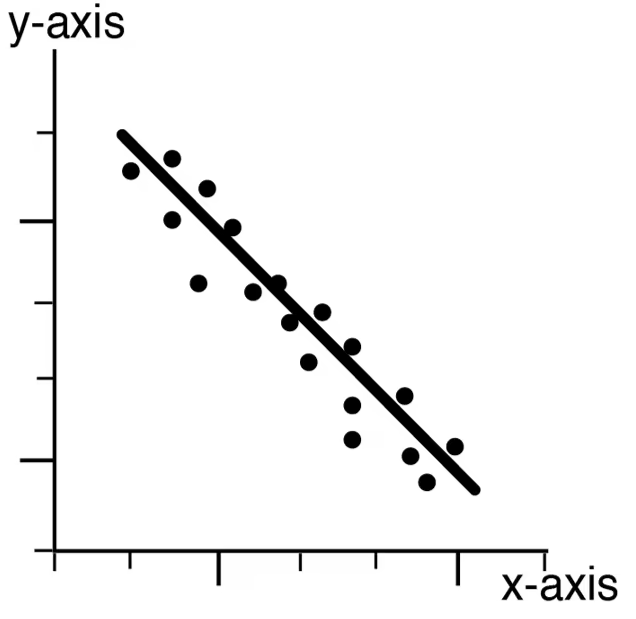
🔴 2. NEGATIVE CORRELATION = OPPOSITE DIRECTIONS
Also called:
Inverse correlation
Indirect correlation
Negative variation
What happens?
X ↑ → Y ↓
or
X ↓ → Y ↑
OPPOSITE
X ↑ Y ↓
X ↓ Y ↑
Graph ↘
Negative = Not together ❌
They move in OPPOSITE directions.
Example:
🚗 Speed ↑ → Travel time ↓
The faster you go, the less time it takes.
The slower you go, the more time it takes.
🧠 MEMORY TRICK:
NEGATIVE = NOT TOGETHER ❌
One goes UP, the other goes DOWN.
Negative = Opposite direction

⚪ 3. NO CORRELATION
NO RELATIONSHIP
This means:
X changes, but Y doesn't have a predictable pattern.
There is no clear connection between them.
Imagine a bunch of dots scattered everywhere.
There isn't a clear ↑ or ↓ pattern.
Example:
👟 Shoe size vs. favorite color
Knowing someone's shoe size doesn't tell you what their favorite color is.
🧠 MEMORY TRICK:
NO CORRELATION = NO PATTERN 🤷
scattered dots
No obvious direction.
Think:
No correlation = messy/random dots
For TEAS, remember:
Correlation = relationship
Causation = one thing causes another
So if two variables move together, that shows a correlation, but by itself it doesn't prove that one caused the other.
What is another term used to describe a direct correlation?
positive slope