psychology exam revision
 Call Kai
 Learn
 Practice Test
 Spaced Repetition
 Match
 Flashcards
 Knowt Play
 Podcast
1/462

There's no tags or description
Looks like no tags are added yet.
463 Terms
what are nerves
Nerves are tightly bound bundles of neurons.
what is a neuron
A neuron is an individual nerve cell that is specialised to receive, process and/or transmit information.
types of neurons
sensory
motor
interneurons
sensory neurons
(afferent) – transmit information from receptors in the body to the Brain (CNS).
motor neurons
(efferent) – transmit information regarding movement from the brain (CNS) to the muscles in the body.
interneurons
enable sensory and motor neurons to communicate and are located within the brain and spinal cord (CNS) only.
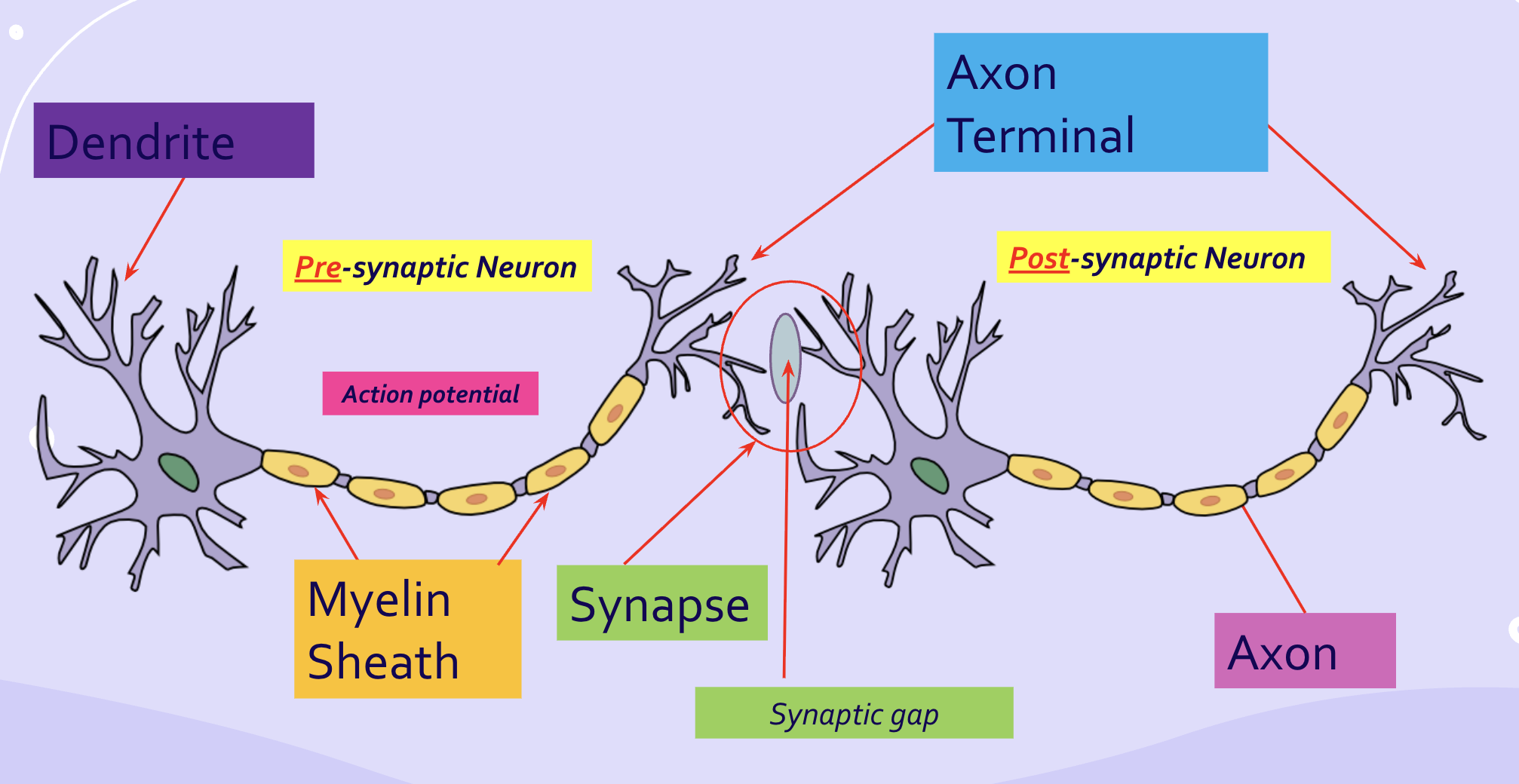
structure of a neuron (image)
what does dendrite do
Receives messages from the pre-synaptic neuron.
They have receptor sites which receive specific neurotransmitters
what does cell body do (soma)
Combines the neural information from dendrites and sends it to axon
Contains Nucleus which has biochemical info to keep neuron functioning
what does axon do
Carries the neural impulse towards the axon terminals.
what does myelin sheath do
Layer of fatty tissue around the axon.
Insulates/speeds up neural transmission and protects the axon from interference.
what do axon terminals do
Branches at the end of the axon.
Contain vesicles that store neurotransmitters at the tip of the axon terminal and release them into the synapse.
what is pre-synaptic neuron
The neuron that is located before the synapse.
what is post-synaptic neuron
The neuron that is located after the synapse.
what is synapse
This location is where communication between neurons occurs.
It includes the pre-synaptic axon terminal, the synaptic gap and the post-synaptic dendrite.
what is synaptic gap
The space between the pre and post-synaptic neurons.
what are neurotransmitters
Neurotransmitters are chemicals that carry neural messages across the nervous system.
spread out or “diffuse” across the synaptic gap/cleft
will only bind or fit into specific postsynaptic receptor sites that match chemically.
what happens when neurotransmitters fit/do not fit
If they fit, and enough of them bind to their specific receptors, then an action potential/nerve impulse is triggered in the postsynaptic neuron.
If a neurotransmitter does not fit/or are released from a receptor it will remain in the cleft for a short time before being recycled (this is called “reuptake”)
neurotransmitter effects
Excite the postsynaptic neuron
An action potential will more likely occur in the postsynaptic neuron
Inhibit the postsynaptic neuron
An action potential is less likely to occur in the postsynaptic neuron
glutamate
A major excitatory neurotransmitter.
increases the likelihood of an action potential being fired.
Enhances learning and memory.
Helps form and strengthen synaptic connections
GABA
A major inhibitory neurotransmitter.
Decreases the likelihood of an action potential being fired
Prevents uncontrolled activation of neurons in the brain.
Helps control anxiety, stress and the sleep–wake cycle and plays an important role in maintaining the overall balance and stability of neural circuits.
Plays a role in reducing anxiety and promoting relaxation
what are neuromodulators
Neuromodulators adjust or regulate neurotransmission
subclass of neurotransmitters
Not all neurotransmitters we study are neuromodulators
what do neuromodulators do
alter the overall effectiveness of neurotransmission
influence neurotransmission effectiveness.
Neuromodulators are very slow to perform their task compared to neurotransmitters
neurotransmitter site of release and target
site of release: into the synapse
target: a single post-synaptic neuron
neuromodulator site of release and target
site of release: outside the synapse into the neural tissue in the brain regions
target: groups of neurons
what is dopamine
Dopamine is a multifunctional neurotransmitter with both excitatory and inhibitory effects
Dopamine is involved in many CNS functions in addition to pleasure, such as movement, attention, mood, cognition and motivation.
dopamine as a neuromodulator
As a neuromodulator, dopamine fine-tunes the effectiveness of signal transmission at the synapses, affecting the activity of a network of neurons.
reward pathway
refers to a group of structures in the brain that are activated by rewarding or reinforcing stimuli
It also triggers memory regions of the brain to pay attention to all the features of that rewarding experience, so it can be repeated in the future
dopamine in addiction
act as a motivating agent
associated with unhealthy and addictive behaviours.
dopamine theory of addiction
suggests that most addictions are caused by the brain’s inability to produce dopamine naturally without the behaviour or the substance that someone is addicted to.
e.g gambling, gaming
what is serotonin
Serotonin is mostly an inhibitory neurotransmitter.
involved in modulating mood, perception, anger, reward, aggression appetite, memory, sexuality, and attention.
serotonin as a neuromodulator
As a neuromodulator, serotonin modulates the activity and function of neural circuits rather than directly transmitting signals between individual neurons.
serotonin in mood
Balanced levels of serotonin generally correlate with calm, focussed, happy, & stable moods.
Low levels of serotonin correlate with an impaired ability to regulate mood.
serontonin and the gut-brain axis
90% of the serotonin in the human body is found in the gastrointestinal tract.
synaptic plasticity
The ability of synaptic connections to change over time in response to activity or experience
sprouting
Sprouting is the process by which a neuron’s axon or dendrites grow to form new connections with other neurons.
typically occurs in response to damage,
neighbouring neurons may extend their axons or dendrites to establish connections with an affected area.
rerouting
create an alternative neural pathway.
s allows neural signals to be redirected and new neural pathways to be formed.
original connections are disrupted or lost. The healthy neuron adapts and establishes alternative connections to maintain functional neural communication.
pruning
selectively eliminating or reducing specific neural connections and synapses to refine and optimise the wiring of the brain.
begins in childhood and continues into adulthood.
helps refine sensory pathways
long-term potentiation
Repeated coactivation of the presynaptic neuron and postsynaptic neuron strengthens the synaptic connection between these neurons.
long-term depression
The weakening of a neural synapse involves infrequent release and/or insufficient release of neurotransmitters into the synaptic gap.
functional changes of LTP
Larger number of neurotransmitters released by the presynaptic neuron
Sensitivity of neurotransmitter receptors on the postsynaptic neuron may also increase.
structural changes of LTP
The axon terminals of the presynaptic neuron may undergo growth, forming more synaptic contacts with the dendrites of the postsynaptic neuron.
Number of neurotransmitter receptors on the postsynaptic neuron may increase
functional changes of LTD
Smaller number of neurotransmitters released by the presynaptic neuron
Sensitivity of neurotransmitter receptors on the postsynaptic neuron may decrease.
structural changes of LTD
The axon terminals of the presynaptic neuron may be pruned, reducing the number of synaptic contacts with the dendrites of the postsynaptic neuron.
Number of neurotransmitter receptors on the postsynaptic neuron may decrease.
divisions of the nervous system
central nervous system
brain
spinal cord
peripheral nervous system
autonomic
somatic
brain in the CNS
Analyses sensory information and directs future responses
Responsible for directing both conscious responses (kicking a ball) and some unconscious responses (breathing regulation)
spinal cord in the CNS
Receives sensory information from Peripheral Nervous System (PNS), transporting these messages to the brain through interneurons (if required).
Receives motor decisions from the brain and relays these back to the Peripheral Nervous System (PNS) through interneurons.
somatic in the PNS
Carries information from sensory organs (eyes, ears, skin etc) through sensory neurons (via afferent pathways) to the CNS
Carries information from the CNS through motor neurons (via efferent pathways) to skeletal muscles that cause USUALLY voluntary or conscious movement
autonomic in the PNS
Carries information from sensory and internal (visceral) organs through sensory neurons (via afferent pathways) to the CNS
Carries information from the CNS through motor neurons (via efferent pathways) to internal (visceral) organs that guide usually involuntary or unconscious regulation of organs
autonomic divisions
sympathetic
parasympathetic
enteric
enteric nervous system
Regulates actions of the gastrointestinal tract (i.e. digestive system).
Can work independently of the brain, E.g. regulation of digestive enzymes etc.
Can also communicate directly with the brain via the vagus cranial nerve
Sympathetic Nervous System
Becomes more dominant in times of vigorous activity, stress, excitement or threat
Prepares the body for action
Fight or Flight is activated when under threat
parasympathetic nervous system
Becomes more dominant when the body is at rest or returning to homeostasis
Takes longer to return to homeostasis,
It facilitates bodily functions during rest and inactivity.
The parasympathetic nervous system becomes dominant during freeze
concious repsonses
Responses that involve awareness
Usually voluntary, goal directed and we have some degree of control over it
Often learnt behaviours
Brain required to make a conscious choice!
concious repsonse steps
stimulus interacts with us
sensory receptors pick up change
Sensory neurons in the PNS send the message (via afferent pathways) to the spinal cord.
Interneurons in the spinal cord transfer/relay this information to the brain and then from the brain to motor neurons
Motor neurons (via efferent pathway) take the message from the CNS to the PNS area needed (muscle/gland/organ)
response: Skeletal muscle/ gland/organ reacts
unconcious responses
Does not involve awareness
Not learnt - present from birth!
Is involuntary, unintentional and automatic
Spinal cord mostly coordinating!
spinal reflex
An unconscious, involuntary and automatically occurring reflex, that occurs in response to certain stimuli without any involvement of the brain.
Follows a “reflex arc”: Automatically reflected back from the spinal cord to the muscle
Is adaptive: faster reaction time
stress definition
Stress is a psychobiological process,
to something that is perceived as challenging or threatening our ability to cope.
stressor
any event that causes stress is referred to as a stressor.
internal
external
internal stressor
Stimulus from within the person’s body
Can be personal perception of events or biological responses
external stressor
Stimulus outside a person’s body
Interaction with the environment
stress responses
Changes in psychological (including appraisal) and/or physical state
coping mechanisms
Actions to try and cope with the stressor and biopsychological states
acute stress
stress that lasts for a relatively short time
Body typically bounces back well
Occurs quickly after the perception of a threat:
Activation of sympathetic NS
fight
Involves dealing with the stressor directly;
flight
Involves evading or escaping the stressor;
freeze
Involves the immobilisation of the body such as minimising movement or vocal sounds to avoid detection;
chronic stress
When a stressor is not dealt with, is severe or ongoing,
Tends to be worse for your body
when is cortisol released
If a stressor is not adequately addressed relatively immediately then cortisol is released:
what does cortisol do
boosting our energy levels
heightening our alertness
increasing the body’s ability to repair tissue
diverting energy from non-essential bodily functions
pain-reliever
Suppresses the immune system
gas model stages
stage 1: alarm reaction
stage 2: resistance
stage 3: exhaustion
stage 1: alarm reaction
shock
first aware of stressor-body goes into temp state of shock
Ability to deal with stressor falls below normal
counter- shock
Sympathetic nervous system activatesAdrenaline and cortisol released into blood stream
Ability to deal with stressor increases
stage 2: resistance physiological process
physiological arousal remains above normal
Unnecessary processes shut down
Cortisol in blood stream energises
Ability to deal with the stressor remains above normal
stage 2: resistance signs and symptoms
Continued release of cortisol→ decreased immune function and decreased ability to cope with new/other stressors:
mild physical ailments
Changes in behaviour
If stressor is successfully dealt with→ body eventually returns to homeostasis
stage 3: exhaustion physiological process
If stress is still not dealt with
body cannot sustain its resistance
Resources begin to deplete
stage 3: exhaustion signs and symptoms
Prolonged release of cortisol and depletion of resources:
Serious Physical illness
GAS model strengths
Considers physiological response of stress over time
Suggests a predictable pattern of responses that can easily be tested in a laboratory with clear evidence.
Identifies various biological processes that occur as a part of the stress response,
ink between stress and disease
GAS model limitations
Does not provide intervention strategies
Overemphasis on the biological process
Does not examine individual differences in responses
Age of model
Used Rats - generalisability to humans is limited
lazarus folkman model steps
interaction or transaction between an individual and their external environment
active role in interpreting the stressor
Interpret a situation as stressful or not depending on their appraisal
Primary Appraisal: Does it affect me? What is at stake? What could be gained?
Secondary Appraisal: Do I have resources to cope
Lazarus and Folkman model

Lazarus folkman model strengths
Allows for the fact that stressors and the circumstances under which they occur can change over time
individual has an active role in their own stress response and can therefore learn to respond and manage it.
Study based on human subjects
Allows for consideration of cognitive/psychological processes within the stress response
lazarus folkman model limitations
Individuals may not always be consciously aware
Difficult to study experimentally and measure, as appraisals are subjective
Primary and secondary appraisals sometimes occur at the same time, or secondary appraisals occur first. The model does not allow for any variation
Underestimates role of physiological process in influencing stress response
does not account for external, sociocultural factors that may influence stress
what is the gut-brain axis
A bidirectional (two way) communication link between the central nervous system and enteric nervous system
vagus nerve
nerve that connects the brain (CNS) to organs within the autonomic nervous system,
controls many crucial bodily functions, including mood, immune response, digestion and heart rate.
signals sent ‘up’ and ‘down’ from gut to brain
gut microbiota
microorganism in stomach
unique
healthy gut descriptors
Microbiota diversity and high population
Resistant to disturbance
Able to recover to a stable state
gut dysbiosis descriptors
changes in production of neurotransmitters
Digestive disorders,
Cognitive functioning, mood disturbance, mental health disorders
Chronic stress, cortisol, and the GBA
A weakened immune system due to chronic stress can change our gut microbiota and lead to dysbiosis
Imbalanced microbiomes have been linked to health problems such as allergies, autoimmune diseases, metabolic disorders, and mental illnesses.
microbiota and GABA
certain microbiota in the gut are associated with the production of GABA.
Bacteroides produce GABA in the rat digestive tract
More GABA-producing bacteria in the gut were found to reduce learned helplessness
how to improve gut health
using probiotics containing ‘good’ strains of bacteria “ Psychobiotics”
healthy faecal microbiota transplants
specific diets
beneficial in reducing the physiological stress responses and negative effects of stress,
coping strategy meaning
A specific method, behavioural or psychological, that people use to manage or reduce the stress produced by a stressor.
approach coping strategies
Confronts stressor and effects directly
Activity is focused towards the stressor
Aims to address the underlying problem
involve engagement with the stressor
avoidant coping strategies
Evades a stressor to address effects indirectly
Activity is focused away from the stressor
no attempt to actively confront the stressor
behavioural or emotional disengagement
approach coping strategies benefits
Approach strategies are generally considered to be more adaptive and effective
People who rely more on approach strategies to cope with a stressor tend to experience fewer psychological symptoms
approach coping strategies disadvantage
Initially or in the short term, approach strategies may increase stress levels
approach strategy may require a lot of the individual’s energy and focus
avoidance strategies benefits
‘switching off’ may be considered an adaptive strategy.
Disengagement might be appropriate in a situation where nothing can be done.
allows you to conserve energy
can be more effective in coping with stress in the short term.
‘time out’ from a stressor while minimising potential stress from another source.
avoidance strategies limitations
Excessive reliance on avoidance strategies tends to be associated with several negative consequences,
tend to be maladaptive.
can also contribute to other problems
strategies tend to only be helpful in the short term
Delaying actually dealing with a stressor can also have negative consequences
coping flexibility
ur ability to modify our coping strategies to meet the demands of different stressful situations.
relinquish an ineffective coping strategy and to devise and implement an alternative, more effective strategy.
context-specific effectiveness
strategy can meet the specific demands of the situation and suits the person using it
what is classical conditions
It involves pairing two stimuli together (one that does not elicit a reflex and one that does), so that an association is formed between the two stimuli.