Homeostasis
 Call Kai
 Learn
Learn Practice Test
 Spaced Repetition
 Match
Match Flashcards
 Knowt Play
1/49

Earn XP
Description and Tags
50 Terms
What is homeostasis?
The maintenence of a stable internal environment despite internal or external changes
Why is homeostasis important?
Ensures optimum condition fro enzyme activity
Maintains metabolic reactions
Prevents cell damage
What four variables are controlled by homeostasis?
Blood glucose concentration
Blood water potential
Blood pH
Body temperature
Describe negative feedback.
A mechanism that reverses any change away from the normal level, returning conditions back to normal
What are the 3 components of negative feedback?
Receptor
Coordination centre
Effector
Why must body temperature be controlled in humans?
Enzymes work best at 37°C.
What happens if body temperature becomes too high?
If the body temp is too high the active site of the enzyme denature leading to metabolic reactions to either slow down or stop completely.
What happens if body temperature becomes too low?
If the body temp is too low the enzymes won't have enough energy to work causing the metabolic reactions to either slow down.
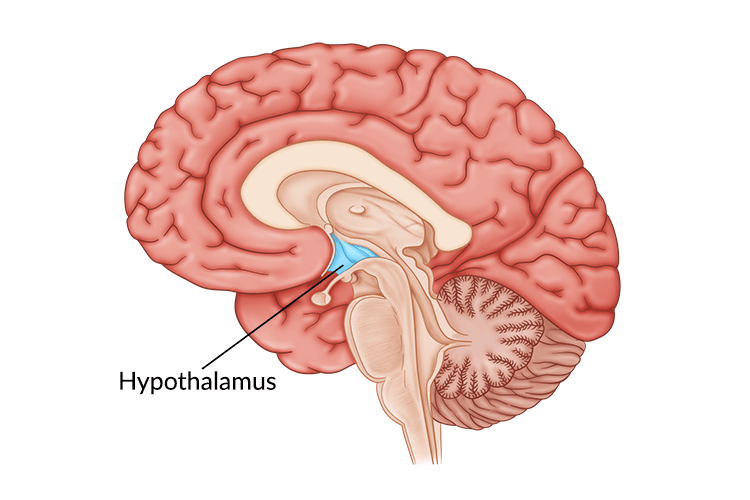
Which part of the brain controls body temperature?
The hypothalamus
What acts as receptors for temperature?
Thermoreceptors in the skin and hypothalamus
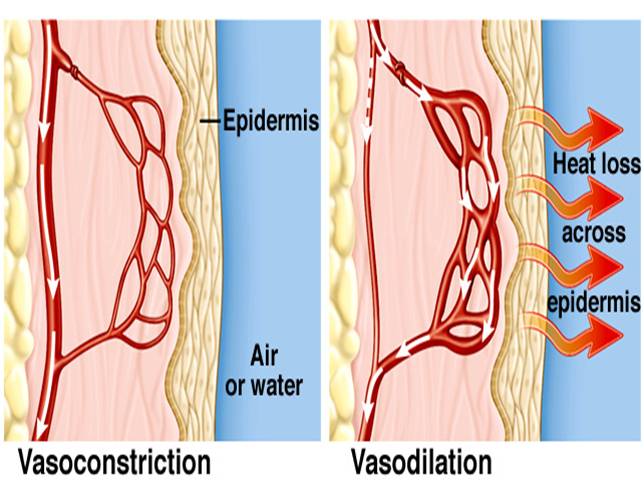
What happens to the skin arterioles when you're too hot?
Vasodilation
What is vasodilation?
Smooth muscles relax causing arterioles to widen so there is more blood flow near the skin surface increasing heat loss by radiation.
What happens to sweat glands when you're too hot?
They secrete more sweat
How does sweating cool the body?
Sweat evaporates, taking latent heat from the skin
What happens to hair when you're hot?
The hair erector muscles relax causing hair to lie flat reducing the insulation air layer
What happens to skin arterioles when you're cold?
Vasoconstriction
What is vasoconstriction?
Smooth muscles(sphinter muscles) contract, narrowing arterioles and causing less blood to flow to the skin surface so less heat is loss through radiation.
Wha happens to the sweat glands when you're cold?
Sweating stops
What happens to hairs when you're cold?
The hair erector muscles contract casuing hair to stand upright and trap an insulating layer of air
What is shivering?
Involuntary muscle contractions that generate heat through respiration.
Name four functions of the liver.
Deamination
Detoxification
Glycogenesis/glycogenolysis
Producing bile
What is deamination?
Removal of excess amino group from excess amino acids
Why can't amino acids be stored?
The body has no storage form for animal acids
What are products of deamination?
Ammonia
Keto acid
Why is ammonia dangerous?
It is highly toxic
What happens to the keto acid after deamination?
It is used in respiration where it is then converted into glycogen and fat.
What happens to ammonia in the liver?
It is converted into urea
What I the name of the process that converts ammonia into urea?
The ornithine cycle (urea cycle)
Why is urea safer than ammonia?
It is much less toxic
What is detoxification?
Breakdown of harmful substances into les harmful compounds.
Where is urea transported?
In the blood to the kidneys
Give examples of substances detoxified by the liver.
Alcohol
Drugs
Hydrogen Peroxide
Which enzyme breaks down hydrogen peroxide?
Catalase
Why must hydrogen peroxide be broken down?
It is toxic and damages cells
What are the main functions of the kidneys?
Removes urea
Regulate water potential
Regulate ion concentrations
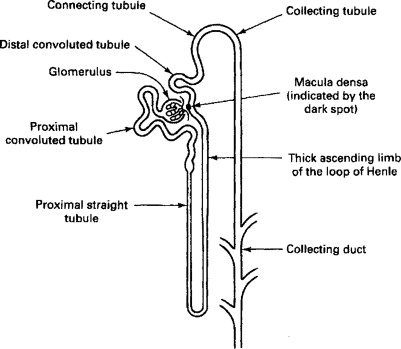
Parts of the nephron
Bowman’s capsule
Proximal Convoluted Tubule (PCT)
Loop of Henle
Distal Convoluted Tubule (DCT)
Collecting Duct
Name the blood vessels associated with the nephron
Afferent arteriole
Glomerulus
Efferent arteriole
Peritubular capillaries
Vasa recta
Gross structure of the mammalian kidney
Cortex
Medulla
Renal pelvis
Ureter
Renal artery
Renal vein
What is the function of the afferent arteriole?
Carriers blood into the glomerulus
What is the function of the efferent arteriole
Carries blood away from the glomerulus and forms the capillary network around the nephron
Where does the ultrafiltration occur?
At the glomerulus and Bowman’s capsule
What causes ultrafiltration?
High Hydrostatic Pressure in glomerulus forces small molecules out of the blood and into Bowman’s capsule
Why is Hydrostatic Pressure high in the glomerulus?
The afferent arteriole has a larger diameter than the efferent arteriole, creating high pressure in the glomerulus
What are the three layers of the filtration barrier?
Fenestrated endothelium of the capillary
Basement membrane
Padocytes with filtration slits
What substances pass through the filtration barrier?
Water
Glucose
Amino Acids
Urea
Mineral ions
What substances remain in the blood?
Blood cells & Plasma proteins
Why do plasma proteins and blood cells remain in the blood?
Because they are too large to pass through the filtration barrier.
What is Glycogenesis?
The conversion of glucose to glycogen for storage which is promoted by insulin.
What is Glycogenolysis?
The breakdown of glycogen to glucose promoted by glucagon and adrenaline