GEO EXAM 3
 Call Kai
 Learn
 Practice Test
 Spaced Repetition
 Match
 Flashcards
 Knowt Play
1/51

There's no tags or description
Looks like no tags are added yet.
52 Terms
Volcanoes
an opening in the Earth's crust through which molten lava, ash, and gases are ejected.
Magmas: Characteristics & Generation
principles of volcanism
- volcanic rocks: lava and pyroclasts
-Pyroclasts- fragmented volcanic rock ejected upwards explosively (Ex. Ash)
Magma
molten rock inside the earth
lava/pyroclasts
magma that reaches the surface
Characteristics of Magma
1. Composition
-Silica- minerals with Si and O
A) Mafic rocks ~ 50% or less silica ---> low silica (Mg, Fe)
-Ex: Basalts (dark, dense rocks)
B) Felsic rocks ~ 60-70% silica ---> high silica (quartz, feldspar), high amount of gases
Ex: Rhyolites (light, less dense rocks)
C). Intermediate rocks ~60% of silica
Ex: Andesites---> most abundant
Rhyolite
A brown fine-grained, felsic, igneous rock made up mostly of feldspar and quartz.

Basalt
A dark, dense, igneous rock with a fine texture, found in oceanic crust

Andesite
a dark, fine-grained, brown or grayish volcanic rock that is intermediate in composition between rhyolite and basalt.

Classification and flow characteristics of volcanic rocks

Viscosity
- resistance to flow
- controlled by silica content and temp
A). Mafic magmas- silica poor, hot --> low viscosity (gases moves easily)
B). felsic and intermediate magmas- silica-rich, cooler --> higher viscosity (gases don't move as easily)
Volcanic gasses (volatiles)
Water vapor (H20), carbon dioxide (CO2), SO2, N2, CL2, CH4
-Exsolve--> driving force of eruptions
How will low-viscosity magmas erupt? Why?
The composition must be?
Since they're so hot, they tend to flow easily out of earth.
Composition = Mafic
Eruption Dynamics
1) Mafic Magmas
- Silica - poor - Hot
- Low viscosity - Gases escape
- RESULT: Fluid eruption --> lava flows (Ex: Hawaii)
2) Felsic / Intermediate Magmas (convergent boundary)
- Silica - rich - Cooler
- High viscosity - Gases trapped
- RESULT: Explosive eruption --> Pyroclastics
***Deadly whether erupted or not***
Basaltic eruptions
not as violent and lots of lava flow
divergent boundary
hazards= lava flows
Andesitic/Rhyolitic Eruptions
plate boundary- convergent
hazards= stro volcanoes, continental volcanic arc
Generation of Magmas
1). Mid-Ocean Ridges
-pressure decrease
2). Subduction zones
-water added
3). Hot spots
-heat added

most land volcanoes
pacific ring of fire
convergent boundary
\pyroclastic eruption
Viscosity= High
Temp= Low
Composition= felsic
Explosivity= High
Hazard= very hazardous
Volcanic Edifices
-craters
-calderas- from massive volcanoes, low frequency

sheild volcano
- broad dome, gentle slope, ; largest
- composition--> basaltic lava flows
made out of mafic magmas
Ex: Iceland and Hawaii (Mauana Loa)

composite/strato volcano
- Steep, tall, layered sides
- Pyroclastic flows & lava flows
- Comp --> mostly andesite
- Gas in magma chamber
Ex: Mt. St. Helens, Mt. Vesuvius

strato volcano hazards
- Eruption cloud
- Ash fall
- Acid rain
- Lava domes
- Lava flows
- Gases
- Debris avalanche - Bombs
- Lahar (mudflow)
-PROCLASTIC FLOWS & LAHAR FLOWS
cinder cone
-steep , small; short-lived
- composition --> andesitic basaltic pyroclasts

Types of Eruptions
Volcanic explosivity index, VEI (0 to 8).
1. Plinian
-felsic
- powerful vertical ejection of pyroclasts, gas
- most powerful
- VEI = 3 - 8
2. Hawaiian
- mafic
- fluid basaltic lava flows
- least explosive
- VEI = 0 - 1
3. Strombolian
-strato volcano
- small eruptions of pyroclasts
- VEI = 1 - 3

Yellowstone
- Giant collapse caldera: Hot Spot
- A volcanic province
- RI = about 600,000 years
- caldara is 80km
- rhyolites
- hot springs
- mantle plume ~ 2,900 km
Melting of continental crust produces rocks that are...
felsic
Catastrophic Summit Collapse

Formation of a composite -volcano caldera

Anak Krakatau
type of volcano:
type of eruption:
some examples of calderas
Crater Lake, Krakatau, and Santorini
Hawaii
The Big Island
Shield Volcanos: Only 2 active
-Kilauea- RI is high, VEI is low
-Mauna Loa
oceanic crust, mafic, low viscosity, basalt rock
Why? the hotspot is no longer feeding the magma chamber
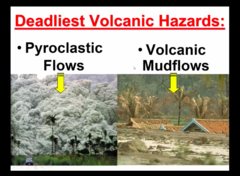
Deadliest Volcanic Hazards
1. pyroclastic flows- Nuee Ardente
- Scalding avalanche of ash and toxic expanding gases
- fast speed down volcano flank
causes:
- column collapse - Pilinian style of eruption follows explosive eruption moves down the sides of volcano, destroying everything in its path
- dome collapse- hot viscous plug that builds overtime and follows collapse of dome
2. volcanic mudflows- Lahar
- rapid flood of pyroclasts and water
causes:
-rainfall on loose ash
- melting of snow and ice
- breakout of a crater lake
- rivers and lakes
Mt. St. Helens
Mt. St. Helens:
- strato-volcano
- cascadia subduction zone
- plate tectonics is the Juan De Fuca and North American plates
precursor events in 1980:
- swarms of EQ's
- stream/ash explosions
main eruption (VEI 5)
- M=5 EQ
- triggered a gigantic landslide
- lateral steam blast
- mudflows
-Plinian column with pyroclastic flows
-57 deaths- mudflows and pyroclastic flows
COLUMN COLLAPSE
Mt. Pelee, 1902, Caribbean
tectonics:
-Atlantic seafloor under the Caribbean- North American and Caribbean plates
precursors:
- EQ's, ash eruptions
St. Pierre - elections
3 days before: invasion of red ants, snakes, centipedes
- eruption--> pyroclastic flows
-death toll: 30,000
- 2 survivors
DOME COLLAPSE
What's Mt. St. Helens producing and how are they formed?
-Plinian column collapse
-formed by pyroclastic flows
Mass Wasting
downslope movement under the influence of Gravity of rock/soil/sediment
Forces of Mass Wasting
-gravity
-friction (slope-resisting force)
slope failure-->gravity > friction

Factors in Mass Wasting
1. Water content
-excess water increases slope failures
2. slope angle
-steep slopes increase slope failures
3. Geological
-tilt of rock layers, different types of rocks, clays
4. Human
-overloading of slopes, artificial fill, excavation of highways, deforestation
5. Vegetation
-decreases slope failures
Types of Mass Wasting
-Falls, Slides, Flows
1. Rockfall--> free fall of rocks
-very rapid. Common in mountainous regions
2. Slides--> movement of rock layers down a failure surface
A)Slump- Rotational Slide: Curved surface, weak sediments, small
B) Rockslide- Translational slide: Planar surface, more coherent, deadlier
3. Flows--> movement as a viscous fluid. Critical component?
A) Mudflow- most fluid; heavy rainstorms
B) Debris flow/ avalanche- largest, fastest; very deadly; rare
C) Lehar- volcanic mud/debris flow
D) Creep- slowest, most widespread
Triggering events of mass wasting
rainstorms, earthquakes, volcanoes
what are some examples?
What is the role of rain? reduces the friction
retaining wall
a wall built up from low ground to hold the higher ground in place.

slump
A type of mass movement that occurs when a mass of material moves down a curved slope

debris flow
A downslope movement of mud mixed with larger rock fragments.

Southern California
costal cliffs with soft, loose sediment:
--> slope failures
Solana Beach
Seawalls
walls built parallel to the coast to block waves before they hit the shore
Shoreline without seawalls
waves move sand on and off the beach, and erosion from the cliffs helps replenish what's lost
Shoreline with seawall
-the barrier helps dissipate wave energy and fend off surging water
-the seawall disrupts the natural replenishment of sand
gradual loss of beach
-the sea continues to rise, squeezing out the beach
-the seawall limits sand replenishment and locks the shoreline in place
Cliff armoring on the beaches
reduces natural creation of sand supply
creep
the slow downhill movement of weathered rock material; bending trees are caused my creeps
wave energy
as waves come in it undercuts and cliff starts to recede