Pesticide Applicator Training (PAT) - Right of Way & Natural Areas
 Call Kai
 Learn
Learn Practice Test
 Spaced Repetition
 Match
Match Flashcards
 Knowt Play
1/531

There's no tags or description
Looks like no tags are added yet.
Name | Mastery | Learn | Test | Matching | Spaced | Call with Kai | Chat |
|---|
No analytics yet
Send a link to your students to track their progress
532 Terms
What is a pest?
An organism that damages or harms desirable plants, animals, products, or structures.
What is IPM?
Integrated Pest Management
What is the main difference between a "right-of-way" and "natural area"?
The main purpose of the land's use
Why are rights-of-way and natural areas discussed in the same pesticide applicator category?
They both deal with unwanted vegetation.
What determines if a given plant is a weed?
It is an unwanted plant that is interfering with the intended land use.
What are the two main goals of weed management?
Minimize weed competition with wanted plants & Minimize weed reproduction

Net-like leaf veins
dicot

Fibrous root system
monocot

Single seed leaf
monocot

tap root
dicot

parallel leaf veins
monocot

Two seed leaves
dicot
All grasses are monocots, but not all monocots are grasses.
True (ex: sedges)
Annual plants live for __ year(s)
one
Biennials live for __ year(s)
two
Perennials live for __ year(s)
three or more
What type of weed life cycle is most difficult to control?
Perennial
Canada thistle is easily controlled by mowing or tillage.
False
It's spring and you notice small, annual weeds sprouting and growing out of control along the roadside. What might you do?
Control the weeds while they're small
Pest control failure is most often caused by
incorrect pest identification
The first step of effective pest management
correct pest identification
Primary goal of pest management
keep pest populations from exceeding a tolerable level
Specific pests may or may not be named on a pesticide label. This occurs because
the risks of using that pesticide are associated with where and how the product is applied rather than the pest it targets
When deciding if pest management is necessary, consider the following:
Control a pest only when it is causing or expected to cause more harm than is tolerable,
Use a control strategy that will reduce the pest numbers to an acceptable level, and
Select a control strategy that causes the least amount of harm to non-target organisms.
Integrated Pest Management (IPM) is
an ecological approach to pest management that combines all available necessary techniques into a unified program
The goal of IPM
to manage pest populations in a way that avoids economic damage and minimizes adverse side effects
There are at least five main benefits of using IPM:
IPM helps preserve a balanced ecosystem.
Pesticides can be ineffective.
IPM can save money.
IPM promotes a healthy environment.
IPM helps maintain a good public image.
State and local laws require landowners to control
noxious weeds to prevent their spread and distribution
___ laws require landowners to control noxious weeds to prevent their spread and distribution
State and local
A right-of-way is
an area of land used (or adjacent to) areas of access, transportation or power
A natural area is
land being preserved or restored and managed for its natural or native features
In rights-of-way, unwanted vegetation can be a problem by:
Obstructing sight lines (e.g., for drivers),
Be a fire hazard (e.g., along railways),
Attract wildlife where they can be a hazard (e.g., next to roads, and
Cause structural damage.
In natural areas, unwanted vegetation is usually
invasive and/or nonnative plants growing in areas where we are trying to preserve or restore a natural landscape
Native plants can be weeds in natural areas
True
Commercial applicators are legally responsible for removing noxious weeds
False
Wisconsin’s designated noxious weeds
Canada thistle, field bindweed, and leafy spurge
Noxious weeds
the person that owns or controls the land where these weeds are found must cut or control such weeds so they don’t produce seeds
Nuisance weed examples
Purple loosestrife and multiflora rose
Nuisance weeds
Although the law does not require that these weeds be controlled, no one may sell, distribute, or cultivate them
State rule NR40
gives the DNR broader authority to control certain invasive species, including weeds, on private land
categorizes species as either “prohibited” or “restricted”
Prohibited species
cannot be transported (including importation), possessed, or transferred (including sale)
Restricted invasive species
can be possessed, but are excluded from transportation, transfer and introduction
cotyledons
The first leaves that emerge when a seed germinates
part of the embryo within the seed of a plant and forms what is called the “seed leaf” in contrast to the “true leaves” that grow later
Monocotyledons, or monocots
plants that have a single cotyledon (seed leaf), including true grasses and sedges.
This cotyledon stays below the soil surface during germination, so the first leaves you see above ground are the plant’s true leaves. In grasses, the growing point is often located at or just below the soil surface.
Grasses typically have:
Narrow leaves with parallel veins
A fibrous root system
The ability to reproduce through seeds, stolons, or rhizomes
Grass-like monocots’ biology ___ grasses, so their management strategies are ___
differs from; different
Dicotyledons, or dicots
broadleaf plants that have two cotyledons (seed leaves).
These cotyledons are always positioned opposite each other on the stem. As the plant grows, the true leaves develop and may be arranged in opposite, alternate, or whorled patterns.
Broadleaf weeds, which are dicots, typically have:
Broad leaves with net-like veins
A taproot system
A visible growing point at the tip of the shoot
Most reproduce by seed, but some can also spread through vegetative buds or spreading roots.
complete their life cycle in less than 12 months and reproduce by seed
annual weeds
especially problematic in cultivated areas and disturbed sites, such as newly planted landscapes
annual weeds
prolific seed producers, making them difficult and costly to control
annual weeds
An annual weed is no longer a threat after the parent plant dies
False
Summer annuals
Germinate in spring
Flower and produce seed during summer
Die in late summer or fall
Overwinter as seeds
Most problematic in spring-seeded crops
Winter annuals
Germinate in fall
Overwinter as low-growing plants
Flower and produce seed in spring
Die after seed production
Especially troublesome in perennial ornamental plantings
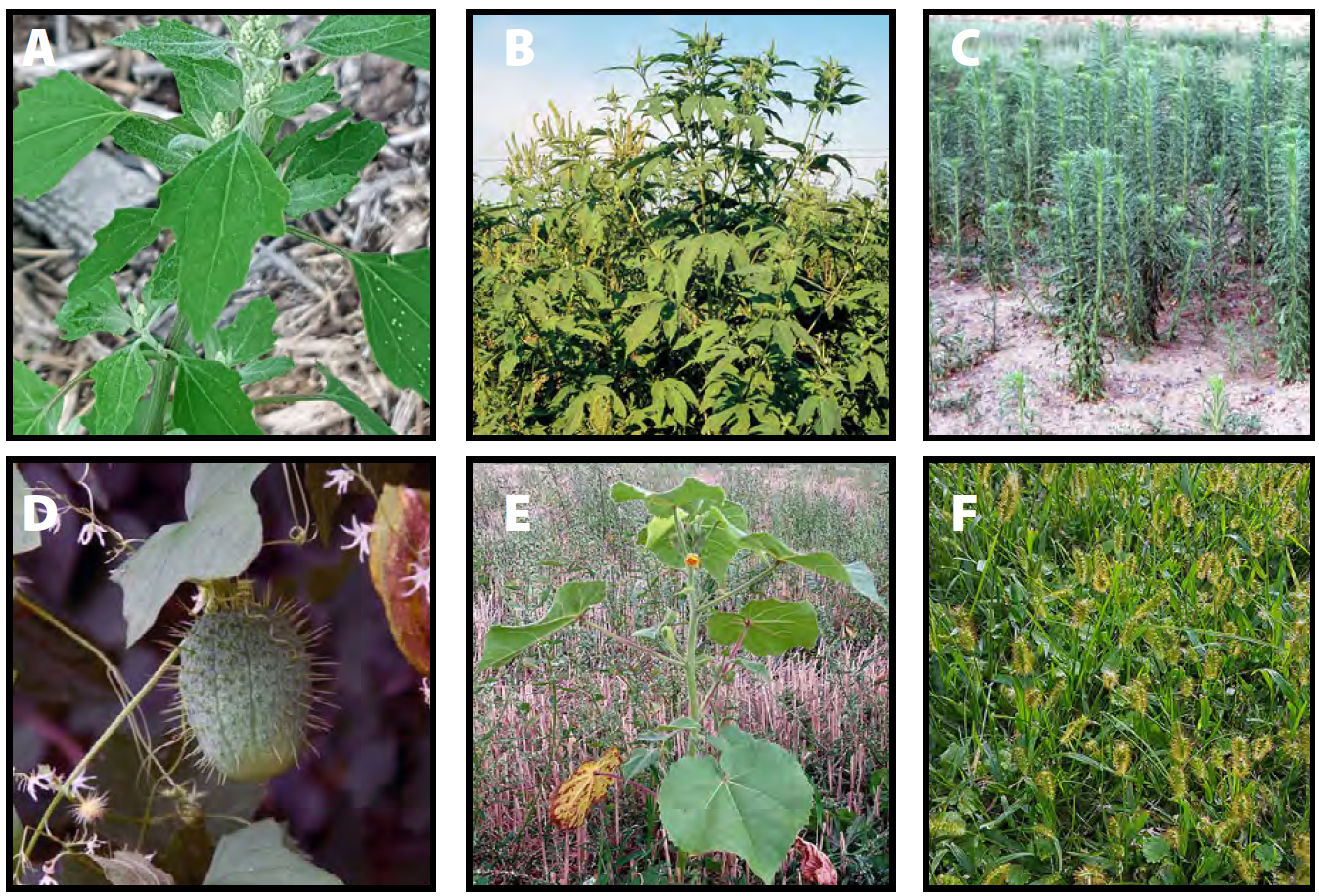
Common annual weeds in Wisconsin
(A) common lambsquarters; (B) giant ragweed; (C) horseweed (also called marestail); (D) wild cucumber; (E) velvetleaf; and (F) foxtail, which is an annual grass
live for two growing seasons and reproduce by seed. In the first year, they germinate from seed in spring or summer and form a rosette (a low-growing cluster of leaves at the soil surface). They overwinter in this rosette stage. In the second year, they grow a flowering stalk, produce seed, and then die.
biennials
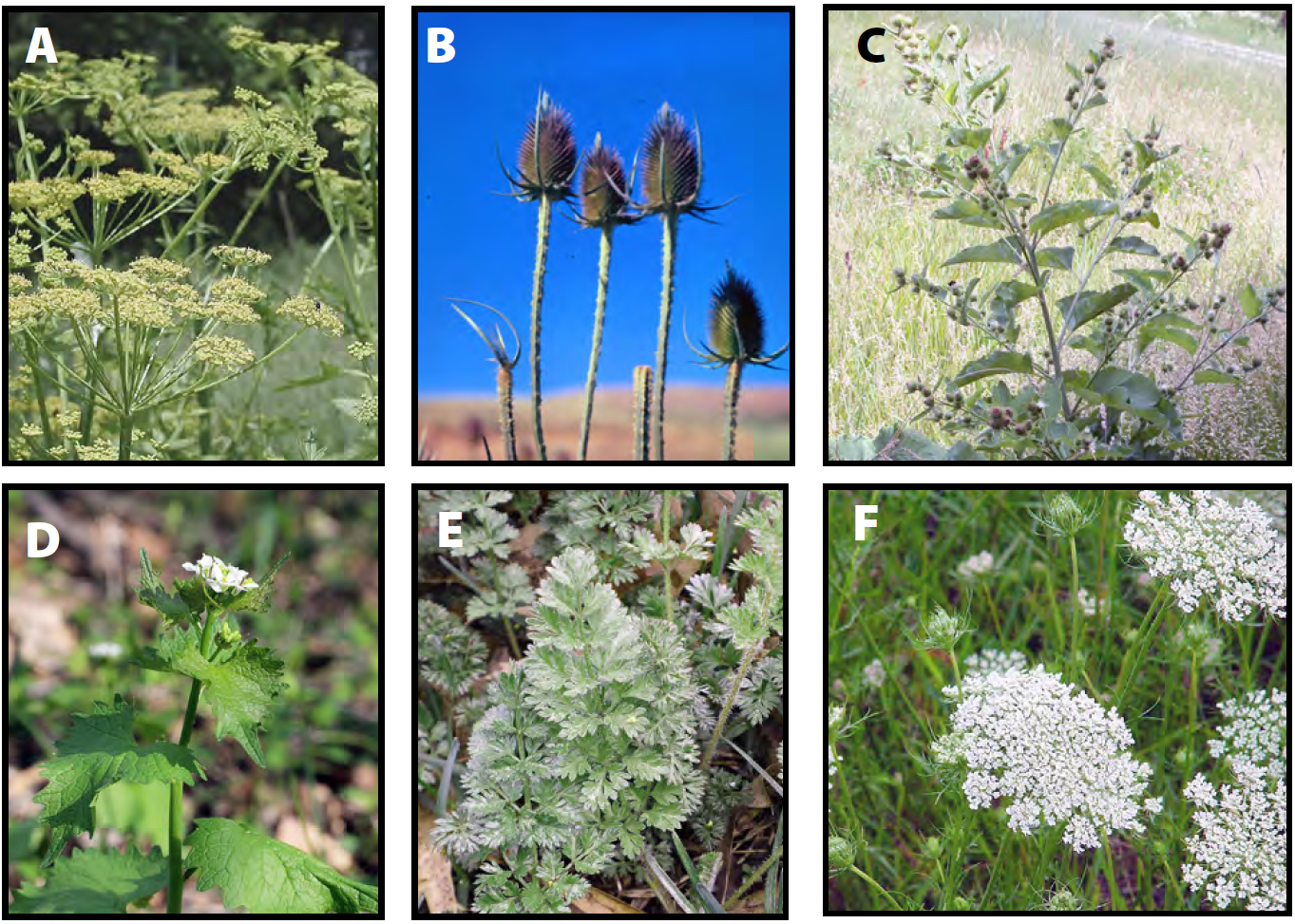
Common biennial weeds in Wisconsin
(A) wild parsnip; (B) common teasel; (C) burdock; (D) garlic mustard; and two views of wild carrot or Queen Anne’s lace: (E) close up of a young plant and (F) shows the flowers
plants that live for two or more years, often much longer. They can reproduce by seed (e.g., dandelion, dock, broadleaf plantain) or by vegetative structures (stolons, rhizomes, spreading roots, tubers, bulbs)
perennials
The above-ground parts of herbaceous ___ die back in winter. The plant survives through underground structures, which store energy and allow regrowth in spring.
perennials
flower and produce seed each year after their first growing season
perennials

Common perennial weeds in Wisconsin
(A) foliage of Canada thistle; (B) Canada thistle flowers; (C) quackgrass; and (D) hemp dogbane. (E) Shows the woody perennial buckthorn as it greens up early in the spring and shades out native wildflowers and (F) shows a close up of the buckthorn leaves
Also curly dock, leafy spurge, phragmites, and smooth sumac
Annual weeds are easiest to control
when they are young and small, before they flower and set seed. Many pesticide labels site an optimum size of 4 inches or smaller
To effectively kill annuals
you must destroy the entire shoot
Tillage, herbicide, and mowing (if seed production is reduced) are some management strategies for
annuals and biennials
Biennial weeds are easiest to control
during the rosette stage in the first year, when the plant is still low to the ground.
In the second year, you should control it before it flowers
To effectively kill biennials, you must
destroy the entire shoot
most persistent and difficult to control because they can regrow year after year from underground parts and often spread aggressively through seed and vegetative reproduction
perennial weeds
difficult to eliminate because they store energy in underground structures like roots, rhizomes, tubers, or bulbs. Simply removing or killing the top-growth once is usually not enough—the plant will regrow using its stored energy
perennial weeds
Repeatedly cutting or destroying new shoots and systemic herbicides are some management strategies for
perennial weeds
most effective way to control perennials
target and destroy their underground structures.
This can be done by repeated tillage to break up and expose underground structures or using systemic herbicides that translocate through the plant and kill the entire vegetative system
Applications of systemic herbicides are most effective in the __ when sugar flows in the plant to the underground storage structures
fall
A pesticide is chemical that only kills a certain pest.
False
In the manual, we group pesticides by EPA pesticide group into three broad categories. Which of the following are those categories?
Conventional, Antimicrobial, and Biopesticides
The common name of a pesticide is also the same as the product's active ingredient.
True
The pesticide formulation is the combination of __ and __
Active ingredient and Inert ingredient

Identify the Trade Name based on the following label.
Tempo Ultra WP

Identify the Common Name based on the following label.
B-Cyfluthrin

Identify the Chemical Name based on the following label.
cyano(4-fluoro-3-pheno... )
Pesticides from different manufacturers can have the same common name.
True
A pesticide is
any substance used to directly control pest populations or to prevent or reduce pest damage
Not all pesticides actually kill the target pest; some may only inhibit its growth, repel it, or reduce its capacity to reproduce.
True
synthetic or manufactured chemicals other than antimicrobial or biopesticides
conventional pesticides
the most commonly used chemicals for pest control and include products that directly kill a pest as well as attractants, repellents, plant-growth regulators, defoliants, and more
conventional pesticides
pesticides used to destroy or suppress the growth of harmful microorganisms (e.g., bacteria, viruses, fungi) on inanimate objects and surfaces
antimicrobial pesticides
Pesticides, like fungicides, used in right of way and landscape settings where applications are made on living materials are not part of this category
antimicrobial pesticides
pesticides made from natural materials such as plants, bacteria, fungi, certain minerals, or other sources.
For example, using an insect toxin or disease to control another insect
biopesticides
pesticides that the EPA has determined might cause unreasonable harm to human health and/or the environment. Because of these qualities, only certified applicators can purchase, mix, load, or apply
Restricted-use pesticides (RUPs)
Most pesticides fall into this category. These pesticides have been registered and had label approval by the EPA. These are pesticides that don't have as much risk to humans or the environment.
Under federal law, their use is not restricted to only certified applicators, but certain state laws may supersede federal laws and require certification to use these products.
Unclassified or General Use Pesticides
Because EPA has determined that the ingredients in certain products pose little to no risk to human health or the environment, EPA has exempted them from the registration process.
People do not need to be certified to use these products. However, individual states can require registration of these products through them.
Minimum-Risk Pesticides
Selectivity refers to
how broad, or narrow, a range of pests a particular chemical will control
useful when several different pests are a problem.
Fumigants, for example. They control a wide variety of pests including fungi, insects, weeds, nematodes, and more. Some __ herbicides (e.g., glyphosate) control most plant species if a sufficient dose is used.
broad-spectrum pesticides
control only a few, usually related, pests without harming others.
For example, certain herbicides control broadleaf weeds while not harming grasses. Sometimes ___ pesticides will only control a particular life stage of a pest
narrow-spectrum (or selective) pesticides
Persistence, or residual activity
how long a pesticide remains active to control pests
Short-term or non-residual pesticides
break down into non-toxic by-products almost immediately
The longer a pesticide stays in its active form
the longer it has to move off the target site and contaminate the environment, get into people and pets, and harm nontarget organisms.
Long lasting pesticides can lead to
pesticide resistance because they apply effective selection pressure on the target pest
The component in the pesticide product that has pesticidal activity
the active ingredient
Pesticide products may contain more than one active ingredient.
True
Different products that contain the same active ingredient(s)
may be labeled for different uses
one or more specific names given to each commercial formulation of a particular active ingredient.
Appears in large letters at the top of the label. This is what the manufacturer decided to call the product
trade name