nursing fundamentals final exam week 15
 Call Kai
 Learn
 Practice Test
 Spaced Repetition
 Match
 Flashcards
 Knowt Play
1/101

There's no tags or description
Looks like no tags are added yet.
102 Terms
How should a nurse communicate with a patient who does not speak English?
Use a qualified medical interpreter and speak directly to the patient rather than the interpreter.
How does impaired liver function affect pharmacokinetics?
Impaired liver function ↓ decreases medication metabolism, potentially prolonging medication effects and increasing toxicity.
How does impaired kidney function affect pharmacokinetics?
Impaired kidney function ↓ decreases medication excretion, causing medications to accumulate and potentially reach toxic levels.
What are the components of a medication order?
A medication order includes patient name, date and time, medication, dose, route, frequency and prescriber authentication. TPRDDD
T- time
P- patient
R- route
D- drug
D- dose
D- document
right to refuse
What are common risk factors for falls?
Muscle weakness,
confusion,
older age,
previous falls,
orthostatic hypotension
sedating medications increase fall risk.
How can nurses prevent pressure injuries?
Reposition patients regularly(every 2 hrs),
offload pressure points,
manage moisture (barrier cream with zinc)
promote adequate nutrition (protein, vit c)
How can nurses prevent hospital falls?
Keep the bed low and locked, provide nonskid footwear and ensure the call light is within reach.
What should the nurse do when a patient experiences dyspnea?
Position the patient in High Fowler's
assess respiratory status
administer oxygen as indicated.
How can nurses promote skin integrity?
Keep skin clean and dry, moisturize dry skin and minimize pressure, friction and shear.
How can nurses promote normal urinary elimination?
Encourage adequate hydration, regular toileting, privacy and complete bladder emptying.
What are the three components of evidence-based practice?
Evidence-based practice combines the best research evidence, clinical expertise and patient preferences.
What are the six rights of medication administration?
The six rights are right patient, medication, dose, route, time and documentation.
What are the major oxygen safety precautions?
Keep oxygen away from flames, smoking, sparks and petroleum products, and secure oxygen cylinders.
What is the most effective method of preventing infection?
Hand hygiene is the most effective method of preventing the transmission of infection.
When should soap and water be used instead of hand sanitizer?
Use soap and water when hands are visibly soiled and for C. difficile according to infection-control policy.
What should the nurse assess before administering oral medications?
Assess consciousness,
swallowing ability,
medication allergies
and any contraindications to oral administration.
What medications should never be crushed?
Enteric-coated and extended-release medications should not be crushed because this alters their intended release.
How can nurses prevent bloodborne pathogen exposure?
Use standard precautions, appropriate PPE and safety-engineered needles, and never routinely recap used needles.
What are the basic principles of nursing documentation?
Documentation must be accurate, factual, objective, timely, complete and confidential.
What is important when applying a transdermal medication patch?
Remove the previous patch, rotate application sites and avoid applying external heat over the patch.
How can nurses prevent urinary tract infections?
Encourage hydration and regular voiding, provide front-to-back perineal care and avoid unnecessary urinary catheters.
What techniques promote therapeutic communication?
Open-ended questions “tell me more about blank”
active listening,
clarification,
reflection and therapeutic silence encourage patients to express concerns.
What are examples of nontherapeutic communication?
False reassurance (Don't worry, everything is going to be just fine, dismisses fears)
unsolicited advice (If I were you, I'd put your father in a nursing home, takes away decision)
changing the subject (Let's not talk about your insurance problems; it's time for your walk now. no empathy)
judgement
How should the nurse assess a radial pulse?
Use the index and middle fingers and count for 30 seconds multiplied by two if regular or 60 seconds if irregular.
What factors influence body temperature and what are common sites?
Age (old people have lower baseline temperature)
illness
oral (most common)
rectal (most accurate)
tympanic (children: ear down and back. Adults: up and back)
temporal (noninvasive)
axillary (least accurate)

What is orthostatic hypotension?
It is a systolic BP decrease of at least 25 mmHg or diastolic decrease of at least 10 mmHg within three minutes of standing.
HR increase of atleast 10 BPM
Where and for how long should an apical pulse be assessed?
Count for 60 seconds at the fifth intercostal space along the left midclavicular line.
What is the proper technique for a subcutaneous injection?
Inject into adipose tissue at a 45- or 90-degree angle, pinching skin.
max 1mL
injection sites: belly, thigh, tricep
needle length is 5/8 inches

What are important nursing interventions for an infection?
Monitor vital signs and laboratory results,
obtain ordered cultures,
administer antibiotics
follow appropriate precautions.
What are the basic principles of proper body mechanics?
Maintain a wide base of support,
bend the knees,
keep loads close
avoid twisting while using appropriate lifting equipment.
What is Maslow's hierarchy of needs from lowest to highest?
Physiological needs, safety, love and belonging, esteem and self-actualization.
What should patients be taught about antibiotic therapy?
Take antibiotics exactly as prescribed, complete the prescribed duration and report significant adverse effects.
What does PQRST stand for in pain assessment?
Provokes (what causes,worsens, relieves pain)
quality (sharp/dull)
radiates (does pain spread)
severity (pain intensity, on chart)
time (when did it start/how long it lasts)
What is the difference between serous and serosanguineous drainage?
Serous drainage is clear or pale yellow, while serosanguineous drainage is thin and pink.

What is the difference between sanguineous and purulent drainage?
Sanguineous drainage contains blood, while purulent drainage contains thick pus that may indicate infection.

When should restraints be used?
Restraints are used only when necessary for safety after less restrictive interventions have been unsuccessful.
What are the essential safety precautions when using restraints?
Use an appropriate provider order, monitor circulation and skin(2hrs), and discontinue restraints as soon as possible.
What characterizes a Stage 1 pressure injury?
Stage 1 involves intact skin with nonblanchable redness or discoloration.
What characterizes a Stage 2 pressure injury?
Stage 2 involves partial-thickness skin loss with exposed dermis or a serum-filled blister.

What characterizes a Stage 3 pressure injury?
Stage 3 involves full-thickness skin loss with possible visible adipose tissue but no exposed muscle, tendon or bone.
What characterizes a Stage 4 pressure injury?
Stage 4 involves full-thickness skin and tissue loss with exposed or directly palpable deeper structures such as muscle or bone.
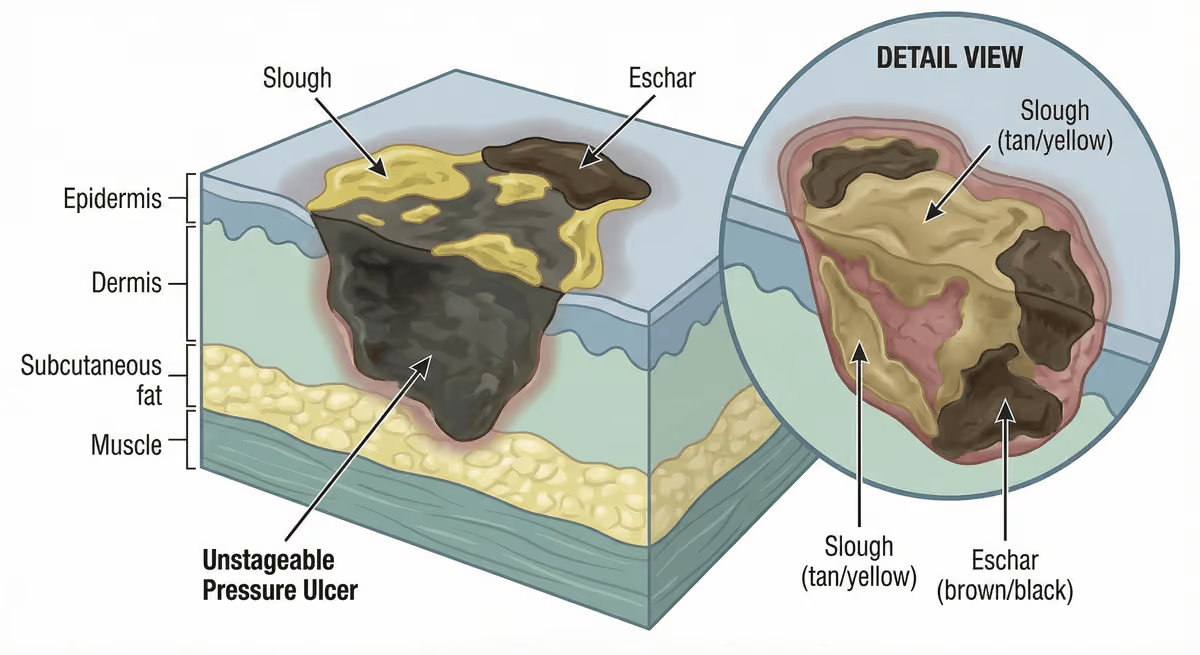
What is an unstageable pressure injury?
The wound depth cannot be determined because slough or eschar obscures the wound bed.
What characterizes a deep tissue pressure injury?
Deep tissue pressure injuries typically appear as persistent nonblanchable deep-red, maroon or purple discoloration.
What are the components of a basic neurological assessment?
Assess consciousness, orientation, pupils, speech, motor strength, sensation and reflexes.
When should discharge planning begin?
Discharge planning begins at admission and addresses patient education, support, resources and follow-up care.
What are the basic principles of a sterile dressing change?
Maintain a sterile field, clean from least contaminated to most contaminated and apply the prescribed sterile dressing.
What are the major roles of a professional nurse?
Nurses function as caregivers, advocates, educators, communicators, leaders and collaborators.
How do heat and cold applications affect circulation?
Heat causes vasodilation and muscle relaxation,
while cold causes vasoconstriction and decreases swelling.
What safety precautions are necessary during heat and cold therapy?
Use a protective barrier, monitor skin and sensation, and limit application time to prevent tissue injury.
What is the correct sequence for ambulating with a cane?
Hold the cane on the strong side and advance the cane, weak leg and then strong leg.
How should a patient use a cane when climbing stairs?
Lead with the strong leg going upstairs and the cane and weak leg going downstairs.
How can infection be prevented during hygiene and bedmaking?
Perform hand hygiene, work from clean to dirty areas and avoid shaking or placing contaminated linens on the floor.
What is the correct order for an abdominal assessment?
Inspection, auscultation, percussion and palpation.
What is the priority adverse effect of opioid analgesics?
Respiratory depression is the priority concern, and naloxone is used to reverse opioid effects.
What are the major risks of acetaminophen and NSAIDs?
Acetaminophen can cause liver toxicity, while NSAIDs can cause gastrointestinal bleeding and kidney injury.
What are the three levels of preventive healthcare?
Primary prevents disease, secondary detects disease early and tertiary reduces complications of existing disease.
What are the steps of the nursing and patient teaching process?
Assessment (subjective and objective)
diagnosis (using data for nursing diagnosis),
planning (set measurable goals)
implementation (plan takes action)
evaluation (did it work)
What are wheezes, crackles and rhonchi?
Wheezes are musical sounds, crackles are popping sounds and rhonchi are coarse, low-pitched sounds.
How can postoperative respiratory complications be prevented?
Early ambulation
coughing,
deep breathing
incentive spirometry help prevent atelectasis and pneumonia.
What should patients know about opioid analgesic safety?
Avoid alcohol and unapproved sedatives, take opioids as prescribed and report excessive sedation or breathing difficulty.
What are the nursing responsibilities associated with PCA?
Verify pump settings and monitor pain, sedation and respiratory status; only the patient should press the button.
What are the provider's and nurse's roles in informed consent?
The provider explains the procedure, risks and alternatives,
while the nurse witnesses consent according to policy. (does pt understand, and cognitive)
What is important during a preoperative assessment?
Assess allergies, medications, NPO status, baseline vital signs and previous anesthesia complications.
What are the immediate postoperative nursing priorities?
Assess airway, breathing and circulation before addressing routine pain management and other needs.
What is the difference between grief, mourning and bereavement?
Grief is the internal response to loss, mourning is its external expression and bereavement follows a death.
What are the five Kübler-Ross stages of grief?
Denial, anger, bargaining, depression and acceptance may occur in any order.
What factors influence a person's grieving process?
Age, culture, coping abilities, social support, previous losses and the meaning of the loss influence grieving.
What is the difference between hospice and palliative care?
Palliative care can accompany curative treatment
hospice focuses on comfort during terminal illness. (no tx)
What are common physical signs of approaching death?
Decreased responsiveness, reduced urine output, mottled extremities and irregular respirations commonly occur.
How should nurses support dying patients and their families?
Provide comfort, symptom relief, emotional support and care that respects the patient's dignity and preferences.
What is the difference between chronic disease, chronic illness and disability?
Chronic disease is a long-term pathological condition, chronic illness is the lived experience and disability limits functioning.
What is the primary goal of nursing care for chronic illness and older adults?
Promote independence, symptom management, functional ability and quality of life while preventing complications.
What is the difference between ADLs and IADLs?
ADLs involve basic self-care, while IADLs involve independent living tasks such as shopping and managing medications.
What are the major fluid compartments and their primary electrolytes?
Intracellular fluid is inside cells and contains primarily potassium, while extracellular fluid contains primarily sodium.
What is the difference between osmosis, diffusion, filtration and active transport?
Osmosis moves water, diffusion moves solutes down a gradient, filtration uses pressure and active transport requires energy.
How do hypotonic, isotonic and hypertonic IV solutions affect cells?
Hypotonic fluids cause cells to swell,
isotonic fluids cause no net size change
hypertonic fluids cause cells to shrink.
How do fluid volume deficit and fluid volume excess differ?
Deficit causes weight loss, weak pulse and hypotension, while excess causes weight gain, edema, JVD and crackles.
How do hyponatremia and hypernatremia differ?
Below 135 mEq/L causes cellular swelling and neurological changes, SEIZURES
more fluid
↓ DTR
above 145 mEq/L causes cellular shrinking and thirst. SWOLLEN TONGUE
increased BP
less fluid (dehydration)
How do hypokalemia and hyperkalemia differ?
Below 3.5 mEq/L causes flattened T waves and U waves, while above 5.0 mEq/L may cause peaked T waves.
Which calcium, magnesium and phosphorus imbalances cause increased neuromuscular excitability?
Hypocalcemia, hypomagnesemia and hyperphosphatemia associated with hypocalcemia can cause tetany, twitching and seizures.
What is the most reliable indicator of fluid volume changes?
Daily weight is the most reliable indicator, with a 1 kg weight change(2.2Ibs) representing approximately 1 liter of fluid.
What laboratory findings indicate fluid volume deficit?
Fluid volume deficit typically causes increased hematocrit, BUN and urine specific gravity due to hemoconcentration.
What are the nursing interventions for fluid volume excess?
Restrict fluids and sodium as ordered, administer prescribed diuretics and monitor daily weights and lung sounds.
What are common causes of hypokalemia?
Vomiting, diarrhea, potassium-wasting diuretics and inadequate potassium intake can cause hypokalemia.
What must the nurse verify before administering IV potassium?
Verify adequate kidney function and urine output, dilute potassium appropriately and never administer it by IV push.
How is severe hyperkalemia treated?
IV calcium protects the heart, while insulin with glucose temporarily shifts potassium into cells.
D: dialysis/dextrose
I: insulin
C: calcium glutonate
K: kayexalate
What are the positive signs associated with hypocalcemia?
A positive Chvostek's sign causes facial twitching, while a positive Trousseau's sign causes carpal spasms.
What are the manifestations of hypercalcemia?
Hypercalcemia causes decreased deep tendon reflexes, muscle weakness, constipation and kidney stones.
What are the manifestations of hypermagnesemia?
Hypermagnesemia causes decreased or absent deep tendon reflexes, hypotension, bradycardia and respiratory depression.
What medication is used to counteract magnesium toxicity?
IV calcium gluconate antagonizes the toxic effects of excessive magnesium.
What are the manifestations of hypophosphatemia?
Hypophosphatemia decreases ATP production, resulting in muscle weakness and potentially respiratory failure.
What is the relationship between calcium and phosphorus?
Calcium and phosphorus generally have an inverse relationship, so elevated phosphorus can contribute to decreased calcium.
What are the primary nursing precautions for severe sodium imbalances?
Monitor neurological status, implement seizure precautions when indicated and avoid overly rapid sodium correction.
What physiological changes normally occur with aging?
Older adults experience decreased muscle mass,
↓ bone density,
↓ skin elasticity
↓ renal function.
Are dementia, depression and urinary incontinence normal consequences of aging?
No, these conditions require assessment and should not automatically be attributed to normal aging.
What health promotion interventions are important for older adults?
Encourage regular exercise, vaccinations, preventive screenings, adequate nutrition and fall prevention.
Why is the prevalence of chronic illness increasing?
Increased life expectancy,
improved medical treatment and lifestyle-related risk factors contribute to increasing chronic illness.
What are the seven tasks of living with chronic illness?
Prevent crises, control symptoms, follow treatment, adjust to changes, prevent isolation, normalize life and manage finances.
What is the difference between anticipatory grief and disenfranchised grief?
Anticipatory grief occurs before an expected loss, while disenfranchised grief occurs when a loss is not socially recognized.
How should the nurse evaluate the effectiveness of patient education?
Use teach-back to assess understanding and return demonstration to evaluate the patient's ability to perform a skill.