CAPA Set 5-7 Questions
 Call Kai
 Learn
 Practice Test
 Spaced Repetition
 Match
 Flashcards
 Knowt Play
1/49

There's no tags or description
Looks like no tags are added yet.
50 Terms
Suppose you know the frequency of a photon and the speed of light. What else can you determine about the photon?
its wavelength and energy
Which of the following best describes the fundamental difference between two different chemical elements (such as oxygen and carbon)?
They have different numbers of protons in their nucleus.
What does temperature measure?
the average kinetic energy of particles in a substance.
Blue light has higher frequency than red light. Thus, Blue light has _______.
the highest energy and the shortest wavelength.

The figure below shows the Sun's visible-light spectrum. Note that this spectrum is displayed in many rows, so that it fits on the figure. Which of the following procedures would allow yourself to make a spectrum of the Sun similar to the one shown, but with less detail?
Pass a narrow beam of sunlight through a prism.

On the figure from the previous question, the upper left portion of the spectrum shows the _______ visible light.
lowest frequency
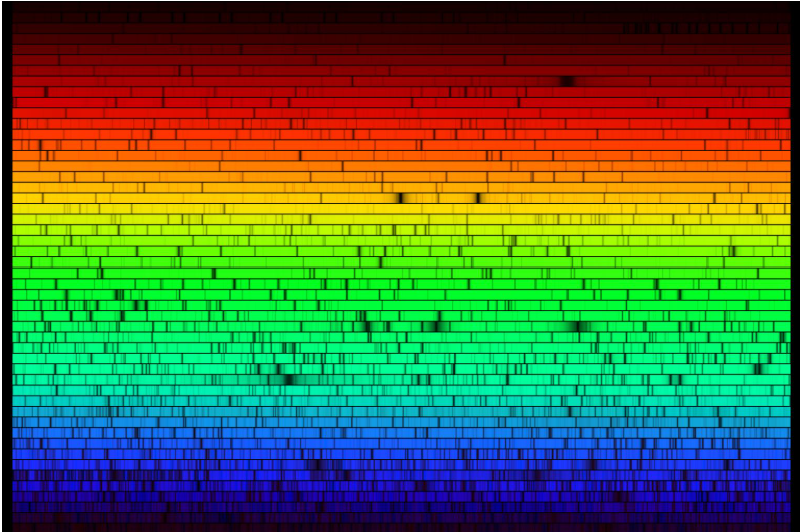
As shown on the figure above, the Sun's spectrum contains black lines over an underlying rainbow. What does that corresponds to, physically speaking?
The Sun's hot interior is responsible for the continuous rainbow or color, but cooler gas at the surface absorbs light at particular wavelengths.
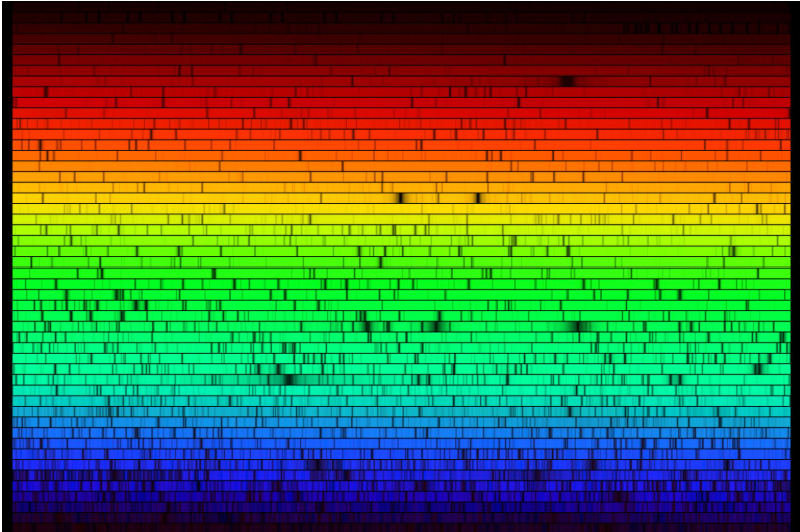
On the previous Sun's spectrum, notice how it appears brightest (or more intense) in the yellow-green region. This fact tells us _______.
the approximate temperature of the Sun's surface
Suppose you want to know what the Sun is made of. What should we do?
Compare the wavelengths of lines in the Sun's spectrum to the wavelengths of lines produced by chemical elements in the laboratory.
If we say that a material is opaque to ultraviolet light, we mean that it _______.
absorbs ultraviolet light
Suppose you look at a spectrum of visible light by looking through a prism or diffraction grating. How can you decide whether it is an emission line spectrum or an absorption line spectrum?
An emission line spectrum consists of bright lines on a dark background, while an absorption line spectrum consists of dark lines on a rainbow background.
What is the definition of thermal radiation?
It's a radiation with a spectrum whose shape depends only on the temperature of the emitting object.
Suppose instead of looking at a gas cloud lying between a hot source and the observer, that we are looking at the same gas cloud but the light source is off to the side instead of directly behind it. In that case, the spectrum would _______.
be an emission spectrum.
What type of visible light spectrum does the Sun produce?
An absorption line spectrum.
Which of the following statements best describes the difference between a refracting telescope and a reflecting telescope?
A refracting telescope uses a transparent glass lens to collect and focus light while a reflecting telescope uses a mirror to collect and focus light.
What does 'angular resolution' measure?
The angular size of the smallest features that the telescope can see.
Which of the following is always true about images captured with X-ray telescopes?
They are always shown with colors that are NOT the true colors of the objects that were photographed.
If your eyes were sensitive only to X-rays, the world would appear _______.
Dark, because X-ray light does not reach Earth's surface.
If you had only one telescope and wanted to take both visible-light and ultraviolet pictures of stars, where should you locate your telescope?
In space.
What do astronomers mean by 'light pollution'?
It is light from human sources that makes it difficult to see the stars at night.
Which of the following effects is caused by atmospheric turbulence?
twinkling of stars

Notice the numbered points on the diagram of a reflecting Cassegrain telescope. Which point represents the place where the starlight is first gathered?
2
Suppose that two stars are separated in the sky by 0.2 arcsecond. If you look at them with a telescope that has an angular resolution of 0.8 arcsecond, what will you see?
One point of light that is the blurred image of both stars.
Based on how your eye works and how it compares to a telescope, we can say that the _______ plays a role analogous to the mirror size in a telescope system.
Pupil
Which of the following statements best describes the two main advantages of telescopes over eyes?
Telescopes can collect far more light with far better angular resolution.
Suppose you want to determine the chemical composition of a distant planet or star. Which of the following will be most useful to have?
High spectral resolution.
What is the purpose of adaptive optics?
It reduces blurring caused by atmospheric turbulence for telescopes on the ground.
What is the purpose of interferometry?
It allows two or more small telescopes to achieve the angular resolution of a much larger telescope.
Which technology can allow a single ground-based telescope to achieve images as sharp as those from the Hubble Space Telescope?
Adaptive optics.
In essence, the nebular theory holds that _______.
our solar system formed from the collapse of an interstellar cloud of gas and dust.
Where would you expect terrestrial planets to form in the solar nebula?
anywhere between 0.3AU and the frost line.
The jovian planets are thought to have formed as gravity drew hydrogen and
helium gas around planetesimals made of _______.
rocks, metals, and ices.
What do we mean by the frost line when we discuss the formation of planets in the solar nebula?
It is a circle at a particular distance from the Sun, beyond which the temperature was low enough for ices to condense.
What is the 'giant impact hypothesis' for the origin of the Moon?
The Moon formed from material blasted out of Earth's mantle and crust by the impact of a Mars-size object.
According to modern scientific dating techniques, approximately how old is the solar system?
4.5 Billion years old

This evolutionary sequence shows how a large gas cloud can collapse to become a much smaller, spinning disk of gas. What law explains why cloud spins faster as it shrinks in size?
The law of conservation of angular momentum.
What law explains why the center of the cloud becomes so much hotter as the cloud shrinks in size?
The law of conservation of energy.

The diagram below represents the solar nebula early in its history, and shows the location of the frost line. Suppose you discover an object that is made of metal, rock, and ice, in which region of the solar system did it form?
4
Which of the following best explains why we can rule out the idea that planets are usually formed by near-collisions between stars?
Stellar near-collisions are far too rare to explain all the planets now known to orbit nearby stars.
According to our modern science, which of the following best explains why the vast majority of the mass of our solar system consists of hydrogen and helium gas?
Hydrogen and helium are the most common elements throughout the universe, because they were the only elements present when the universe was young.
What is the primary basis upon which we divide the ingredients of the solar nebula into four categories (hydrogen/helium; hydrogen compound; rock; metal)?
The temperatures at which various materials will condense from gaseous form to solid form.
Many meteorites appear to have formed very early in the solar system's history. How do these meteorites support our theory about how the terrestrial planets formed?
The meteorites appearance and composition is just what we'd expect if metal and rock condensed and accreted as our theory suggests.
According to our present theory of solar system formation, how did Earth end up with enough water to make oceans?
The water was brought to the forming Earth by planetesimals that accreted beyond the orbit of Mars.
What is the primary reason that astronomers suspect that some jovian moons were captured into their current orbits?
Some moons have orbits that are 'backwards' (compared to their planet's rotation) or highly inclined to their planet's equator.
Why are terrestrial planets denser than jovian planets?
Only dense materials could condense in the inner solar nebula.
The region of our solar system between Mercury and Mars has very few asteroids, while the region between Mars and Jupiter has many asteroids. Based on what you have learned, what is the most likely explanation for the lack of asteroids between Mercury and Mars?
There were very few planetary leftovers in this region, because most of the solid material was accreted by the terrestrial planets as the planets formed.
According to modern science, what was the approximate chemical composition of the solar nebula?
98 percent hydrogen and helium, 2 percent everything else
The terrestrial planets are made almost entirely of elements heavier than hydrogen and helium. According to modern science, where did these elements come from?
They were produced by stars that lived and died before our solar system was born.
What do we mean by accretion in the context of planet formation?
The growth of planetesimals from smaller solid particles that collided and stuck together
What do we mean by the period of heavy bombardment in the context of the history of our solar system?
The first few hundred million years after the planets formed, which is when most impact craters were formed.