Speech Science-Lecture 8/9
 Call Kai
 Learn
Learn Practice Test
 Spaced Repetition
 Match
Match Flashcards
 Knowt Play
1/39

There's no tags or description
Looks like no tags are added yet.
Name | Mastery | Learn | Test | Matching | Spaced | Call with Kai | Chat |
|---|
No analytics yet
Send a link to your students to track their progress
40 Terms
vocal-fold cycle
1) air pressure from the lungs blows the vocal folds apart
2) glottis opens during each vibration
3) the folds come together during each vibration (adduction during phonation, elasticity)
4) subglottal air pressure drops, and vocal folds are forced together (Bernoulli effect)
transglottal pressure
relative difference between the pressure above and below the vocal folds
“driving pressure”
phonation requires
the pressure difference of a minimum of 2cm h20
conversational speech
7cm h20
what must be greater than supraglottal pressure?
lung pressure or equivalently subglottal pressure
2 mass theory "(ishizaka + flanagan 1972)
lower part of vf are forced open by pressure from lungs (subglottal pressure)
upper parts of vf remain closed
later the upper parts are opened as well (partly as a result of subglottal pressure, partly bcs they are pulled apart by tissue of lower part)
both the upper and lower part execute the opening and closing movement,
the lag between the movement of the upper and the lower parts of the vocal folds enables them to complete closure

arytenoid cartilages
rock inward to adduct the vocal folds (partially or completely)

The pulmonic pressure

pushes the lower parts of the vocal folds apart

1st step: Subglottal pressure

Increases and pushes against elastic vocal folds

2nd step: When the pressure is great enough (subglottal)

To overcome vocal fold resistance, the glottis is pushed to open laterally
Convergent-shaped glottis
What part of the vocal folds separates first?
Inferior part of the vocal folds separates before superior

3rd step: upper margins of vocal folds

Are separated and airflow commences
subglottal pressure: is greater than supraglottal pressure
Pressure across the vocal folds drop

4th step: the lower border

Is reaching maximal excursion; the upper body continues to open due to the inertia of the mass of the folds

Step 5: the lower portion of the vocal folds
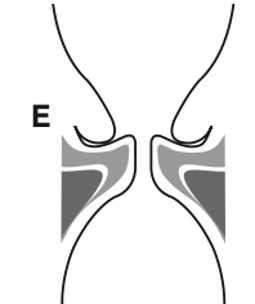
Is returning to the middle due to Bernoulli effect and the elastic recoil forces

Step 6: upper parts

Are still moving apart
Divergent-shaped glottis

Step 7: lower parts

are fully closed (Bernoulli effect is strong)

Step 8: upper border

Returning to the midline due to elastic recoil forces (not Bernoulli effect); airflow stopped

Step 9: full contact of the vocal cords

Full contact of the vocal cords
vertical phase difference: mucosal wave
1) open
2) closed
3) opening
4) closing

out-of-phase movement
upper & lower margins in early part of closing phase are moving in opposite directions
due to mucosal wave traveling wave of mucosa from inferior to superior margin
coronal section of vocal fold


intraoral pressure
higher pressures are produced during
voiceless compared to voiced
prevocalic compared to postvocalic consonants
stressed compared to unstressed syllables
stops compared to fricatives
what do children produce?
higher intraoral pressure compared to adults because they tend to speak at higher SPL
phonation threshold pressure
the lung pressure required to initiate phonation is greater than the lung pressure required to sustain phonation (due to inertia and momentum); minimum lung pressure required to initiate vibration
what is the minimal lung pressure required to initate vibration?
0.3-0.5 kPa (3-5cm H20)
what is the lung pressure required to maintain vibration?
0.1-0.2kPa
4 factors affecting phonation threshold pressure
lowered by decreased vocal fold viscosity
lowered by decreased mucosal wave velocity
lowered by increased approximation of vocal folds (in pre-phonatory stage (phonation onset)
raised by increased frequency of vibration
what do the vocal folds need to be in order to permit oscillation?
within the phonatory adductory range (not too far apart and not too overly compressed) and the transglottal pressure must be at or greater than phonation threshold pressure
phonation onset
pre-phonatory or phonation-ready phase can vary; initiation of phonation
simultaneous
breathy
glottal attack/hard onset
simultaneous onset (gentle/easy/soft onset)
complete adduction and exhalation are simultaneous
breathy onset (aspirate onset)
exhalation precedes complete adduction
glottal attack (hard onset)
complete & forceful adduction precedes exhalation; initial movement of vocal folds is lateral

phonation onset-vocal rise time
helpful for assessing phonation onset
equals duration from the onset of sound to the moment at which the amplitude of the acoustic wave reaches a steady-state
Fundamental frequency controlled by? (LOOK NOTES NOT FINISHED)
criciothyroid muscle contraction
thyroarytenoid muscle contraction
subglottal pressure
extrinsic muscle activity for articulatory functions
Fo is
rate of vib of VFs
pitch is the perceptual correlate (Fo is physical correlate of pitch)
male Fo
125 Hz
women Fo
> 200 Hz
children Fo
300+ Hz
Fo varies within speakers
longer more massive VFs yeild lower Fos; lengthening the VFs increases tension and decreases mass, leading to highr Fos