Attention 1-4
 Call Kai
 Learn
 Practice Test
 Spaced Repetition
 Match
 Flashcards
 Knowt Play
1/47

There's no tags or description
Looks like no tags are added yet.
48 Terms
Selective attention
Focusing attention on certain information while ignoring other information

Sustained attention
Maintaining focused attention
'vigilance'

Divided attention
Concentrating on more than one activity at the same time

Covert vs Overt attention
*Overt* - shifting your gaze to directly look at a stimulus
*Covert* - focusing your mind on a stimulus in your peripheral field without making any physical movement
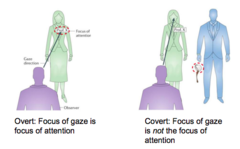
Endogenous vs. Exogenous cues
*Endogenous* cues: Cues that *voluntarily* direct attention to a location
(e.g. a central arrow pointing left).
*Exogenous cues*: Cues that *automatically* capture attention towards a location
(e.g. a brief peripheral flash).
Attentional capture
When a salient stimulus involuntarily attracts attention, disrupting performance when it is irrelevant.
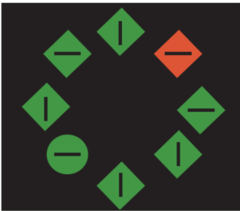
How do colour singletons demonstrate attentional capture?
*Non-target singleton*: Increases search reaction time (RT).
*Target singleton*: Reduces search reaction time (RT).
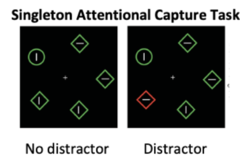

How is mind-wandering associated with attentional performance?
People reporting more mind-wandering show:
- Greater RT interference from distraction.
- More errors on sustained attention tasks.
Two brain regions known to respond selectively to specific stimulus categories
Fusiform face area (*FFA*)
Parahippocampal place area (*PPA*)
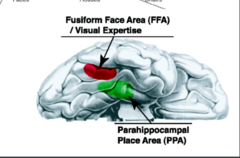
Central fixation
Staring continuously at a designated point in the middle of a screen

What happens when covert attention is directed to faces or houses during central fixation?
Covert attention to faces increases *FFA* activity.
Covert attention to houses increases *PPA* activity.
Shows that attention boosts neural responses to attended stimuli, even without moving the eyes.

Early selection theory
States that humans have a limited capacity for processing information and that a *selective filter* screens out irrelevant sensory data *before* it is analysed for meaning
You filter it out based on the physical characteristics (e.g., pitch of voice)

Broadbent's Filter Theory (1958)
An *early*-selection model - filtering occurs *before* incoming stimuli are analysed to the semantic level (e.g., surface features but not meaning analysed)
*Sensory store* - Holds incoming information for a short period of time.
*Filter* - Analyses messages based on physical characteristics
*Detector* - Information is processed to determine meaning.
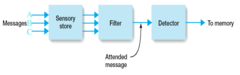
Triesman's Attenuation Model
*Early*-selection theory. Key *modification* to filter theory:
- Unattended messages attenuated (*reduced*) *rather* than lost completely
- Words need to meet a certain threshold of signal strength to be detected
- And the threshold for words primed by context or name etc., is lowered


Problems with *early* selection
Moray (1959): Subjects heard their name in the unattended stream
Treisman (1960): Bilinguals influenced by unattended stream if it is in second language
Gray & Weddeburn (1960): Response should've been "Dear 7 Jane" but subjects said "Dear Aunt Jane"
The Cocktail Party Effect
The brain's ability to focus on a single speaker while filtering out a competing background noise which is the same volume.


Dichotic Listening Task - results
Participants shadowed the attended message easily.
When asked about the unattended message:
*Noticed*:
- Physical characteristics (e.g., sex of voice, changes in pitch)
*Didn't notice*:
- When message was in a foreign language, or reversed.
- Or when the same word was presented 35 times!
Late selection theory
States that *all* sensory information is *fully processed* for meaning before any attentional filter selects what reaches conscious awareness.

Support for late selection models (3)
1. *Dichotic listening*
Attended stream: ambiguous sentence
Unattended stream: biasing word
2. *Response competition interference*
People are slowed down when letter is *congruent* (when the distractor is the same as the stimulus you are looking for)
Compared to when it is incongruent (when the distractor is different)
3. *Negative priming*
If you've previously ignored something, your response to it is slowed.
Task: Categorise red stimuli, ignore green.
Result: Responses to word slowed when preceded by semantically related IGNORED picture
Suggests ignored stimuli is semantically categorised and inhibited

*Lavie's* Load Theory
BOTH *early and late* selection are possible.
The stage of selection depends on availability of perceptual capacity, which in turn depends on the perceptual demands (or "load") of the task stimuli.
Support for load theory (3)
1. *Behavioural evidence*: Distraction effects occur under low load but are reduced or eliminated under high load. High load also increases inattentional blindness.
2. *Neuroimaging evidence*: High perceptual load *reduces neural responses to irrelevant stimuli in V1 (visual cortex)* and the *amygdala*.
3. *Individual differences*: Selective attention depends on perceptual capacity. Capacity varies with age, autism, congenital deafness and video-game experience.
Biased Competition Theory
States that multiple objects in the visual field compete for limited neural representation and processing capacity in the brain, mutually suppressing one another.

Theeuwes' interpretation of attentional capture
Said complete top-down selectivity is not possible.
Even when searching for a specific feature (e.g. shape), salient irrelevant stimuli can capture attention.
Stimulus-driven (bottom-up) selection occurs BEFORE top-down control.

Theeuwes: The role of the 'Attentional window'
Argued stimulus-driven selection only takes place within *attentional window*. And that spatial cues can vary size of attentional window
Also argued that Singletons outside cued location do not capture attention

Theeuwes: stimulus driven selection
Bottom-up BEFORE top-down
*Pre-attentive analysers* = calculation of local salience, most salient item selected
*Selection* = is this what I was looking for? If yes, output to response + memory systems
First stage:
- Initial sweep across visual field, entirely bottom-up
- Calculation of local salience
Second stage:
- Is selected item target? If not, location inhibited.
- Attention then shifts to item that is next in line with respect to salience.

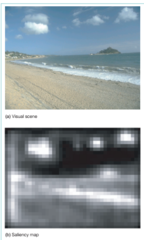
Saliency map
Visual overlays used to highlight the most visual attention-grabbing regions of an image
Contingent Capture Folk & Remington (1992)
- Attentional capture NOT stimulus-driven
- Attention can only be captured by stimuli *relevant to our goals*
E.g., Does the yellow sign capture our attention because it is salient, or because we were looking for a yellow taxi?

Contingent Capture Folk & Remington (1992) - Task
Invalid cues produced slower RTs.
BUT this was contingent on relation to task:
- *Colour cues* capture attention when target was defined on colour
- *Onset cues* captures attention when target was defined on onset
*But NOT vice versa.*
-> Suggests attentional capture contingent on task goals.


Bacon & Egeth (1994) - Response to Theeuwes
- Participants used a singleton detection strategy: spotting the odd one out.
- So, colour was relevant to their top-down goal of finding a singleton, even though the target was defined by shape.
-> When the shape target was no longer a singleton, the colour singleton no longer interfered, arguing colour IS relevant to top-down goals.

Theeuwes - Response to Bacon & Egeth
- Argued that their task reduced the colour singleton's local salience.
- A colour singleton can still capture attention when the target is not a singleton, provided its local salience is maintained.
- Therefore, irrelevant salient stimuli can still capture attention despite top-down goals.
Abrupt onsets
Stimuli which appears abruptly, tending to capture attention.
Another theory states: *only* abrupt onsets can produce stimulus driven capture

Abrupt Onsets - Experimental Task
Participants searched for an S and reported whether it was present.
A non-predictive singleton could be either a colour singleton or an abrupt onset (a suddenly appearing stimulus).
*Abrupt onsets captured attention; colour singletons did not.*

Display-wide settings (Gibson & Kelsey, 1998): Another argument against stimulus-driven capture
Attention tasks involve display changes (e.g. stimulus onset/offset or colour change), creating a general display-wide setting to detect dynamic changes.
->Abrupt onsets may capture attention because participants are *already set to notice display changes*.

Attentional capture beyond physical salience (Purkis, Lester & Field, 2011)
Sometimes things appear to attract attention because of their meaning or personal relevance.
Example:
Showed that people afraid of spiders showed attentional capture by spiders
Doctor Who fans showed attentional capture by Doctor Who images.


Value-Driven Attentional Capture (Anderson, 2013)
Stimuli associated with value also capture attention.
Test:
One colour was associated with monetary reward.
The rewarded colour distracted participants during an unrelated visual search.
Perceptual load examples
vs
Cognitive load examples
*Perceptual load examples*:
- Searching for a friend in a crowd
- Finding a needle in a haystack
*Cognitive load examples*:
- Doing complex mathematical calculations
- Figuring out the solution to a complex problem

Lavie et al. (2004) - Effects of Cognitive Load
*Task*: Flanker task while remembering either 1 digit (low cognitive load) or 6 digits (high cognitive load).
*Finding*: High cognitive load *increased* distractor interference; high perceptual load *decreased* it.
Explanation: Remembering digits uses executive control, leaving fewer resources to prevent distraction.
High perceptual / cognitive load and distractor processing
*High perceptual load*: *Reduces distractor processing* and increases inattentional blindness.
*High cognitive load*: *Increases distractor processing* and susceptibility to distraction.
Carmel et al. (2012) - Cognitive Load and Awareness (Faces)
*Task*: Classify names while ignoring faces, followed by a surprise face-memory test.
*Finding*:
Face recognition was 50% (chance) under *low* load
but ~80% under *high* load.
Early vs late selection for perceptual/cognitive load
*Early selection*: availability of perceptual capacity determines whether distractors receive further processing
*Late selection*: cognitive control required to inhibit any distractors that make it this far.
The Operation Span (OSPAN) task
Perform simple maths while reading words, then recall the words (e.g. 4 ÷ 2 + 1 = 3; NO; CAT).
*OSPAN relates to fluid intelligence* and is argued to assess prefrontal functioning.
What difficulties do individuals with low working memory capacity show?
*Increased* Stroop and response-competition interference.
*Greater* detection of their own name in unattended dichotic listening:
*65%* vs
*20%* in high-WM individuals.
Patients with damage to ________ and _______ regions show problems in attention and cognitive control.
Patients with damage to frontal and parietal regions show problems in attention and cognitive control.
Ways of testing which brain regions are involved in cognitive control of attention
fMRI spatial cuing studies
fMRI attentional capture
fMRI response competition
fMRI spatial cuing studies show...
Attention increases visual cortical responses to cued locations.
*Frontal-parietal activation* at the cue indicates mechanisms that orient attention.


fMRI attentional capture studies show...
Singleton distractors produce RT interference and *frontal-parietal activation*.
Greater frontal activation predicts *less* behavioural interference.

fMRI response competition studies show...
Incongruent distractors produce RT interference and recruit:
DLPFC: *dorsolateral prefrontal cortex*
ACC: *anterior cingulate cortex*
High-anxiety individuals recruit *less DLPFC and ACC*, showing *greater interference*.

How does working memory capacity relate to mind-wandering?
High WM capacity → less mind-wandering *during attentionally demanding tasks*
High WM capacity → more mind-wandering *during low perceptual load*