FS 341 exam 2
 Call Kai
 Learn
 Practice Test
 Spaced Repetition
 Match
 Flashcards
 Knowt Play
1/45

There's no tags or description
Looks like no tags are added yet.
46 Terms
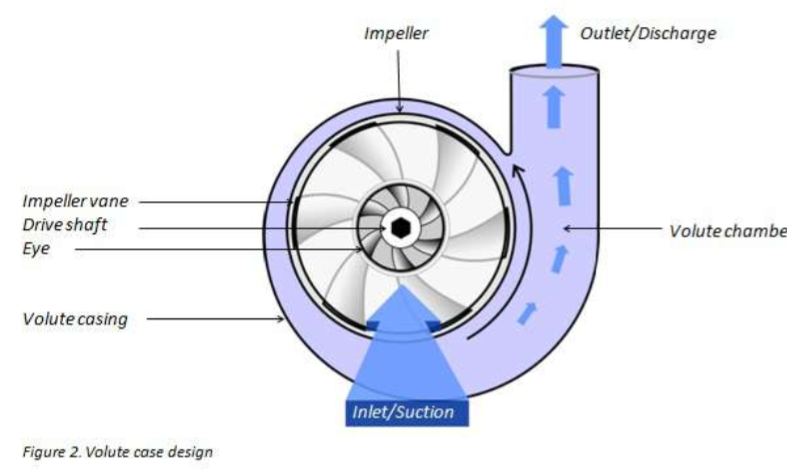
Centrifugal pump
Impeller rotating to deliver fluid flow rate by increasing kinetic energy of the fluid at the periphery of the impeller propelling fluid
Positive displacement pump
Traps liquid on suction side of the pump and forces into the discharge pump, useful as metering pumps and can handle viscous liquids
Reciprocating pumps
Move backward and forward
Rotary pumps
Rotate around a central axis
Piston pumps
Reciprocating pump where liquid is moved by action of a piston with a cylinder and is then delivered. Delivery is not constant, but can deliver against high pressures
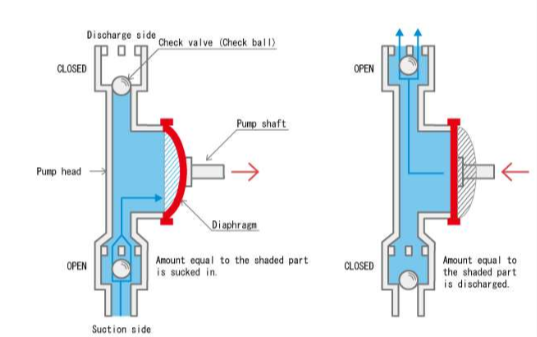
Diaphragm pump
Piston pump variant where there is no contact between liquid and any moving parts, and avoids excess shear
Gear pump
Two gear wheels inter-mesh inside a casing and one gear is driven which the other follows. Gears rotate to push liquid forward in the spaces between teeth

Peristaltic pump
Elastic tube looped around 3 rollers, placed on a triangular pitch so the tube is flattened when the disk rotates, pushing liquid along the tube. No contact between liquid and moving parts

Screw pump
Uses one or multiple screws to move fluids along the screw’s axis
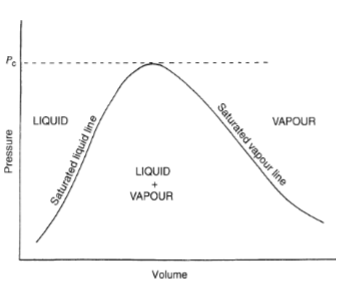
Pressure volume diagram
Saturation temperature
Temperature where vaporization takes place at a given pressure
Saturation pressure
Pressure where vaporization takes place at a given temperature
Saturated vapor
Vapor at saturation pressure and temperature
Saturated liquid
Liquid at saturation temperature and pressure
Superheated vapor
Vapor temperature is higher than saturation temperature
Subcooled liquid
Temperature of liquid is below the saturation temperature
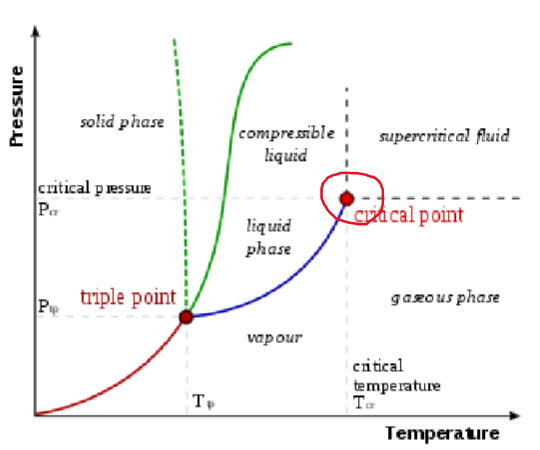
Pressure vs temperature diagram
Critical point
End point of a phase equilibrium curve
Triple point
State where three phases coexist
Steam quality

Vapor-liquid mixtures
Steam with less than 100% quality
Degrees of superheat
Number of degrees temperature exceeds boiling temperature
Fluid
Substance that continually deforms under applied external force
Viscosity
Resistance to deformation at a given deformation rate (thickness)
Gauge pressure
When measured pressure is greater than atmospheric pressure
Vacuum pressure
When pressure is below atmospheric pressure
Rheology
Branch of physics and engineering that studies the flow and deformation of matter
Type I rheological measurements
Apply stress and measure deformation rate
Type II rheological measurements
Apply strain or strain rate in shear or extension and measure stress
Strain
Relative displacement (displacement at a certain height)
Stress
Force/area
Newtonian fluids
Linear relationship between shear stress and shear rate
Non-newtonian fluids
Fluids with variable viscosity which depends on shear rate
Pseudoplastic fluids/shear-thinning fluids
As more stress is applied the viscosity decreases
Dilatant fluids (shear-thickening fluids)
As more stress is applied, viscosity increases
Thixotrophic fluids
Viscosity decreases with stress over time (ex: honey)
Rheopectic fluid
Viscosity increases with stress over time (ex: cream)
Viscosity vs. temperature curve

Kinematic viscosity
Ratio of absolute viscosity to density
Volumetric flow rate
volume of fluid passing through an area during a period of time
Continuity in flow
Flow rate through every section of a system is constant at steady state
Dimensions of Bernoulli’s equation
Pressure, kinetic energy, potential energy
Laminar flow
All particles flow in a straight line parallel to flow direction
Turbulent flow
Particles swirl due to an increased flow rate causing more frequent molecular collisions and Eddy current development
Reynolds number
Predicts laminar or turbulent flow
Reynolds number for laminar and turbulent flow
Laminar: <2100
Turbulent: >4000