1. Pain In Kids
 Call Kai
 Learn
 Practice Test
 Spaced Repetition
 Match
 Flashcards
 Knowt Play
1/18

There's no tags or description
Looks like no tags are added yet.
19 Terms
neonates and preterm infants experience pain with _____ intensity
greater
what findings indicate pain in infants?
facial expressions, body movements, and crying
changes in HR, RR, BP, oxygen saturation, breathing pattern, and skin color
how may toddlers respond to pain or procedures?
they may react to painless procedures as intensely as painful ones and demonstrate regressive behavior
how should the nurse communicate with toddlers about pain?
use developmentally appropriate vocabulary
how may preschoolers respond to pain?
they may become quiet, withdraw, or hide and believe pain is punishment because of magical thinking
what can preschoolers communicate about pain?
where it hurts and its severity using pain assessment tools
how may school-age children express pain?
they can describe its type, location, and severity but may deny pain to appear brave or show withdrawal and muscular rigidity
how may adolescents respond to pain?
deny pain or refuse help because of body image concerns or fear of losing control
show muscle tension, clenched fists and teeth, rapid breathing, and guarding
how should the nurse choose and use a child’s pain scale?
choose an appropriate tool and use it consistently unless the child’s status changes

how is the FACES pain scale used?
children ages 3–8 select the illustrated face that best describes their pain after the nurse explains each face
what’s the Oucher pain scale?
a scale for ages 3–12 using six photographs, with versions reflecting different racial and ethnic backgrounds


when can a numeric pain scale be used in children?
ages 7 and older, using a 0–10 scale
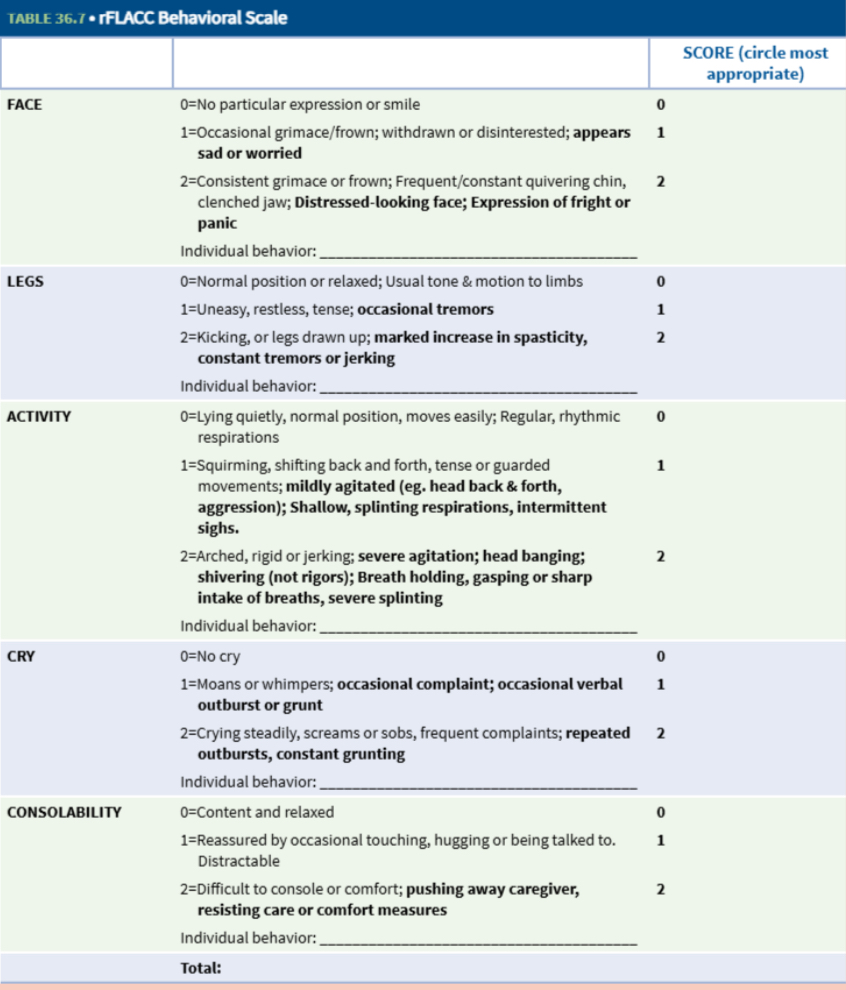
when is the rFLACC behavioral pain scale used?
face
legs
activity
cry
consolability
when a child can’t accurately report pain, reliable from 2 months to 7 years
what does the rFLACC pain scale assess?
face, legs, activity, cry, consolability
0-10, 10 worst pain
what is Neonatal Infant Pain Scale (NIPS)?
pain assessment scale for term and preterm neonates
measures facial expression, cry, breathing patterns, arms, legs. and state of arousal
max score: 7

what three principles guide pain management in children?
individualize interventions to the child and amount of pain
combine nonpharmacologic and pharmacologic approaches
teach the child and family pain relief techniques and discuss expectations
what nonpharmacologic interventions can reduce a child’s pain?
behavioral-cognitive
distraction, imagery, relaxation
biophysical
sucking and sucrose, massage, pressure
what nonopioid analgesics may be used for children’s pain?
acetaminophen
ibuprofen
ketorolac
naproxen
what opioid analgesics may be used for children’s pain?
morphine
hydromorphone
oxycodone