bchs 3304 exam 2 lecture/concept flashcards
 Call Kai
 Learn
Learn Practice Test
 Spaced Repetition
 Match
Match Flashcards
 Knowt Play
1/180

There's no tags or description
Looks like no tags are added yet.
Name | Mastery | Learn | Test | Matching | Spaced | Call with Kai | Chat |
|---|
No analytics yet
Send a link to your students to track their progress
181 Terms
proteins can be separated and purified based on different properties. list some of them
size
charge
binding properties
solubility
true or false: alanine is NOT commonly found in beta helices
true
list 3 amino acid structures not commonly found in beta helices
which of these 2 are also not commonly found in alpha helices?
alanine, glycine, proline
alanine favors alpha helices, glycine too flexible, proline too rigid
glycine and proline
briefly outline the steps for protein purification
break open tissues or microbial cells to release crude extract
fractionation - separate proteins into fractions based on size or charge
dialysis - semipermeable membrane to separate small solutes and proteins
protein solubility depends on ___________ _________________.
ionic strength
occurs at low ionic strength. increases in the concentration of dissolved ions leads to an increase in solubility by weakening the interaction between protein molecules
salting in
interactions between protein molecules leads to what?
aggregation, or the insolubility of proteins
occurs as the ionic strength increases. they outcompete the proteins for water molecules and the proteins become less soluble, aggregate, and fall out of the solution
salting out
for the purification of a protein, what is an effective salt to use? explain why
(NH4)2SO4. it is a very soluble salt that doesn’t harm proteins
which of the following statements are FALSE regarding salting out?
A. at low ionic strength, all of the proteins are soluble
B. As ionic strength increases, the least soluble protein precipitates
C. At even higher ionic strengths, further proteins precipitate
D. Proteins are most soluble when they are neutral so salting out experiments do not perform well when executed at the pI of the protein.
D. Proteins are most soluble when they are neutral so salting out experiments do not perform well when executed at the pI of the protein.
in this chromatography method, a buffered solution migrates through a porous solid material, then a solid phase, distinguishing proteins based on their migration rates
column chromatography
which component is absolutely necessary for protein purification?
A. column chromatography
B. gene sequence of the protein
C. means of detecting the protein
D. centrifuge
C. a means of detecting the protein.
Researchers must be able to separate a protein from others in pure form and must have techniques to determine its properties.
this chromatography method separates based on the sign and magnitude of the net electric charge. pH and concentration of free salt ions affect protein affinity.
mainly uses bound charged groups: cation and anion exchangers
ion-exchange chromatography
which of the following statements regarding ion exchange chromatography is FALSE?
A. the mixture of proteins is applied to a column
B. the salt concentration is high at the beginning, eluting proteins with the highest affinity for the column first
C. salt concentration is increased, eluting proteins that interact more strongly with the column
B. the salt concentration is high at the beginning, eluting proteins with the highest affinity for the column first.
The salt concentration is low at the beginning, eluting proteins with the lowest affinity for the column first.
what’s the most frequently used anion exchanger? cation exchanger?
anion exchanger - DEAE
cation exchanger - carboxymethyl
also called gel filtration chromatography. it separates proteins based on size, with large proteins emerging from the column before small ones
size-exclusion chromatography
chromatography method that separates based on binding affinity. it is eluted by high concentration of salt or ligand
affinity chromatography
which of the following is FALSE regarding affinity chromatography?
A. Only one protein will have the binding site for the ligand attached to the solid resin matrix
B. Proteins without the proper ligand binding site will flow through the column fastest
C. Desired protein can be recovered from the column by washing with a solution with high ligand concentration, altered ionic strength, or altered pH.
D. protein A column from staphaureus captures IgG, substrate column captures enzyme, and Ni+ column captures his-tagged protein
E. All of the following are true regarding affinity chromatography
E. All of the following are true regarding affinity chromatography
this form of affinity chromatography is executed by engineering a protein of interest to have a his6 tag using Ni-NTA/Ni-TED to capture it, eluting using imidazole (his side group), and cleaving the tag away
his-tag affinity chromatography
which protein would elute first from a gel filtration column?
A. protein A, with Mr = 27,000
B. protein B, with Mr = 58,400
C. protein C, a homodimer with promoter Mr = 11,300
D. protein D, Mr = 15,600
B. protein B, with Mr = 58,400. remember in size-exclusion chromatography, proteins are separated according to size, so large ones emerge before small ones.
how do you find purification factor? what is it a ratio of? what about percent yield for a purification reaction?
final specific activity : starting specific activity is the ratio for purification factor
percent yield = final activity/starting activity * 100%
specific activity of a protein is 15 units/mg. after purification, specific activity is 12,000 units/mg. what is the purification factor?
A. 180,000
B. 800
C. 0.00125
D. 15
E. 12,000
B. 800. final specific activity/starting = 12,000/15 = 800
this process helps visualize and characterize purified proteins. it can estimate the number of different proteins in a mix, degree of purity, isoelectric point, and molecular weight
electrophoresis
which of the following is FALSE regarding electrophoresis for protein analysis?
A. does not use cross-linked polymer polyacrylamide gels (PAGE)
B. proteins migrate based on charge to mass ratio
C. visualized using the aid of coomassie blue dye to bind to the proteins
D. none of the above are false
A. does not use cross-linked polymer polyacrylamide gels (PAGE). it does
detergent that binds and partially unfolds proteins, giving all proteins a similar charge-to-mass ratio. electrophoresis in the presence of this compound separates proteins by molecular weight and causes small proteins to migrate more rapidly
sodium dodecyl sulfate (SDS)
denaturing gel electrophoresis separates proteins based on differences in:
A. size and shape
B. molecular mass
C. charge
D. amino acid content
A. size and shape.
this is also given by the equation that µ = (V/E) - (Z/f), where µ = electrophoretic mobility, V = velocity, E = electrical potential, Z = net charge, f = friction coefficient
when using isoelectric focusing to determine th api of a protein, how ar proteins distributed along the pH gradient?
according to their pI values. the lower the pI, the lower (less than 7, positive direction on the strip) they are on the protein gradient.
______ electrophoresis permits the resolution of complex protein mixtures of proteins and is more sensitive than individual methods. it is a combination of _________________ and SDS-PAGE. first, __________________ is carried out in one direction, and then SDS-PAGE occurs in the perpendicular direction
2D, isoelectric focusing, isoelectric focusing
put lecture 11 here, nothing for lecture 10
protein structures are stabilized by _________ interactions and forces. the formation of a thermodynamically favorable structure depends on the influences of the ____________ effect, hydrogen bonds, ionic interactions, and van Der Waals forces.
natural protein structures are constrained by ___________, whose configurations can be described using dihedral angles
non covalent, hydrophobic, peptide bonds
protein conformations prioritize the conformation that is…?
thermodynamically the most stable (lowest free energy)
proteins in any functional, folded conformations
native
tenden cy of a protein to maintain a native conformation
stability
unfolded proteins have a ________ conformational entropy
high. remember entropy is a measure of disorder
chemical interactions can help stabilize native conformations. what kind of bonds are uncommon? what kind of bonds are very common? list some examples of common ones
strong disulfide (covalent) bonds are uncommon. weak (non covalent) interactions and forces are very common. examples include: hydrogen bonds, hydrophobic effect, and ionic interactions
the packing of hydrophobic amino acids away from water favors protein folding. what does the solvation layer formed look like?
highly structured shell of h2o around hydrophobic interior. it decreases when non polar groups cluster together, which causes a favorable increase in net entropy
which item is the predominant factor in protein stability?
A. disulfide bonds
B. hydrophobic effect
C. salt bridges
D. non peptide covalent bonds
B. the hydrophobic effect. it makes the major contribution to stabilizing the globular form
which statement regarding protein structure is true?
A. entropy is generally not a consideration when determining stability
B. van der Waals interactions are insignificant
C. hydrophilic side chains are never found in the interior
D. hydrophobic side chains are usually found in the interior of the native structure
D. hydrophobic side chains are usually in the interior of the native structure
highly structured shell of h2o around a hydrophobic molecule. it decreases when non polar groups cluster together, which increases entropy
solvation layer
how many covalent bonds separate the alpha carbons of adjacent amino acid residues?
3 separate them. it goes Ca-C-N-Ca
true or false: the peptide bond is rigid and planar. resonance can also be found between eh carbonyl oxygen and amide nitrogen through the presence of partial charges
true
how many atoms of the peptide group lie in a single plane? why are they unable to rotate freely?
6 lie in a single plane. they cannot rotate freely due to the partial double-bond character of the C-N peptide bond that prevents rotation
when a peptide chain is fully extended, the angles are defined as _________ or ____________ (these are the sam).
180 or -180
bonds between an alpha carbon and Nitrogen (Ca-N) are called….?
phi bonds
bonds between an alpha carbon and another carbon are called…?
psi bonds
many phi and psi values are prohibited by ____________. for example, both cannot equal 0 degrees
steric interference
why is there very little allowable rotation around the peptide bond?
A. peptide bonds are amide bonds
B. the R group prevents rotation about the peptide bond, except in glycine
C. the C-N bond is shorter
D. peptide bonds are only formed in the cis configuration
E. the partial double-bond character makes the peptide planar
E. the partial double-bond character makes the peptide planar
regular secondary structures are defined by the particular values of ψ and φ and their formation is impacted by the __________ ___________ composition of the segment
amino acid
how can the φ and ψ values for a given protein structure be visualized?
using a ramachandran plot
secondary structure describes the spatial arrangement of the _______________ in a ______ of a polypeptide chain. in a regular secondary structure φ and ψ remain the same throughout the segment.
main-chain atoms, segment
what are some common types of secondary structure?
alpha helix, beta conformation, beta turn, and random coils
this allows for a visualization of all φ and ψ angles. it tests the quality of 3d protein structures
ramachandran plots
true or false: for a ramachandran diagram, φ is is plotted on the Y-axis and ψ on the x-axis
true
memorize the given table
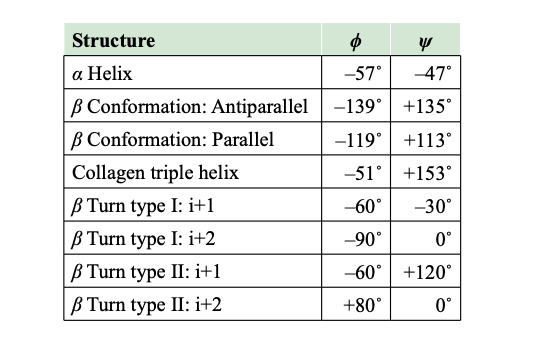
simplest arrangement that has the maximum number of hydrogen bonds. it features a backbone wound around an imaginary longitudinal axis, protruding R groups out the backbone, and each helical turn = 3.6 residues (n) and a pitch of ~5.4
alpha helix
how many residues are in a helical turn? what is the pitch?
3.6 amino acid residues, 5.4 pitch
what structural feature can be found between hydrogen atom attached to the electronegative nitrogen atom of residue n and the electronegative carbonyl oxygen of residue n+4?
intrahelical hydrogen bonds
given that an alpha helix has 3.6 amino acids per turn and a rise of 5.4 per turn, what is the length per amino acid of the alpha helix?
A. 3.6
B. 5.4
C. 1.5
D. 19.4
1.5 Å.
length per amino acid = 5.4 A per turn/3.6 amino acids per turn
an α helix is _______-handed when it twists clockwise, with R groups protrude away from the helical backbone. it is __________-handed when it twists counterclockwise, and R groups create instability due to clashing with the backbone, making this the _________ stable option
right, left, less
what group are left-handed α helices not observed in?
proteins
proline and glycine are both infrequent in α helices, why?
proline - the nitrogen atom is part of a rigid ring in the structure of proline, making it highly restrictive.
glycine - opposite reason, it is too unrestricted. it has high conformational flexibility due to it just having a hydrogen as its special group. this causes it to have a massive conformational entropy.
this form of conformation is a backbone that extends into a zigzag. it consists of a strand and a sheet. the strand is a single protein segment, while a sheet is several strands in this conformation side by side
beta conformation
what is the difference between a beta strand and a beta sheet?
a strand is a single protein segment, while a sheet is several strands in beta conformations side by side
adjacent polypeptide chains in a beta sheet can be antiparallel or parallel, true or false?
true
which of the following is true of beta conformation?
A. backbone extends into a zigzag
B. a β strand is a single protein segment
C. β sheet is several strands in conformation side by side
D. all of the above are true of beta conformation
D. all of the above are true of beta conformation
which form of a β sheet is more common, antiparallel or parallel?
antiparallel
true or false: for additional stability, cysteine bonds form between the backbone atoms of adjacent segments of beta sheets
false, hydrogen atoms
the β sheet:
A. can be either parallel or perpendicular
B. has strands in which the R groups of the amino acids are all on the same side of the sheet
C. is composed of amino acid residues all very near each other in the primary structure
D. is primarily stabilized by hydrogen bonds
D. is primarily stabilized by hydrogen bonds
Hydrogen bonds form between backbone atoms of adjacent segments of polypeptide chains within the sheet
name one example of a twisted beta sheet protein
bovine carboxypeptidase
connect ends of two adjacent segments of an antiparallel sheet. they consist of 180 degree turns involving 4 residues and hydrogen bonding between the 1st and 4th residue.
beta turns
glycine and proline are often common in what type of turns in basic protein structure?
beta turns
which of the following statements about β turns is FALSE?
A. They connect the ends of 2 adjacent segments of an antiparallel B sheet
B. Involve 4 residues and 180 degree turns
C. There are hydrogen bonds between the first and fourth residue
D. Gly and Trp often occur in β turns
E. All of the above statements are true
D. Gly and Trp often occur in β turns
which is the more stable β sheet: parallel or antiparallel?
A. antiparallel due to more linear hydrogen bonds
B. parallel due to the alignment of all terminal amino groups on one side and all carboxyl groups on the other side
C. parallel due to a high concentration of proline residues, promoting more linear hydrogen bonds
D. antiparallel due to a more elongated structure than parallel sheets
E. antiparallel because β turns can join the strands, an arrangement that is not possible with parallel sheets
A. antiparallel due to more linear hydrogen bonds
The inter strand hydrogen bonds aren-line in the antiparallel β sheet, while they’re distorted in parallel formations
overall 3d arrangement of all atoms in a protein. weak interactions and covalent bonds hold interacting segments in place
tertiary structure
arrangement of 2+ separate polypeptide chains in 3d complexes
quaternary structure
what are the 4 major types of protein groups based on polypeptide chains?
fibrous, globular, intrinsically disordered, and membrane proteins
Which statement regarding the tertiary structure of proteins is
false?
A. Amino acid residues far apart in primary structure may
interact with each other in the tertiary structure.
B. The tertiary structure of a protein is destabilized by the
hydrophobic effect.
C. Many proteins can be classified as either globular or
fibrous (but not both).
D. Quaternary structure is the description of how the
tertiary structures in a multisubunit protein are
arranged with respect to each other.
B. The tertiary structure of a protein is destabilized by the hydrophobic effect. Hydrophobic effect actually stabilizes it
these proteins are adapted for a function. they give strength and/or flexibility to structures, have a simple repeating element of secondary structure, and are h2o insoluble due to high concentration of hydrophobic residues
fibrous proteins
alpha-keratin helix is a ___________ alpha helix
right-handed
which of the following is true regarding the structure of alpha keratin in hair?
a. it consists of two strands of alpha-keratin
b. the strands are oriented in parallel fashion
c. form a super twisted coil with a left handed helical path, despite being right handed
d. all of the above
d. all of the above
the vertical distance of 1 full turn is also referred to as the…
pitch
why is the pitch in alpha keratin 5.15-5.2, despite a standard right handed helix having a usual pitch of 5.4?
the coiling compression, which is caused by the coiled-coil quaternary structure of the protein
α-Keratin proteins constitute almost the entire dry weight of horns and hooves in mammals. The strength of α- keratin proteins comes from:
A. cross-linking of α helices by disulfide bonds.
B. a close packing of β sheets.
C. a triple helix.
D. high concentrations of charged amino acids.
A. cross-linking of alpha helices by disulfide bonds
found in connective tissue. has a left handed secondary structure with a repeating tripeptide unit Gly-X-Y, where X is often proline and Y is often 4-Hyp. glycine is located in its center
collagen
what does the tertiary and quaternary structure of collagen consist of?
right-hand twisting of 3 separate polypeptides
collagen fibers are cross-linked by covalent bonds including lysine, hydroxylysine or _______?
His
scurvy is caused by a lack of vitamin c and characterized by a general ____________ of connective tissue. vitamin C is required for the hydroxylation of ________ and ________ in collagen
degradation, proline, lysine
Collagen:
A. has fibrils consisting of cross-linked triple helices of polypeptide chains.
B. does not have quaternary structure.
C. consists of alpha-helical subunits.
D. has a primary structure of repeating –Glu-X-Y- .
A. has fibrils consisting of cross-linked triple helices of polypeptide chains
proteins that are more compact than fibrous proteins and fold back on each other. examples include: enzymes, immunoglobulins transport proteins, motor proteins, etc.
globular proteins
recognizable folding pattern involving 2+ elements of secondary structures and the connections. can be simple or elaborate
motifs
A motif in the glycolysis enzyme hexokinase could NOT contain:
A. a β turn.
B. a β sheet.
C. an alpha helix.
D. disulfide bonds
E. All of these could be found in a motif.
E. all of these can be found in a motif
part of polypeptide chain that is independently stable or could undergo movements as a single entity. can be distinct or difficult to discern.
domain
true or false: small proteins usually have only 1 domain
true
___________________ proteins lack definable structure and a hydrophobic core, have high densities of charged residues, and facilitate protein interactions
intrinsically disordered
Which feature is NOT associated with globular proteins?
A. domains
B. motifs
C. classified as either all α or all β
D. intrinsically disordered regions of structure
C. classified as either all alpha or all beta
diagram representing elements of secondary structure and the relationship amongst segments of structure in a secondary protein
topology diagram
another word for multimer is ___________. this is a multi subunit protein. a specific repeating structural unit is called a _________
oligomer, protomer
Quaternary structure:
A. describes how oligomers are assembled into
protomers.
B. refers to proteins with identical subunits.
C. refers to proteins with four subunits.
D. refers to an arrangement of tertiary protein subunits
in a three-dimensional complex.
D. refers to an arrangement of tertiary protein subunits in a 3d complex
explain the difference between protein families and super families
proteins with significant similarity in primary structure and/or tertiary structure and function are in the same ______. meanwhile, _____ are 2+ families that have little sequence similarity, but the same major structural motif and have functional similarities
protein family, super families
continual maintenance of the active set of cellular proteins required under a given set of conditions
proteostasis