[L3] Solid water storage & percolation / EEE
 Call Kai
 Learn
Learn Practice Test
 Spaced Repetition
 Match
Match Flashcards
 Knowt Play
1/35

There's no tags or description
Looks like no tags are added yet.
Name | Mastery | Learn | Test | Matching | Spaced | Call with Kai | Chat |
|---|
No analytics yet
Send a link to your students to track their progress
36 Terms
Unsaturated zone
portion of the subsurface above of the groundwater table
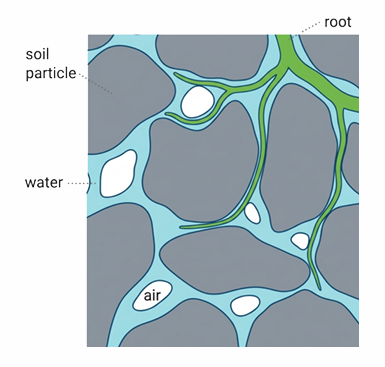
rock and soil contains air as well as water in its pores
important capacity to distribute the incoming flux of precipitation into 3 outgoing fluxes: overland flow, recharge & evapo(transpi)ration + provides water storage capacity

Soil
most active part of the unsaturated zone
Formed by both:
disintegration and decomposition of rocks by physical and chemical processes
activity and accumulation of residues of numerous plants and animals
→ is a complex mixture of solids (rock + organic material), liquids and gases
Density of solids (Soil Hydrophysical properties)

Dry bulk density (Soil Hydrophysical properties)

Total bulk density (Soil Hydrophysical properties)

Porosity (Soil Hydrophysical properties)

Void ratio (Soil Hydrophysical properties)

Interrelating formula (Soil Hydrophysical properties)

Volumetric moisture content
apply to soil & underlying (unconsolidated & consolidated sediments & rocks)

Gravimetric moisture content
apply to soil & underlying (unconsolidated & consolidated sediments & rocks)

Interrelating water / moisture content formula
apply to soil & underlying (unconsolidated & consolidated sediments & rocks)

Types of porosity
structure determines porosity & other hydraulic properties

Categories of hydraulic properties
physical properties = easy to obtain → need soil hydraulic properties to understand movement and storage of water & solutes
2 categories:
Storage
Transmission
Storage
the soil moisture characteristic, 𝜃(𝜓)
→ how much water the soil holds at a given matric potential; also called the water retention curve
𝜃 = volumetric moisture content
𝐾 = hydraulic conductivity
𝜓 = the matric potential (< 0) or matric suction (> 0)
Transmission
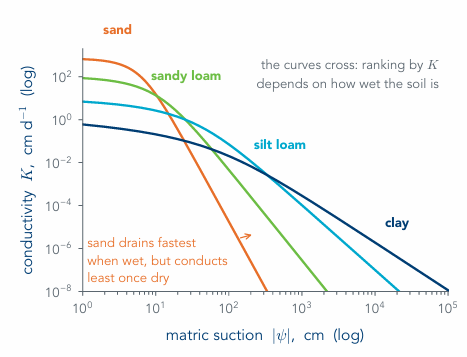
the hydraulic conductivity function, 𝐾(𝜓)
how readily the soil passes water at a given matric potential; it falls steeply as the soil dries
𝜃 = volumetric moisture content
𝐾 = hydraulic conductivity
𝜓 = the matric potential (< 0) or matric suction (> 0)
Energy of water in the soil
fluid potential for flow through porous media = mechanical energy per unit mass of fluid
Water flows region of high potential → low potential
In soil → determined by potential, kinetic and elastic energy
In unsaturated zone → kinetic & elastic energy can be neglected.
Forces that determine potential energy
Capillarity
a result of the surface tension at the interface between soil air, soil water and solids
Adsorption
on the surfaces of soil particles, due to electrostatic forces attaching the polar water molecules to the charged faces of the solids
Osmosis
from solutes in the water - much less important, but can matter (e.g. saline water around roots)
Gravity
Soil water potential
potential energy of soil water relative to water in a standard reference state
(determined by combination of capillary, adsorption, osmosis & gravity)
Capillarity
definition
formula
Tendency of a liquid in a capillary tube to rise or fall as a result of differences in surface tension between the solid/liquid and the solid/gas interface.
Most solids: solid/water interface surface tension < solid/air interface → water is “pulled up” against gravity

Soil matric potential
Potential energy of water related to capillary retention pm Pa[𝑀𝐿−1𝑇−2].
also expressed as head of water m [L]
Soil pore spaces = analogous to capillary tubes → soil retains water against the force of gravity
Effect decreases rapidly w/ increasing radius → water is retained more strongly in small pores than in large ones
Pressure head associated w/ capillarity is always negative relative to the reference position outside the soil → can be referred to as matric suction (> 0)
![<p>Potential energy of water related to capillary retention p<sub>m</sub> Pa[𝑀𝐿<sup>−1</sup>𝑇<sup>−2</sup>].</p><ul><li><p>also expressed as head of water m [L]</p></li></ul><p></p><p>Soil pore spaces = analogous to capillary tubes → soil retains water against the force of gravity</p><p>Effect decreases rapidly w/ increasing radius → water is retained more strongly in small pores than in large ones</p><p></p><p>Pressure head associated w/ capillarity is always negative relative to the reference position outside the soil → can be referred to as matric suction (> 0)</p>](https://assets.knowt.com/user-attachments/89d1fd9a-4ce1-414b-a58c-5d2b29b641ab.png)
Soil moisture characteristic (= water retention curve)
Empirical relation between 𝜓 (a function of the soil pore size distribution) & volumetric water content 𝜃.

Wilting point
the maximum suction that plants can apply to extract water from the soil (around 15 bar or 15000 cm)
Field capacity
excess water has drained away; beyond this point the soil will not drain further because retention forces exceed the gravitational force (0.33 bar or 330 cm)
Saturation point
The maximum soil water content; all pores are filled (0 bar or 0 cm).
Matric suction = 0
the soil is completely saturated (e.g. after a rain event) → the soil volume is entirely filled with water and solids.
External force is applied → air gradually replaces the water
water w/ the lowest retention (in the largest pores) is released first
Movement of soil water
Soil water moves from regions of high total potential → regions of lower potential
Driving force = gravity while water is retained by the matric potential
Hydraulic head
Potential mechanical energy per unit weight of fluid relative to a datum.
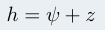
Darcy’s law, unsaturated
hydraulic head related to flux of water through the soil
where 𝐾(𝜃) is the hydraulic conductivity [𝐿𝑇−1]
∇ℎ the hydraulic head gradient in three dimensions
In saturated conditions → 𝐾(𝜃) = the saturated conductivity 𝐾𝑠
At the soil surface → is the soil’s infiltration capacity
𝑞 is a flux through bulk area, not the speed of the water: the water itself moves faster, 𝑣𝑝 = 𝑞/𝑛e
![<p>hydraulic head related to flux of water through the soil</p><p></p><p>where 𝐾(𝜃) is the hydraulic conductivity [𝐿𝑇−1] </p><p>∇ℎ the hydraulic head gradient in three dimensions</p><p></p><p>In saturated conditions → 𝐾(𝜃) = the saturated conductivity 𝐾<sub>𝑠</sub></p><p>At the soil surface → is the soil’s infiltration capacity</p><p></p><p>𝑞 is a flux through bulk area, not the speed of the water: the water itself moves faster, 𝑣<sub>𝑝</sub> = 𝑞/𝑛<sub>e</sub></p>](https://assets.knowt.com/user-attachments/1be98e2d-90dd-468f-92ec-0fba200816c0.png)
Hydraulic conductivity & matric potential
water moves quicker through larger pores than smaller pores
suction applied → larger pores empty first → forces water to flow through smaller pores
shape of curve depends on pore distribution → sandy soils usually have larger pores than clayey soils therefore higher conductivity near saturation
curve is empirical → can’t be derived analytically
Macroscopic implications
Flow in the unsaturated zone = predominantly vertical under the influence of gravity → recharges the saturated zone, causing the water table (= phreatic surface) to move
→ may cause pressure gradients which force water to flow horizontally

Generation of overland flow
No overland flow
Infiltration-excess: rainfall intensity i > infiltration capacity f
Saturation-excess: rain falls on the ground already saturated from below

Contribution to stormflow & baseflow
quickflow = rainfall slides over ground
baseflow = rainfall infiltrates

Model of the unsaturated zone

Gravimetric determination (Measuring of soil water)
a soil sample of known volume (𝑉𝑇) is removed from the ground w/ a soil auger
sample is weighed (𝑀𝑇)
sample is then dried in an oven w/ the temperature controlled between 100 and 110∘C until the final weight (𝑀𝑆) is constant
calculate 𝜃G
calculate dry bulk density 𝜌𝑑 = 𝑀𝑆 / 𝑉T
knowing pw (1gcm-3) volumetric water content 𝜃 can be calculated

Time domain reflectometry (TDR)
originally developed to detect faults in electric cables → now a widely applied method to measure soil moisture
dielectric constant of soil depends strongly on its water content ← is determined from the travel time of an electromagnetic wave along two or more parallel metal rods in the soil
main advantage = TDR already integrates 𝜃 over the length of the probe
Field methods
Experimental design to measure overland flow as a proportion of precipitation.
Vertical plates isolate a plot so that neither overland nor subsurface flow enters it from outside
Gutters at the foot collect what leaves it