Rawls's Theory of Justice and the Veil of Ignorance
 Call Kai
 Learn
 Practice Test
 Spaced Repetition
 Match
 Flashcards
 Knowt Play
1/13

Earn XP
Description and Tags
Vocabulary practice flashcards covering John Rawls's liberal theory of justice, the two principles of justice, basic liberties, the maximin rule, critiques of utilitarianism, and the Veil of Ignorance (§24).
14 Terms
Society (Rawls)
A cooperative venture for mutual benefit in which rules and constitutional structures are largely obeyed because participation benefits members and is shared among others.
Social contract
A hypothetical scenario used to determine justice by asking what principles people would choose to implement and not implement if society were to start from scratch.
Basic structure
The system that determines how rights and duties are assigned and how social benefits are distributed across society.
Veil of ignorance
A hypothetical condition where individuals do not know their position in society, preventing personal bias and the influence of arbitrary luck so principles benefit everyone.
First principle of justice
The principle stating that each person is to have an equal right to the most extensive scheme of equal basic liberties compatible with a similar scheme with liberty for others
Second principle of justice
The principle stating that social and economic inequalities must be arranged so that they are reasonably expected to be to everyone's advantage and attached to positions and offices open to all.
Basic liberties
The set of liberties distributed equally under Rawls's theory, comprising political liberty, freedom of speech and assembly, liberty of conscience and freedom of thought, freedom of the person, personal property rights, and freedom from arbitrary arrest and seizure.
Priority of principles
Rawls's rule of order stipulating that the first principle of justice (equal basic liberties) must be prioritized over the second principle of justice.
Permissible inequalities
Unequal distributions (such as of wealth or authority) that are morally justified only if they benefit everyone, specifically the least advantaged people in society.
Utilitarianism (Rawls's critique)
A theory criticized by Rawls because it aggregates costs and benefits rather than considering distribution, ignores arbitrary luck, and allows basic liberties to be sacrificed for aggregate welfare.
Maximin rule
A decision-making rule based on choosing the least bad option among available alternatives.
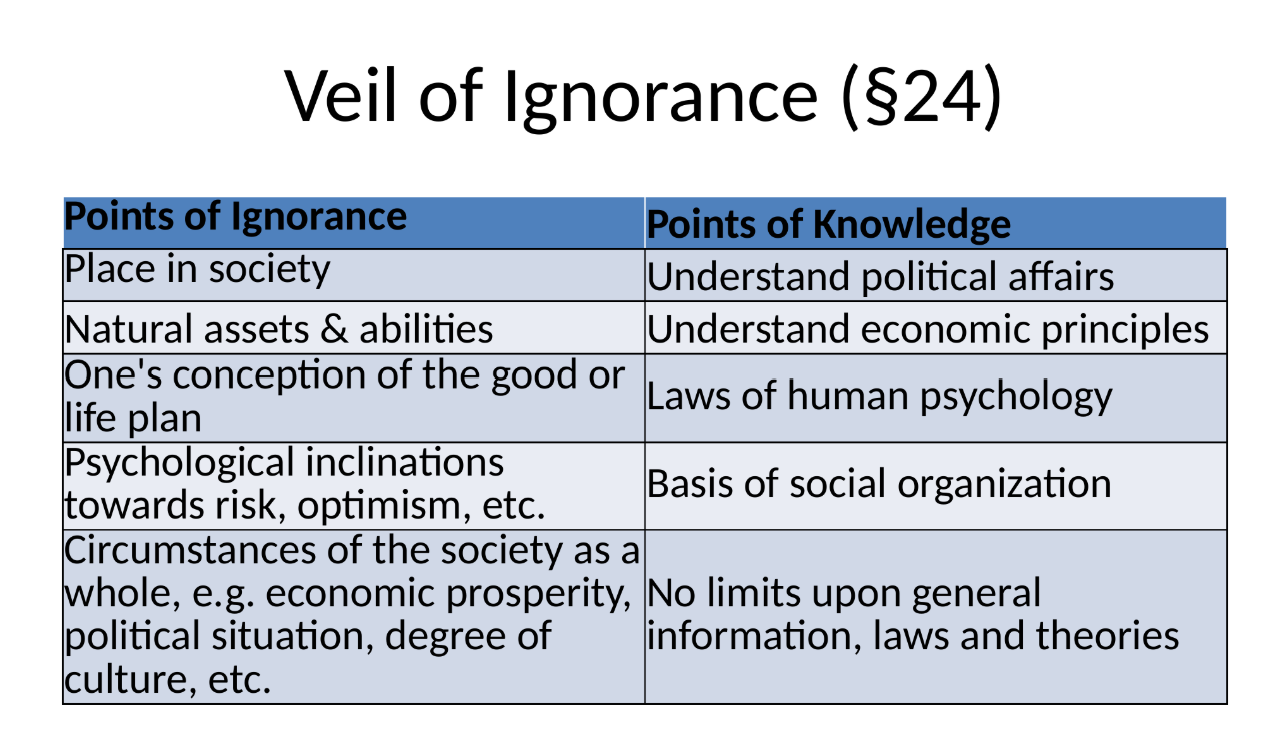
Points of Ignorance (§24)
The specific conditions obscured behind the veil of ignorance: place in society, natural assets and abilities, one's conception of the good or life plan, psychological inclinations, and the circumstances of society as a whole.
Points of Knowledge (§24)
The general facts known behind the veil of ignorance: understanding of political affairs, economic principles, laws of human psychology, the basis of social organization, and general information, laws, and theories.
Veil of Ignorance (§24) division
The explicit division established by Rawls between unknown particular facts about oneself and society (Points of Ignorance) and known general principles and laws (Points of Knowledge).