Calc 3 Midterm #3
 Call Kai
 Learn
 Practice Test
 Spaced Repetition
 Match
 Flashcards
 Knowt Play
1/25

There's no tags or description
Looks like no tags are added yet.
26 Terms
Multivariable Chain Rule for Single Independent Variable (t)
For w = f(x, y, z) where x = x(t), y = y(t), and z = z(t):

Multivariable Chain Rule for Two Intermediate & Two Independent Variables
z = f(x, y) where x = x(s, t) and y = y(s, t):

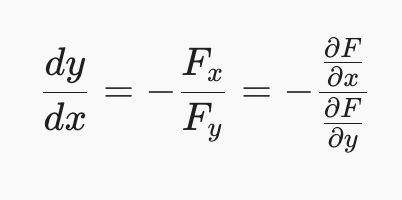
Implicit Differentiation Formulas
Two variables (F(x, y) = 0):
dy/dx=
Implicit Differentiation Formulas
Two variables (F(x, y,z) = 0):


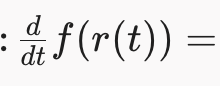
it measures the rate of change of ____along the direction __
if given θ not u, then u=

f (x, y ) , u
<cos θ, sin θ>



∇f and u have the same direction.

∇f and u have the opp direction


∇f and u are ____
But this also means u is ____ to a level set of f (x, y)
perp, tangent

Draw an arrow ____ to the level curve at the given point, pointing toward level curves with ___ values of f.
perp, larger





View the graph as the 0-level set of F(x, y, z) = ____= 0, which gives normal vector ∇F = ____
f(x, y) - z, <fx, fy, -1>
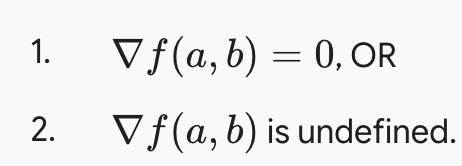
If f(x, y) has a local maximum or minimum at (a, b), what must be true about its partial derivatives, gradient, and tangent plane?

a critical point (or stationary point) of f(x, y) occurs where either ____ or ____
What is the formula for the discriminant D in the Second Derivative Test for f(x, y) at a critical point (a, b)?

How do you classify a critical point (a,b) using the Second Derivative Test?
if D__0 and fxx(a,b)__0 (or fyy(a,b)__0): f(a,b) is local min
if D__0 and fxx(a,b)__0 (or fyy(a,b)__0): f(a,b) is local max
if D__0, f(a,b) is a saddle point
D__0: test is inconclusive:
>, >
>, <
<
=
In r2,
___ set: A set that contains all of its boundary points.
___ set: A set that can be contained within a disk.
____ set: A set that is both closed and bounded.
closed, bounded, compact
Extreme Value Theorem: If f is ___ on a ____ set D in R2 (or Rn), then f attains both an _____ and an _____ on D
cont, compact, absolute maximum, absolute min
Steps to find the absolute maximum and minimum of a continuous function f on a closed and bounded set D:
Find the values of ___ at the _____ of f inside D.
Find the ___ values of f on the ____ of D
Compare all values from Steps 1 and 2: the largest is the absolute maximum value, and the smallest is the absolute minimum value
f, critical pts
extreme, boundary
How do you find extreme values of a 2-variable function f(x, y) along the boundary?
Break the boundary into individual pieces, then parameterize or substitute each piece.
Horizontal/vertical lines: Plug in the ____ coordinate (e.g., y=0 → g(x) = ___
Slanted lines: Solve for one variable and substitute (e.g., y = mx + b → g(x) = ____
For each piece g(t) on [a, b], evaluate g(t) at all interior ____ (where ____) and at the ____ t = a, b (the corners)
Compare all candidates
constant, f(x, 0)
f(x, mx + b)
critical pts, g’t = 0 or und, endpoints
finding and classifying critical pts as local min, local max, saddle pt
set fx = 0 and fy = 0
list out all ____
solve for formulas for fxx, fyy, fxy, and D
at each crit pt, in a table, evaluate ___, ___, & classify
critical points
D, fxx
How do you distinguish a local maximum, local minimum, and saddle point from a contour map (level curves)?
Local Maximum: _____ where contour values ____ as you move inward toward the center.
Local Minimum: ______ where contour values ____ as you move inward toward the center.
Saddle Point: A single level curve crossing itself in an "___" shape. Move ___ from pt increases f in two ____ directions and decreases f in the ____ directions
Concentric closed loops, inc
Concentric closed loops, dec
X, away, opp, perp
What is a constrained local max/min of f(x,y) on a constrained set g(x,y)=k (or C)
A point (a,b) on C where f(x,y) __/__ f(a,b) for all (x,y) lying on C and near (a,b). (Note: Constrained extrema do not have to be unconstrained critical points of f.)
≤/≥
Method of Lagrange Multipliers for one constraint g(x,y)=k
Find all values of (x,y) (and λ) satisfying either:
_____ and ______
_____ and ______
Evaluate ___ at all points found in Step 1. Largest value = max, and smallest value = min
∇g = 0 and g = k
∇f=λ∇g and g=k
f
What are all three cases to check when solving a two-constraint Lagrange Multiplier problem (g=k and h=l)
_____ , _____ ,and ______
_____ , _____ ,and ______
_____ , _____ ,and ______
∇g = 0, g = k, & h=l
∇h = 0, g = k, & h=l
∇f=λ∇g +u∇h, g=k, & h=l
Find extreme values on "exotic" boundary defined by multiple inequalities (e.g., x^2+y^2 ≤ 9, y ≥1)
Break boundary into smaller pieces by replacing one or more ____ w/ ___, then apply _____ (or direct evaluation if piece consists of a few corner/intersection points) to each piece
eg. x^2+y^2 ≤ 9 & y =1 (lagrange), x^2+y^2 = 9 (lagrange) & y ≥1, and x^2+y^2 = 9 & y=1 (intersection pts)
inequalities, equalities, Lagrange multipliers