Biodiversity Quiz 2
 Call Kai
 Learn
 Practice Test
 Spaced Repetition
 Match
 Flashcards
 Knowt Play
1/41

There's no tags or description
Looks like no tags are added yet.
42 Terms
Evolutionary milestones
true tisue
body symmetry
protosome & deuterostome development
Body symmetry
Radial
2 germ layers
endoerm & endoderm
Bilateral
3 germ layers
most have heads & show cephalization
have distinct anterior/posterior & dorsal/ventral sides
Body cavity function
hydrostatic skeleton: provides support for body and muscles push against it to move
protective buffer: fluid cushions internal organs
independent organ movement: gut and heart can move without being affected by body-wall movement
Body cavity types
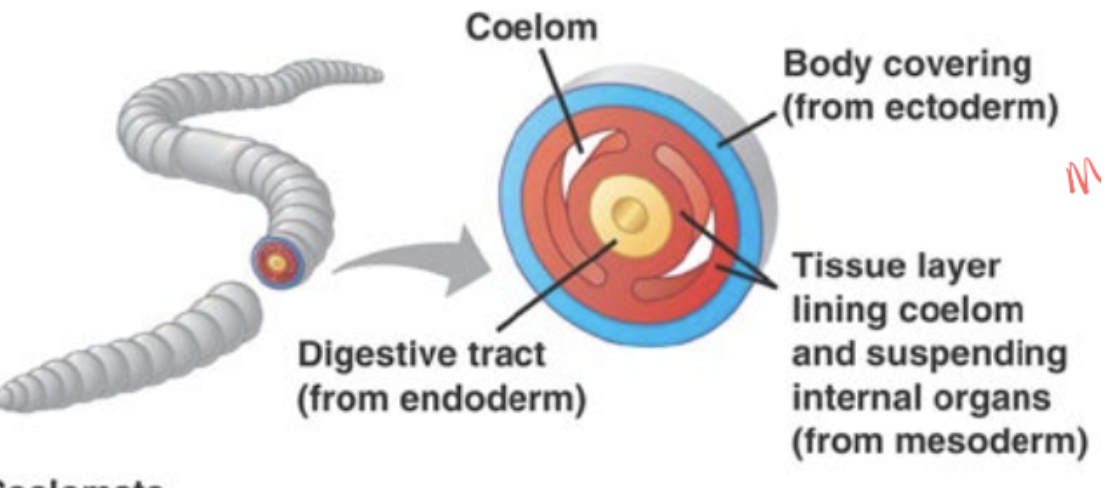
fluid-filled space completely lined with mesoderm
annelids, arthopods, molluscs, echinoderms, chordates
Pseudocoelomates
fluid-filled body cavity only partly lined with mesoderm (lines body wall but not gut)
Nematodes, rotifers

Acoelomates
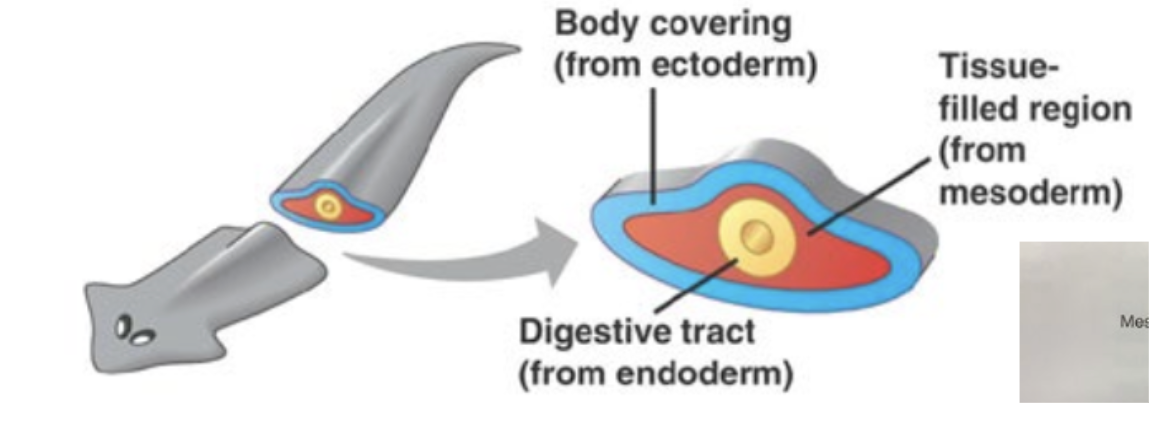
no body cavity
solid tissue fills space between gut & body wall
flatworms'
Protosome development
spiral cleavage
determinate (each cell will develop into something)
mesoderm splits to form coelom
blastopore forms mouth
nematodes, arthropods, annelids, molluscs
Deuterostome development
radial cleavage
indeterminate
archenteron pinches off to form coelom
blastopore forms anus
echinoderms, chordates
Sponges
no true tissues/organs
free-swimming larvae → sessile adults
asexual & sexual reproduction
sponge spicules
form internal skeletons
sponge collar cells (choanocytes)
line gastrovascular cavity & capture food
sponge amoebocytes
motile cells in mesohyl
digest & distribute food
produce reproductive cells
secrete spicules
sponge porocytes
contract to control water flow
Sponge feeding process
water enters through porocytes → flow through spongocoel (central cavity) → leaves through osculum
Choanocytes beat flagella to pull water through sponge
As water passes through, food particles get trapped in microvilli around flagellum & cell engulfs them through phagocytosis
Amoebocytes carry nutrients to other cells
Cnidarians
no brain, few/no true organs
non-coelomate (only have 2 layers)
nematocysts inside cnidocytes paralyze prey
Platyhelminthes
bilateral symmetry
acoelomate
have organs but no respiratory and circulatory system
No circulatory system: digestive system allows exchange of materials by diffusion
No respiratory system: gas exchange by diffusion
Platyhelminthes excretory system
flame cells remove waste through filtration
cilia propel waste down tubules & out of body through excretory pores
Platyhelminthes digestive system
extracellular breakdown by proteolytic enzymes
suck small pieces into intestine
phagocytic cells complete digestion intracellularly
Planaria
type of flatworm
ability to regenerate from stem cells called blastema
can only be 279 pieces
Annelids
segmented
coelomates
closed circulatory system
Annelids movement process
bristles anchor onto surface
longitudinal muscle relaxed & circular muscle contracted → forward segment narrows and pushes head forward
circular muscle relaxed & longitudinal muscle contracted → pull front segment into fatter shape and front bristles grip ground
pull rear end to anchored front end
Annelid nervous system
simple brain
each segment has two ganglia so each segment can make own decisions (can make more fine-tune movements compared to flatworms)
Annelid clitellum
only present when mature
functions:
collect eggs and sperm and secrete cocoon to protect fertilized egg inside (not for copulation but important for reproduction)
secrete mucus for gas exchange to keep body moist
sexual and asexual (but not main method)
Mollusks
bilateral
coelomates
open circulatory system
mantle cavity: space between mantle & visceral mass (usually houses respiratory organs)
3 classes of molluscs
gastropods: feed using radula
bivalves
cephalopods: only molluscs with closed circulatory system to meet oxygen requirements for being predator
Echinoderms
larvae are bilateral symmetry
adults are pentaradial symmetry
deuterostome
coelomates
no circulatory system
Water-vascular system process
water enters sieve plate and into radial canal to fill ampulla
ampulla contracts → water enters podium
podium relaxes → can elongate and hold prey
podium secrete adhesive proteins to attach to prey/substrate
secrete another protein to detach from prey/substrate
podium contracts and ampulla relaxes so water enters again
Water-vascular system functions
feeding
respiration
locomotion
Arthropods
bilateral symmetry
coelomates
segmented
Head: feeding & sensing environment
Thorax: structures for locomotion
Abdomen: internal digestive & reproductive organs
open circulatory system
Arthropods respiratory system
air enters spiracles
air transported through trachea
main trachea splits into tracheoles → diffusion of oxygen into muscle fibers
Arthropod open circulatory system
not for gas exchange, for transport of nutrients
heart contracts → hemolymph enters ostium
hemolymph goes from posterior to anterior end to keep circulation (even in wings & antennae)
Arthropod fat body
store and release energy for quick muscle action
stores energy in form of glycogen & triglycerides
important during early stages of insect because production of vitellogenin (yolk protein) needed for development of oocytes
Why are insects so successful?
only flying invertebrates
enables rapid escape from predators + locate widely dispersed food sources
Metamorphosis types
complete
egg → larvae → pupa → adult
advantage: feed on different foods at different life stage = less competition between stages
disadvantage: larva is defenseless
incomplete
egg → nymph → adult
advantage: nymph independent after hatching
disadvantage: direct competition between nymphs and adults
Chordate key features
notochord
derived from mesoderm
first axial support structure to form in embryo
replaced by vertebral column during development in most vertebrates
in humans, become spinal discs
below dorsal nerve cord
dorsal nerve cord
develops into brain & vertebrae (front end enlarges to form brain, rest becomes spinal cord)
in humans, only structure to stay in original form
pharyngeal gill slits
adapted to filter feeding/gills
post-anal tail
provides motility in tunicate larvae
in humans, become coccyx
3 clades of chordates
tunicates
lancelets
craniates
tunicates
sea squirts & sea salps
use tail muscles & notochord to swim & attach to suitable site → undergo metamorphosis into adult
adults lose tail, nerve cord, notochord
craniates
chordates with skull that protects brain
includes myxini and vertebrates
most vertebrates: notochord replaced by backbone
in hagfish & lampreys: notochord stays as main support
myxini
not true vertebrates but have simple braincase made of cartilage
no jaws
defense mechanism: mucus makes slime that absorbs water and solidifies quickly so predators cannot close mouth & eat them
Vertebrate adaptations
internal skeleton: large, more mobile bodies
jaws: wider range of food sources
paired appendages: move to land & air
larger brain & better sense: respond in more flexible ways
Reptiles 3 key features that allow them to live & breed on land
waterproof scaly skin
internal fertilization
shelled amniotic egg
Circulatory system of amphibians, reptiles, mammals & birds
3 chambered heart
no separation between oxygenated & deoxygenated blood
modified 3 chambered heart
incomplete septum: has some separation between oxygenated & deoxygenated blood to meet oxygen demands for reptiles
cardiac shunt: circulation bypasses pulmonary circuit if oxygen is low and circulates within systematic circuit to salvage oxygen available (saves energy)
4 chambered heart
alligators, crocodiles, mammals, birds
septum for separation of oxygenated & deoxygenated blood