Lecture 9: Week 8: Disproportionate Minority Contact
 Call Kai
 Learn
Learn Practice Test
 Spaced Repetition
 Match
Match Flashcards
 Knowt Play
1/24

There's no tags or description
Looks like no tags are added yet.
Name | Mastery | Learn | Test | Matching | Spaced | Call with Kai | Chat |
|---|
No analytics yet
Send a link to your students to track their progress
25 Terms
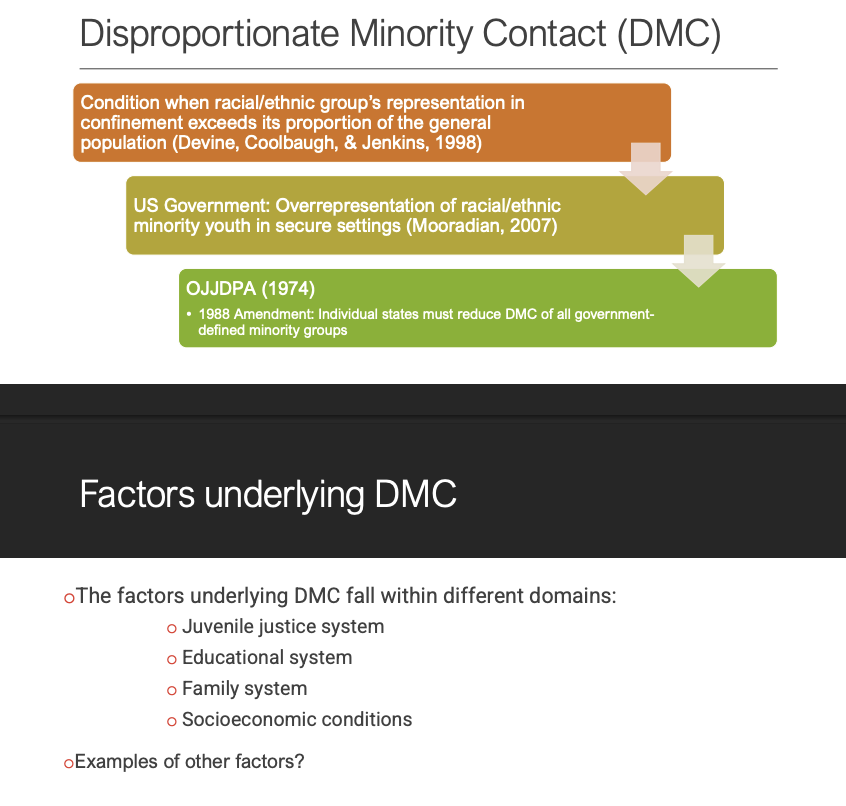
What is Disproportionate Minority Contact (DMC)? (Fully explain)
DMC is the condition where a racial/ethnic group’s representation in confinement (or justice-system involvement) exceeds its proportion in the general population—meaning minority youth show up in secure settings at higher rates than expected given population size.
This phenomenon highlights systemic inequalities and biases in the criminal justice system that disproportionately affect minority youth.

What type of condition is DMC?
A disproportionality/overrepresentation condition—a population-level imbalance where justice involvement doesn’t match population proportions.
This condition often stems from systemic biases in arrest, detention, and sentencing practices.

How does DMC “look” in U.S. government framing?
The U.S. government describes it as overrepresentation of racial/ethnic minority youth in secure settings.
This framing indicates that these youths are incarcerated at rates higher than their demographic makeup in the overall population, reflecting systemic issues within the justice system.

What is the OJJDPA’s role in DMC?
The OJJDPA (1974) addressed juvenile justice standards, and the 1988 Amendment required states to work to reduce DMC for all government-defined minority groups.
The OJJDP Act aims to promote fair treatment and equal justice for minority youth in the juvenile justice system, encouraging states to implement measures and strategies to decrease disproportionate minority contact.

What are the factors underlying DMC (and what do they mean)?
The slide groups causes into domains:
Juvenile justice system (policing, decisions, practices)
Educational system (discipline, labeling, school pushout)
Family system (child welfare/CPS and foster care pathways)
Socioeconomic conditions (poverty, resource access, structural inequality)
These domains create unequal pathways into justice involvement.
The factors underlying DMC include systemic issues within the juvenile justice system, educational inequities, family dynamics, and socioeconomic disparities that collectively disproportionately affect minority youth.
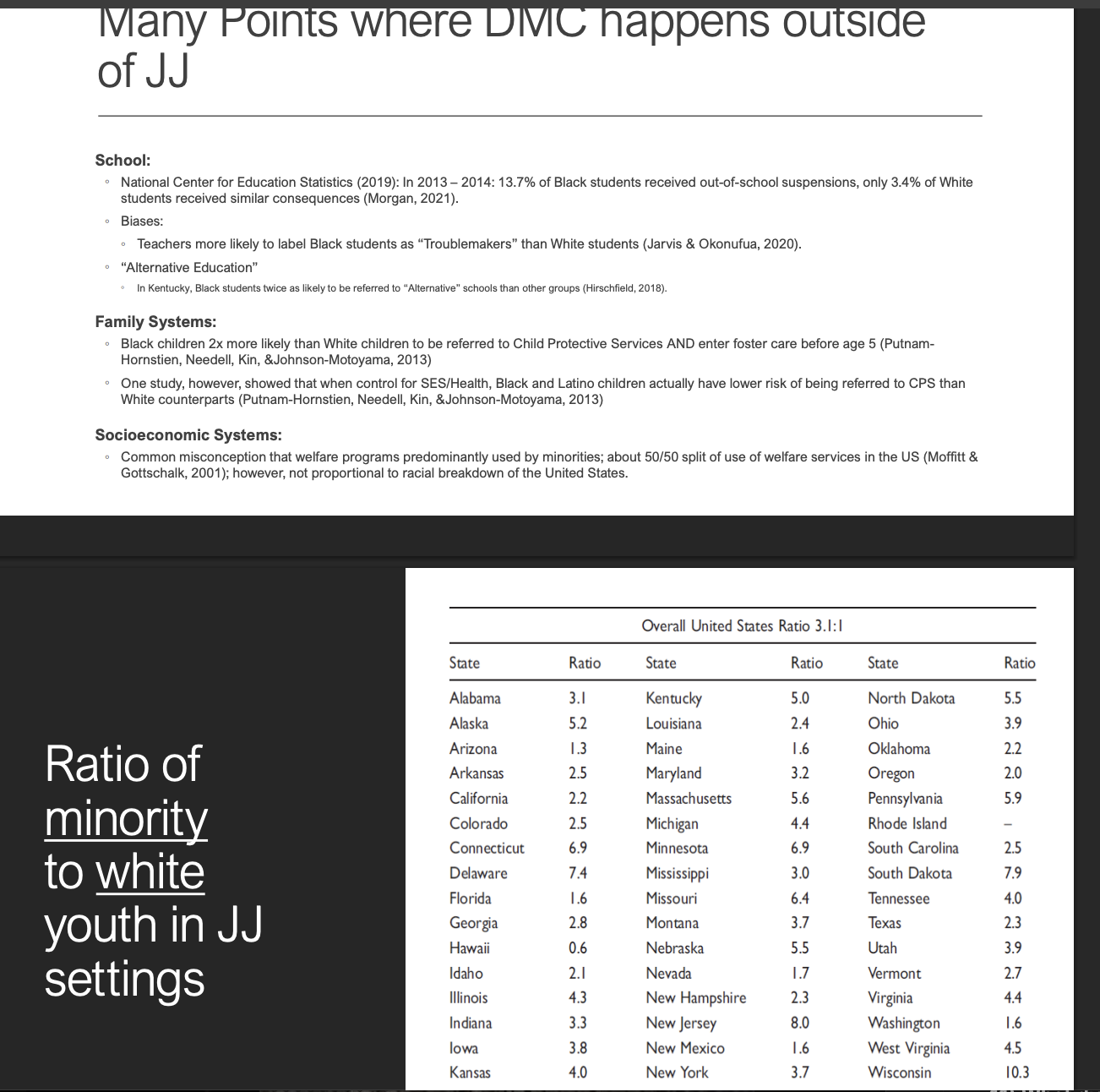
What are the three different points where DMC happens outside of juvenile justice?
School, Family systems, Socioeconomic systems—each can increase system contact and amplify disparities before youth ever reach juvenile court.
These points represent early intervention areas where disparities can begin, leading to increased contact with the justice system.
Explain the school point where DMC happens outside of juvenile justice.
Schools discipline Black youth more harshly: in 2013–2014, 13.7% of Black students received out-of-school suspensions vs 3.4% of White students, increasing exclusion from school and risk of justice contact.
This harsher discipline leads to a higher likelihood of disciplinary measures that funnel Black youth into the juvenile justice system, showcasing systemic racial biases in school policies.

What are “biases” in the school point of DMC?
Teachers are more likely to label Black students as “troublemakers” than White students—bias in perception/discipline contributes to unequal consequences.
This bias manifests through harsher disciplinary actions, contributing to a school-to-prison pipeline that disproportionately affects Black youth.

What role does “alternative education” play in school-based DMC?
Black students can be pushed into “alternative” schools at higher rates—example: in Kentucky, Black students were twice as likely to be referred to alternative schools, which can intensify exclusion and stigma.
These alternative schools often have fewer resources and less supervision, which can lead to increased dropout rates and a higher risk of entering the juvenile justice system.

Explain the family system point where DMC happens outside of juvenile justice.
Child welfare involvement differs by race: Black children are 2x more likely than White children to be referred to CPS and enter foster care before age 5—creating pathways that raise later justice-system contact risk.
This overrepresentation in child welfare can stem from systemic issues such as poverty and bias in reporting, which disproportionately affect Black families and lead to greater scrutiny and disruption.

What was shown by the study in the family system point (and why is it important)?
One study found that when controlling for SES/health, Black and Latino children actually had lower risk of being referred to CPS than White children—showing raw disparity numbers can reflect confounding factors and system context, not just race alone.
This finding suggests that systemic biases may contribute more to disparities in CPS referrals than inherent differences in behavior or risk factors.

Explain the socioeconomic systems point where DMC happens outside juvenile justice.
Socioeconomic conditions shape exposure to risk, surveillance, and system contact. The slide highlights that public beliefs about welfare use can be inaccurate and tied to stereotypes that affect policy and enforcement.
Lower-income communities often experience higher rates of police presence and intervention, leading to increased juvenile justice contact for marginalized groups. Economic disparities contribute to a higher likelihood of DMC due to biased perceptions of crime linked to poverty.
What is the common misconception in the socioeconomic systems point of DMC?
The misconception is that welfare programs are predominantly used by minorities. The slide states use is about a 50/50 split in the U.S., though still not proportional to the nation’s racial breakdown.
This belief overlooks the fact that welfare systems serve diverse populations and can perpetuate stereotypes about race and poverty.

What is the ratio of minority to White youth in juvenile justice settings (overall U.S.)?
Overall U.S. ratio: 3.1 : 1 (minority youth to White youth in JJ settings).
This means that for every White youth in the juvenile justice system, there are approximately 3.1 minority youth, indicating significant disparities in youth incarceration rates.

What does the slide show about overrepresentation of African American youth in the juvenile justice system?
The percentage of African American youth increases at deeper system points (from population → arrests → adjudications → out-of-home placements), showing disparity grows as youth move through the system.
The slide illustrates that African American youth face escalating overrepresentation at each stage of the juvenile justice system, from initial population statistics to arrests and further into adjudications and out-of-home placements, indicating that systemic biases intensify throughout the process.

What are “Indirect Race Effects”?
The idea that race is associated with other factors that influence justice involvement, meaning race differences can partly reflect confounded variables that correlate with race due to structural inequality.
This concept involves socio-economic factors, cultural contexts, and community resources that disproportionately affect different racial groups within the justice system.

What are the confounding variables listed under “Indirect Race Effects”?
Poverty, family structure (single parent), low academic achievement, exposure to violence. These factors are correlated with both race and justice contact, complicating simple cause claims.
These confounding variables include socioeconomic status, family composition, educational attainment, and experiences of community violence.

How did they begin enacting change in the early 2000s/2010s (and why)?
Multidisciplinary groups formed to create “systems-level” changes, and government funding was tied to reducing DMC—pushing jurisdictions to attempt measurable disparity reductions.
These initiatives aimed to address root causes of overrepresentation and sought to implement more equitable practices in the juvenile justice system.

What are examples of how they began enacting change in the early 2000s/2010s?
Examples included efforts like Alameda County (Oakland area) initiatives and police training programs (e.g., Gainesville, Florida) focused on addressing DMC through policy/practice reforms.
Additionally, programs aimed at community engagement and collaboration between agencies were implemented to improve outcomes for minority youth.

Alameda County (Oakland area): how is it an example of enacting change for DMC?
It’s a cited systems-level reform effort aimed at reducing DMC, used as a model example in the early reform era.
This initiative focused on improving community policing strategies, enhancing collaboration with schools and social services, and engaging community members in reform discussions.

How was police training used as an enacting-change strategy for DMC?
Training packages were created for law enforcement to address disproportionate minority contacts—aiming to reduce bias and improve decision-making at points of contact.
These programs emphasized community interaction, cultural competence, and understanding the impact of biases on policing practices.

Did attempts to enact change work? Fully explain.
Mixed results. Some areas saw small improvements, but other disparity indicators worsened or stayed. The slide emphasizes that effectiveness varied by measure and group.
All efforts were not uniformly successful, highlighting ongoing challenges in achieving equity in treatment and outcomes for minority youth.

What happened in Alameda County according to the “Did it work?” slide?
Reports showed small decreases in arrest rates for Latino/Asian youth and institutional commitments for Black youth, but in-custody holds for detention hearings increased across every ethnic group among youth of color.
Overall, while there were some positive outcomes in arrest rates, the increases in detention hearing holds highlighted persistent issues in the system.

What does “the pendulum swings” mean here (2018 mandate change)?
In 2018, the mandate language changed: states had more discretion to “address” disparities and no longer had to reduce proportions/decrease numbers—a policy shift away from strict reduction requirements.
This phrase suggests that approaches to legislative mandates can oscillate between strict regulations and more flexible interpretations, reflecting changes in policy and focus on disparities.

What are some fixes to DMC mentioned on the slide? (Fully explain)
Human Rights Approach (Mooradian, 2010): treat racial/ethnic disparities as a rights issue, not just technical reform.
Collective responsibility for offender behaviors: community/shared systems responsibility rather than blaming individuals alone.
Challenge the expert/exclusionary process: don’t “privilege” only official voices—include voices of those most impacted.
Strengths-based/asset-building activities: focus on building community supports and youth strengths rather than only surveillance/punishment.
These approaches aim to address Disproportionate Minority Contact (DMC) by emphasizing human rights, collective community accountability, inclusion of diverse perspectives, and the promotion of strengths-based strategies.
