Pharmacology Exam 1
 Call Kai
 Learn
 Practice Test
 Spaced Repetition
 Match
 Flashcards
 Knowt Play
1/85

Earn XP
Description and Tags
Lectures 1, 2, & 3
86 Terms
Definition of Drug:
any chemical that can affect living processes
Definition of Pharmacology
The study of drugs and their interactions with living systems, the physical and chemical properties of drugs, as well as their biochemical and physiologic effects.
What are the three characteristics of an “ideal drug” and their definitions?
EFFECTIVENESS: the drug's ability to produce the desired therapeutic effect or response when administered
SAFETY: a drug that cannot produce harmful effects, even if administered in very high doses and for a very long time All drugs have the ability to cause injury
SELECTIVITY: elicits only the response for which it is given. No No drug is wholly selective - all drugs cause side effects
What are some additional properties of an ideal drug?
reversible action, predictability, ease of administration, free of drug interactions, & low cost
What is the therapeutic objective of drug therapy?
To provide MAXIMUM benefit with MINIMUM harm
What is the most common pharmaceutical administered?
Over the Counter (OTC) drugs take up 60% of all drugs administered
What are the three types of drug names?
chemical: N-acetyl-para-aminophenol, generic: aceteminophen, brand name: Tylenol
What are the factors that determine the intensity of drug responses?
Administration (route determines absorbance, med errors), Pharmacokinetics (concentration at site of action, many variables), and Pharmacodynamics (drug-receptor interaction)
What is the most reliable research method for drugs?
randomized controlled trials (however, typically includes a small patient population)
What is pharmacokinetics? What are the 4 stages?
Pharmacokinetics is what the body does and how it interacts with a drug over time. The 4 stages are absorption, distribution, metabolism, and excretion (ADME)

What are the three main factors that affect absorption?
increase of surface area, lipid solubility, pH partitioning
What are coated and modified release drugs?
extended release or long acting oral drugs that contain a coating that gradually releases medication over 12-24 hours. Enteric coated do not dissolve in stomach acid. DO NOT crush or cut these pills
What are the main characteristics of the oral medication route?
FIRST PASS EFFECT, most common route, relatively slow absorption and onset of action, convenient and noninvasive, faster absorption on RIGHT side, liquid form is fastest
When is the oral route not appropriate?
When the patient has nausea/vomiting, decreased gastric/gut mobility, and if the patient is unable to swallow or has a compromised airway (ex: intubated)
What are some characteristics of the transmucosal route?
can be sublingual (under the tongue), buccal (in the cheek), or a nasal/oral spray. NO first pass effect, faster absorption as mucous membranes are highly vascularized, pt must be able to hold tablet in place for several minutes
What are some example of topical routes?
gels/creams/ointments, transdermal patches, aerosol sprays, eye & ear drops, vaginal and rectal suppositories, enemas, and more
What are parental routes of absorption?
IV, IM, SubQ, ID (instant absorption, NO first pass, risk for infection)
What is the distribution of a drug in the body?
transport of a drug to its site of action (rate of delivery depends on amount of blood flow), crossing membrane if needed (lipid-soluble much faster), and the time it takes to reach minimum concentration (determined by rate of absorption)
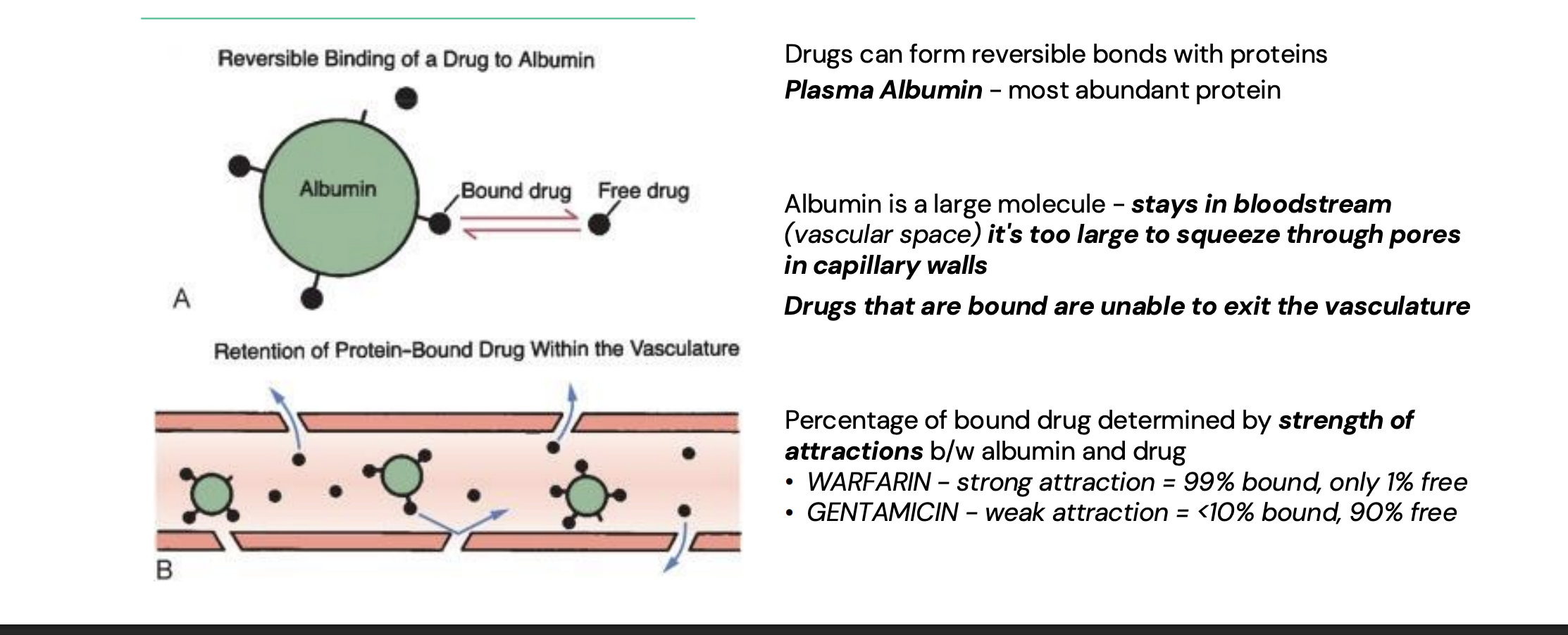
Describe protein binding of a drug
Drugs form a bond with albumin (protein in plasma) that make it UNACTIVE and unable to move out of bloodstream. some drugs are more likely to bind than others and require a higher dose. low albumin levels require a lower dose as there are more “free” or active drugs
What is the blood brain barrier?
Highly selective semipermeable membrane between circulating blood and the brain’s extracellular matrix. Only certain drugs can pass through it to affect the CNS. Helps protect the brain against foreign pathogens, is not well developed at birth and decreases strength with old age)
What is the first pass effect for oral and enteric medications?
When the drug is absorbed from the stomach/intestines into the liver, some portion of the drug is METABOLIZED or inactivated into bile while the rest are passed into systemic circulation. This is why a higher doses of the same drug is required for oral meds than parenteral meds
What affects drug metabolism in the liver?
age (infants and elderly have decreased liver function), induction or inhibits enzymes, nutritional status (malnutrition), and competition between drugs
What organ is primarily in charge of the excretion of medications? What are the steps of filtration?
Occurs in the KIDNEYS.
1.glomular filtration: blood flows and filtration moves drugs from blood to urine (drugs bound to albumin remain behind)
2.passive tubular reabsorption: lipid-soluble drugs are reabsorbed into blood
3.active tubular secretion: tubules actively pump lipid soluble drugs and others back into urine right before excretion

What are important labs that monitor kidney function?
Serum Creatinine (Creat), Blood urea nitrogen (BUN), estimated Glomular Filtration Rate (eGFR) (normal rate is over 90 mL/min and decreases with comorbities), and Creatinine Clearance
What are other ways the body eliminates/excretes drugs besides the kidneys?
The other most common is when drugs are metabolized through the liver in bile and are secreted as feces. Lungs secrete volatile anesthetics (laughing gas), mammary glands can pass medications to infants (especially lipid-soluble drugs)
What is pharmacodynamics? What are two aspects of it?
The study of how the drug affects the body. Maximal efficacy is the largest effect a drug can produce. Relative Potency is the amount of drug given to get the desired response
What is the difference between an agonist and an antagonistic drug?
An agonist drug binds to a receptor and PRODUCES or heightens a response. Antagonists binds to a receptor and BLOCKS natural processes from happening
What is a therapeutic index in pharmacodynamics?
The therapeutic index is a ratio that compares the dose of a drug that causes toxicity to the dose that produces a desired therapeutic effect. The further the effective dose is from a lethal dose, the safer the drug.

What is a drug half life?
The time required for the amount/efficacy of a drug to reach 50%. Differs in each drug, short half life=short dosing interval. (ex: morphine half life is 3 hours regardless of dose=every 3 hour dose)
What are peaks and troughs?
peak is collected (in a steady state after several doses) 30 min after administration and is the highest efficacy of a dose. trough is collected right before next dose is administered and is the lowest concentration of the drug

What are the 5 main rights of medication administration?
Right: patient, time, medication, dose, route
What is the difference between side effects and adverse effects?
Side Effects: expected, non-allergic, dose-dependent, and not life threatening (ex: nausea, drowsiness)
Adverse Effects/Reactions: unintended and undesired effect that occurs at normal doses. Can be mild (rash, itching) or severe (anaphalaxyis, cardiac dysrythmias)
What is a black box warning?
the strongest safety warning that a drug can have and still be on the market. includes the potentially life threatening side effects
What is the grapefruit juice effect? (food-drug interaction)
Grape juice binds to enzymes in the liver (CYP3A) and inhibits metabolism of drugs which increases half life
What is inflammation and the pathophysiology behind it?
Inflammation is the body’s reaction to tissue injury. It occurs when chemical mediators (kinins, histamine, and prostaglandin) are released and initiate inflammation (swelling, redness, pain, heat, and loss of function). Treatment includes analgesics, NSAIDS, and corticosteroids
What are the different chemical mediators of inflammation and their function?
Histamines: dilates arterioles, think allergies
Kinins: increase pain & capillary permeability
Prostaglandins: increase vasodilation, pain, and fever
What is COX (cylclooxygenase) enzyme and its isoforms?
The key enzyme that helps creates prostaglandins
COX-1: “good cox”, maintains gastric mucous, regulates platelets (clotting) and induces vasoconstriction
COX-2: “bad cox”, produces prostaglandins during inflammation and induces pain, swelling, and fever.
What are the inhibition effects of the COX-1 enzyme? (drugs that block cox-1 do what?)
main purpose is to protect against MI, stroke, and DVT and it prevents platelet clotting. harmful effects include gastric erosion/ulcers, increased bleeding risk, and renal impairment. Main example is aspirin (ASA)
What are inhibition effects of the COX-2 enzyme? (drugs that block cox-2 do what?)
suppression of inflammation, pain, and fever. harmful effects include promotion of MI and stroke (as vasodilation of cox-2 is suppressed) and renal impairment. Is the main target enzyme of NSAIDS
What is the difference between a 1st Gen and a 2nd Gen NSAID?
1st Gen is nonselective and inhibits both cox-1 and cox-2: aspirin, ibuprofen (Advil), and naproxen (Aleve).
2nd Gen targets only cox-2: celecoxib (Celebrex)
Is acetaminophen/paracetamol (Tylenol) a 1st Gen or 2nd Gen NSAID?
It is neither as it acts very weakly on any COX. Instead, it acts centrally in the brain to reduce pain and fever. DOES NOT reduce inflammation as COX-2 is not inhibited
Give an overview of Aspirin: indications, adverse effects, contraindications, & therapeutic levels
indications: rheumatoid arthritis, inflammatory conditions, cardiovascular indications (decreases risk of MI)
contraindications: pregnancy (increases risk of hemorrhage), and children (Reye's syndrome)
adverse effects: toxicity, tinnitus, gastric ulcers, renal impairment, and bleeding
therapeutic levels: low for MI/stroke prevention = 81 mg w/ 2 hour half life. high for pain/inflammation = 325-650mg q4h
effects of a single dose PERSISTS for life of platelet= 8 days
What are the main nursing considerations of aspirin?
take with food, full glass of water, & avoid alcohol to reduce GI irritation
Should not be taken with ACE inhibitors and ARBs as all impair renal function
Can heighten the effects of other anticoagulants (warfarin, heparin)
Give an overview of ibuprofen (Advil): indications, adverse effects, drug interactions, and maximum dosage
indications: fever, mild-moderate pain, arthritis
adverse effects: well tolerated, there is no antidote & no protection against MI/stroke (like aspirin), Steven-Johnson Syndrome (severe hypersensitivity)
drug interactions: when taken with SSRIs gastric bleeding is increased
maximum dosing (24hours): OTC=1200mg, Rx=3200mg because of the risk of nephrotoxicity and GI
What is celecoxib (Celebrex) and why is it used/ not used?
a cox-2 selective inhibitor that decreases pain & inflammation (about same strength as naproxen), but increases cardiovascular risk and renal function and is not used for chronic conditions (like arthritis)
Overview of acetaminophen (Tylenol): indications, adverse effects, acute toxicity
indications: pain & fever; preferred for children and pts with GI disorders or CKD
adverse effects: chronic use=HTN and liver injury
toxicity: max dose=4000mg. going over the max dose produces large quantity of toxins in liver leading to necrosis. antidote is acetylcystine
What are glucocorticoids (subcategory of corticosteroids)?
interupt inflammatory processes and produce greater effects than NSAIDs. most common examples are prednisone and cortisone (oral or IM)
indications: rheumatoid arthritis, lupus, IBS, many more
adverse effects: hyperglycemia, osteoporosis, injection site infection, insomnia, myopathy, adrenal insufficiency
What is the biggest concern with long-term use of corticosteroids and the kidneys?
Adrenal suppression: long-term therapy (> 3 weeks), the pituitary
loses much of its ability to manufacture ACTH
In response to the prolonged absence
of ACTH, the adrenal glands atrophy and lose their ability to synthesize cortisol and other glucocorticoids - can be life-threatening
To minimize expression of adrenal insufficiency when glucocorticoids are discontinued, doses should be tapered very gradually
What are the most common drug interactions with corticosteroids?
digoxin (can cause heart arrythmias), loop diuretics (hyperkalemia), NSAID (GI bleeding), and vaccines (suppresses immune system)
What are the main symptoms of rheumatoid arthritis?
symmetric joint stiffness and pain; joints become swollen, tender, and warm
What is the main choice for long-term pharmacological management of rheumatoid arthritis?
Disease-modifying Antirheumatic Drugs (DMARDs). The three categories of DMARDs include:
conventional/traditional: methotrexate (first line), sulfasalazine
biologic: etanercept (Enbrel)
targeted: colchicine (specific for gout)
must be started within 3 months of diagnosis to delay/prevent joint injury. require close monitoring due to severe adverse effects
What is methotrexate? What are its side effects?
Methotrexate: first conventional DMARD and first choice drug for rheumatoid arthritis; reduces inflammation and slows disease progression
SE: immunosuppressive/prone to infections, hepatotoxicity (must monitor liver enzymes), folate antagonist, GI ulceration
What is sulfasalazine/Azulfidine? What are its adverse effects?
Sulfasalazine: conventional DMARD that slows the progression of joint inflammation by decreasing WBC response
Adverse Effects: agranulocytosis (VERY serious decrease in neutrophils, must report fever Sx), GI Rx, crystalluria/kidney damage, photosensitivity, folic acid deficiencies
What is etanercept/Enbrel? What are its adverse effects?
Etanercept: biologic DMARD that neutralizes TNF and suppresses inflammation
Adverse Effects: injection site Rx, heart failure, liver failure, blood disorders, HIGH risk for TB and HBV infections
What is colchicine and what does it target? What are its adverse effects?
Colchicine: specific DMARD for gout that stops neutrophils from arriving to inflammation. Not used as often due to high risk of GI toxicity
Adverse Effects: severe diarrhea, narrow therapeutic index, rhabdomyolysis (muscle breakdown), avoid in pregnancy and patients with GI, kidney, or liver issues
What are some drugs for hyperuricemia? when are they indicated?
allopurinol, febuxostat, probenecid, peglocitase all decrease uric acid production
Indications: frequent gout flares (caused by increase in uric acid). does not decrease inflammation, goal is prevention
What is the pathophysiology behind migraine headaches?
a neurovascular disorder in which intracranial blood vessels dilate and are inflamed (linked to calcitonin and serotonin interference). results in long throbbing headaches that disrupt ADLs and N/V
What are some categories of defense for an acute migraine attack?
Mild-Moderate: acetaminophen+aspirin+caffiene (Excedrin), NSAIDS
Migraine-Specific: serotonin triptans (Sumatriptan), ergotamine, calcitonin gene-related peptides (CGRP) (rimegepant/Nurtec, ubregepant/Ubrelvy)
Antiemetics: metoclopramide (Reglan), prochlorperazine (Compazine)
overuse of drugs can lead to a rebound headache
What is sumatriptan/Imitrex? What are its adverse effects?
Sumatriptan: first-line defense for chronic migraines that target serotonin and constrict intracranial blood vessels. highly effective, well tolerated, and comes in subQ, oral, or intranasal
Adverse Effects: can cause coronary vasospasm, not for use for pts with uncontrolled HTN
What is ergotamine? Adverse Effects?
Ergotamine: second-line drug for migraines and cluster headaches
Adverse Effects: ergotism (toxicity/gangrene), dependence risk, N/V so often taken with antiemetic, cardiac Sx
What is morphine?
first opioid derived from poppy pods for moderate-severe pain. induces drowsiness, euphoria, sedation, but can build tolerance
What is the mechanism of action for morphine?
It mimics peptides at mu receptors within the brain and spinal cord that control our perception of pain
Morphine is easily metabolized by the liver, so oral morphine requires much higher dosing than parental
What are the symptoms of an opioid overdose? What is the most serious adverse effect?
Symptoms of an opioid overdose include sedation, respiratory depression, and pinpoint pupils. Respiratory depression is most serious and an assessment of breaths above 12rpm is required before each administration
Treatment is ventilatory support and titrate naloxone gradually 20-100mcg by IV (intranasal in field)
What are the other main side effects/things to watch in opioids?
cough suppression, orthostatic hypotension, and neurologic effects (sedation, euphoria/dysphoria, miosis (shrinking pupils), neurotoxicity, constipation, N/V, urinary retention, and birth defects
What are the indications for fentanyl and its potency?
fentanyl is 100x the strength of morphine.
indications: surgical recovery, chronic pain, hospice care, and control of break through pain with other opioid use
What are special characteristics of hydromorphone?
less histamine release than morphine leading to less N/V and psuedoallergenic reactions
schedule II and available in prefilled syringes
What is the potency of codeine and its main indication?
30mg (usual dose) of codeine equals about 325mg of Tylenol in analgesic effects. Therefore it is often combined with Tylenol or Aspirin and its main indication is cough suppression
Converted to morphine in the liver, some pts do not have enzyme to convert leading to no pain relief
NOT for children
What are some characteristics of hydrocodone?
Most commonly used in combination with tylenol (Norco, Vicodin), for moderate to severe pain (common in post-op)
Relatively same potency as oral morphine
What are some characteristics of oxycodone?
common oral opioid with severe addiction risk
can be combined with acetaminophen to create a Percocet (still schedule II due to high dependence)
What are some characteristics of Tramadol/Ultram
An oral opioid for moderate to severe pain and focuses on serotonin in CNS (contraindicated with SSRIs)
can produce seizures, naloxone only partially effective at reversal
What is the difference between bacteriostatic and bactericidal antibiotics?
Bacteriostatic: Drugs that inhibits bacterial growth and
reproduction. Mild to moderate infections in patients with
healthy immune systems.
Bactericidal: Drugs that kill bacteria by directly damaging and
destroying the bacterial cell wall, cell membrane, or
vital enzymes, causing cell death. For severe or life-threatening infections
What are the twom most common drug resistant organisms?
C-diff and MRSA
What are the three principal factors that must be identified before ordering antibiotics?
Identifying organism (CULTURE), drug sensitivity, and host factors (immunocompromised)
What is empiric antibiotic therapy?
When a patient has a severe infection, broad-spectrum antibiotic therapy is started before culture comes back. Selection is based off of clinical evidence overviewing site of infection and Sx.
What are some characteristics of the penicillin class?
beta-lactum abx that weaken the cell wall causing the bacteria to uptake fluid and burst (bactericidal)
Two major groups are penicillins and cephalosporins
Penicillin G
first discovered, not given oral (V version), streptococcus gram positive, drug of choice still for many as its very safe, eliminated by kidneys. common allergic Rx
PCN allergy characteristics:
can be immediately, accelerated, or delayed. ranges in severity, other PCN family should not be given. If severe, cephalosporins should not be given
Aminocillin characteristics:
Ampicillin: IV version, rash & diarrhea, severe systemic infections, enterococci (endocarditis, severe UTIs) infections & GI infections & gonorrhea
Amoxicillin: oral version, ENT & lower respiratory infections, skin infections, most commonly prescribed abx
What is an amoxicillin rash?
Children (adults rarely) often develop a harmless, non-allergic maculopapular rash while taking amoxicillin (approximately 5 to 10%). Does not exhibit any signs/symptoms of anaphylaxis.
Non-IgE-mediated (Delayed) Reactions
Cephalosporins:
subcategory of PCN w/ cell wall breakdown (beta-lactum), bactericidal, broad-spectrum, mostly given IM/IV, can cause BLEEDING tendencies
1st Gen/Prototype: Cephalexin (Keflex) most sensitive to resistance
3rd Gen: ceftriaxone/Rocephin, first-line meningitis
down to 5th Gen: effective against resistant organisms like MRSA
Glycopeptide= Vancomycin
Indications: c-diff, MRSA, serious infections (especially staph)
Renal Failure Risk: red-man syndrome, must be infused over 60 min, dose related
Tetracyclines: bacteriostatic
Mechanism: inhibits protein synthesis, broad spectrum
Indications: chlamydia, acne, pneumonia, lyme disease
Absorption:short= tetracycline, moderate=demecycline, long= doxycycline DO NOT take with Mg/Ca/Fe
Adverse Effects: GI irritation, teeth & bones, photosensitivity, groth stunt
NOT FOR PREGNANCY/PEDS
Macrolides: erythromycin (prototype) & azithromycin
broad-spectrum bacteriostatic
First-choice: whooping cough, diphtheria, chlamydia
Erythromycin: enteric-coated, GI side effects, cardiac dysrythmmias
Azithromycin/Zithromax: pneumonia, bronchitis, sinus & ear infections, generally preferred over erythromycin, comes in Z-pack (2 doses day one, 1 dose each day after)
Lincosamides: clindamycin, lincomycin
bacteriostatic protein synthesis inhibitors, narrow spectrum for anaerobic (S. aereus)
CDAD: Clostridium difficile Associated Diarrhea
Drug of Choice:Severe group A streptococcal infection and Gas gangrene
Aminoglycosides: streptomycin, gentomycin
narrow-spectrum, nigh risk of ototoxicity and nephrotoxicity (many drug interactions)
Sulfanomides: TMP/SMX (Bactrim)
bacteriostatic by suppressing folate synthesis, broad spectrum, first line for uncomplicated UTIs, but can. also be used for bronchitis or ear infections
NOT for infants or pregnancy
renal damage, encourage fluids
Photosensitivity