biochem e2l5: enzyme regulation
 Call Kai
 Learn
Learn Practice Test
 Spaced Repetition
 Match
Match Flashcards
 Knowt Play
1/8

There's no tags or description
Looks like no tags are added yet.
Name | Mastery | Learn | Test | Matching | Spaced | Call with Kai | Chat |
|---|
No analytics yet
Send a link to your students to track their progress
9 Terms
chymotrypsin 8 steps according to cummins
general base catalysis
his57 makes ser195 nucleophile
covalent catalysis and TS stabilization (oxyanion hole)
ser195 nucleophilic attack forms tetra O- in o hole w/ Gly
acid catalysis
tetrahedral collapse and this57 protonates LG
product release
general base catalysis
his57 makes water nucleophile
covalent catalysis and TS stabilization (oxyanion hole)
OH- nucleophilic attack forms tetra O- in o hole w/ guy
general acid catalysis
tetra collapse his57 protonates Ser195-OH
product release
allostery
homo v heterotropic, where bind?
positive or neg
covalent modification
cleavage
neg allosteric modulator v inhibitor?
reversible non-covalent binding of homotropic or heterotropic modulators (activator or inhibitor)
homo = multisubunit enzyme that can bind more than one substrate at a time, but binding of one alters the binding of another
often bind catalytic protein active site
hetero = not a substrate, modulator binds somewhere else other than active site on enzyme but modifies active site activity
modulator and substrate are DIFFERENT
often binds regulatory subunits
like phosphorylation
activation of zymogens (pro-enzymes, not pro-protein) by proteolytic cleavage
inhibitor = no activity, neg also = reduced activity
allosteric enzymes show what relationship on V0 v. [S] plot?
why
how similar to normal non regulatory micaelis Minton?
how do positive and negative allosteric modulators affect the curve?
what do modulators change?
KEY characteristic of sigmoidal kinetics
allosteric enzymes = sigmoidal instead of normal hyperbolic curve
usually complex multimer proteins w/ complex reaction
still reach saturation at high [S]
positive = hyperbolic, shift left (high activity/r state)
negative = shifts right (low activity/T state)
there are many diff kinds that could change max or rate etc.
small changes in modulator concentration can have large affects on activity
![<ol><li><p>allosteric enzymes = sigmoidal instead of normal hyperbolic curve</p></li><li><p>usually complex multimer proteins w/ complex reaction</p></li><li><p>still reach saturation at high [S]</p></li><li><p>positive = hyperbolic, shift left (high activity/r state)</p></li><li><p>negative = shifts right (low activity/T state)</p></li><li><p>there are many diff kinds that could change max or rate etc.</p></li><li><p>small changes in modulator concentration can have large affects on activity</p></li></ol><p></p>](https://assets.knowt.com/user-attachments/c4342145-de86-4afc-88a1-03b7e933f3b0.png)
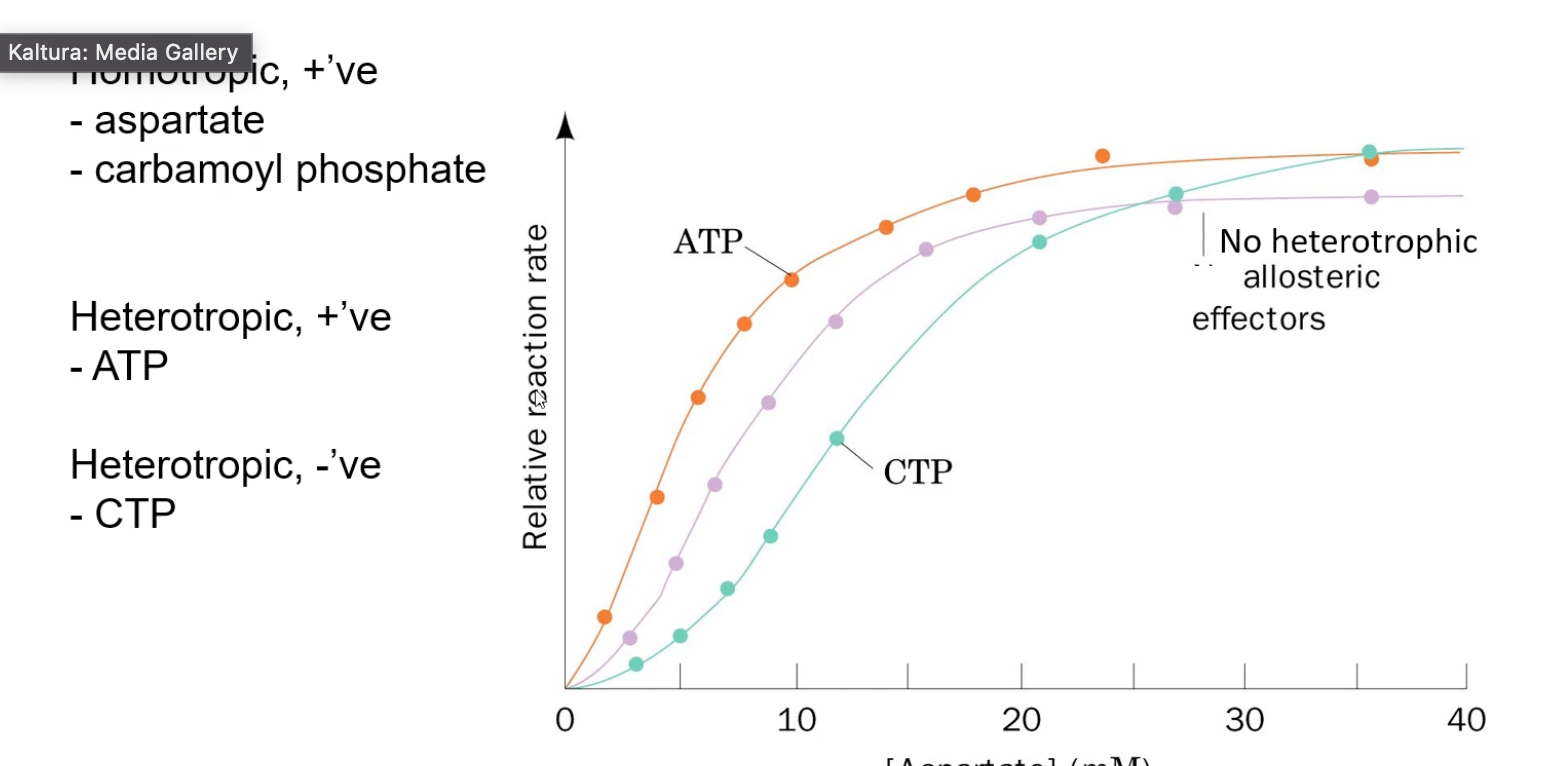
aspartate transcarbamoylase (ATCase):
what does it do
how regulated (4) / how plot move
why sigmoidal
homo or hetero?
catalyses reaction of aspartate
has regulatory subunits and catalytic subunits
catalytic bind substrate
regulatory binding change conformation
aspartate and carbamoyl phosphate = positive homotropic (substrate)
ATP = positive heterotropic allosteric modulator → shift left relaxed state / high affinity
CTP = neg heterotropic allosteric modulator → shift right tense state / low affinity
binding of substrates aspartate and carbamoyl phosphate = transition from T state →R state
ATCase both homo and hetero allosteric kinetic behavior

aspartate transcarbamoylase (ATCase):
why does ATP activate and CTP inhibit?
what’s the mechanism?
what are pathways? what’s usually the final product usually do?
rationale behind ATP activating and CTP inhibiting?
allosteric control of ATCase by CTP = feedback inhibition
CTP is product produced at end of long pathway and acts feedback inhibitor of earlier ATCase reaction to control level of CTP in the cell
processes where product of one enzyme becomes substrate of next each step catalyzed by a different enzyme
final product usually heterotropic allosteric inhibitor of earlier enzymes in the pathway
rationale
ATP activates = want to make stuff when have energy
CTP feedback inhibitor = don’t want to waste E making too much

how covalent modification regulate enzyme function
how permanent are covalent mods
many different types/affects of cov mods catalyzed by enzymes
permanent until removed by another enzyme
describe usefulness of phosphorylation in enzymatic regulation and how glycogen phosphorylase is regulated in response to phosphorylation
Phosphorylation:
catalyzed by
what do they reconize
removed by
specificity
how is glycogen phosphorylase regulated by phosphorylation?
catalyzed by kinases
specific, kinases recognize seq motifs
removed phosphatase
not specific
its really complex, but simple version:
glycogen phosphorylase switches b/t active a form and inactive b form by phosphorylating 2 Ser residues
phosphorylase kinase activates = turns b → a
protein phosphatase 1 inhibits = turns a → b
cleavage:
how modify enzymes?
zymogen
chymotrypsin cleavage?
inactive precursors can be permanently converted to active enzymes by enzymatic (specific) cleavage
can be autolysis
zymogen = proenzyme
chymotrypsin and trypsin activated by proteolytic cleavage of their zymogen forms