Lecture 6 - Fundamentals of the Nervous System and Nervous Tissue
 Call Kai
 Learn
 Practice Test
 Spaced Repetition
 Match
 Flashcards
 Knowt Play
1/57

There's no tags or description
Looks like no tags are added yet.
58 Terms
What makes up the central nervous system?
brain and spinal cord
What makes up the peripheral nervous system?
cranial nerves, spinal nerves, ganglia
Somatic Sensory Fibers in Sensory (afferent) division of PNS
convey impulses from the skin, skeletal muscles, and joints TO CNS
Visceral Sensory Fibers in Sensory (afferent) division of PNS
convey impulses from visceral organs TO CNS
Motor (efferent) division of PNS
transmits impulses FROM CNS to effector organs (muscles/glands)
What division is the somatic and autonomic nervous systems part of?
Motor (efferent)
Somatic Nervous System
voluntary
somatic motor nerve fibers
regulates skeletal muscle
Autonomic Nervous System
involuntary
visceral motor nerve fibers
regulates smooth muscle, cardiac muscle, and glands
What division does sympathetic and parasympathetic nervous systems belong to?
Autonomic Nervous System
Which nervous system is fight or flight?
Sympathetic —> think S for stress
Which nervous system is rest and digest?
Parasympathetic —> think P for peaceful
Characteristics of neurons (nerve cells)
last a lifetime, amitotic, high metabolic rate

What is the function of dendrites?
part of the neuron that receives signals (input region)
conveys messages toward cell body as graded potentials (short distance signals)
are short and branched
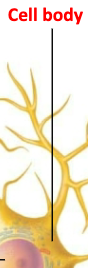
What is the function of cell bodies?
synthesizes proteins, membranes, and chemicals
rough ER
has a nucleus and nucleolus
plasma membrane receives info from other neurons
What are clusters of neuron cell bodies called in the CNS?
nuclei
What are clusters of neuron cell bodies called in the PNS?
ganglia

What is the function of axons?
generates nerve impulses and transmits them to axon terminal (conducting region)
can be short, very long, or even
axon starts at a cone-shaped area called axon hillock
endings are branched called axon terminals
What sends graded potentials?
dendrites —> runs down from dendrite TOWARDS the cell body then eventually to the axon
What sends action potentials?
axons —> runs down from the axon AWAY from the cell body all the way down to the axon terminal
What are bundles of neuron processes (axons) called in the CNS?
tracts
What are bundles of neuron processes (axons) called in the PNS?
nerves
What is the Myelin Sheath?
white fatty segments that individually wrap axons that protects and electrically insulates them to increase the speed of nerve impulse transmission
good insulator bc less protein
Myelin sheath in the PNS
formed by Schwann cells
1 cell wraps 1 neuron = one bubble of the sheath
called myelinated fibers
spaces between cells are called myelin sheath gaps
Non-myelinated fibers in the PNS
one Schwann cell surrounds up to 15 thin fibers
Unmyelinated fibers in the CNS
thin fibers have no myelin surrounding them
Myelin Sheath in the CNS
formed by oligodendrocytes
one cell can wrap up to 60 axons at once
spaces between cells called nodes of Ranvier
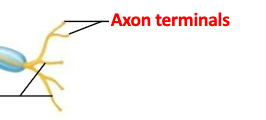
What is the function of axon terminals?
secrete neurotransmitters that get released into extracellular space
these can excite or inhibit neurons it comes into contact with
quickly decay if cut or damaged
interact w many neurons at the same time to send signals
What is the resting membrane potential of a neuron?
-70mV (inside is negative)
we have negatively charged proteins inside the cell that cannot pass through the plasma membrane to leave
is a polarized membrane
(the higher the voltage the greater the distance or difference in charges)
What cells can change their membrane potential?
muscles and nerves
What are leakage ion channels?
NOT gated
ions move DOWN their gradient
passive process
What are gated ion channels?
protein changes shape to open/close the channel
passive process
Chemically gated ion channels
open in response to its appropriate neurotransmitter binding to its receptor
passive
Voltage-gated ion channels
open in response to changes in the membrane potential
passive
What is involved in maintaining resting membrane potential
Higher concentration of sodium (Na+) outside the cell
Higher concentration of potassium (K+) inside the cell
we have more leakage ion channels for potassium so we are more permeable to potassium so potassium leaks out at a faster rate than sodium does
overall: potassium (+) goes out and sodium (+) comes in
Sodium Potassium Pump
Moves ions AGAINST concentration gradients = active transport
Goal is to maintain the gradient so that ions can continue moving down their concentration gradients
whatever sodium leaked in gets pumped out
whatever potassium leaked out gets pumped back in
What is depolarization?
membrane potential gets more positive than resting
more likely to produce impulses
What is repolarization?
membrane potential gets more negative than resting
has to be more negative than -70
less likely to produce impulses
What is the plasma membrane of an axon?
Axolemma
Action Potentials
occurs at one part of an axon at a time
doesn’t lose strength as it travels down axon = propagation
Depolarization: opens Na+ voltage-gated ion channels and causes TONS of Na to rush in and causes a major depolarization (charge goes more positive)
Repolarization: closes Na+ channels and opens K+ channels
K+ leaves going down its gradient
Brings electrical condition back to normal but ions are in the wrong spot
Hyperpolarization occurs where membrane potential is now slightly more negative than resting to ensure that the next gate will not cause the action potential to go backwards on the initial gate
Sodium Potassium Pump moves the ions to get back to reset ion position
Graded Potentials
short-lived changes in membrane potential that result in depolarization or hyperpolarization
magnitude varies depending on stimulus strength
stronger stimulus goes further and bigger voltage change
opens chemically gated ion channels
What is a synapse?
the point where two neurons meet
axon terminal of one neuron forms a synapse with dendrites of next neuron
Presynaptic neuron
the neuron that is “before/ahead” the synapse point and sends information
Postsynaptic neuron
the neuron that is “after/behind” the synapse point and receives the information
What is the function of a chemical synapse?
changes an electrical impulse into a chemical impulse across the synapse and then back to an electrical impulse
releases chemical neurotransmitters

What is the structure of a chemical synapse?
Axon terminal of presynaptic neuron (has vesicles filled w neurotransmitters)
Fluid-filled gap called the synaptic cleft (the synapse)
Receptor region on dendrite or cell body of postsynaptic neuron’s membrane
What is the function of the synaptic cleft?
prevents nerve impulses from directly passing from one neuron to the next
ensures signals between neurons only travel in one direction
Process of Chemical Synapse
axon potential arrives at the axon terminal of presynaptic neuron
voltage-gated calcium channels open and Ca+ enters the axon terminal
the entry of Ca2+ causes synaptic vesicles (sacs filled w neurotransmitters) to fuse with the cell membrane (releases them via exocytosis = active!)
the higher the frequency the more vesicles are exocytosed
neurotransmitter binds to the receptor protein on the postsynaptic neuron which opens chemically gated ion channels (protein changes shape)
graded potential triggered on postsynaptic neuron (excitatory or inhibitory)
neurotransmitter is terminated via one of three ways:
re-uptake by presynaptic neuron
degradation by enzymes
diffusion where it is swept away from synaptic cleft
Why does the effect of a neurotransmitter need to be terminated quickly?
as long as the neurotransmitter is bound to a receptor the graded potentials will continue to occur
Acetylcholine Neurotransmitter
neuromuscular junctions (ANS and CNS neurons use it)
degraded by enzyme acetycholinesterase
What are the types of Biogenic Amines?
Catecholamines and Indolamines
What are the types of Catecholamines?
Norepinephrine and Epinephrine
made from the amino acid tyrosine
used by some ANS motor neurons (especially NE)
used by the brain (CNS) for regulating emotional behaviors and biological clock
imbalances associated w mental illness
What are the types of Indolamines?
Serotonin: made from amino acid tryptophan
Histamine: made from amino acid histidine
used by the brain (CNS) for regulating emotional behaviors and biological clock
imbalances associated w mental illness
What are the types of Peptides?
are derived from strings of amino acids
Substance P
Endorphins
Gut-Brain Peptides
Substance P function
mediates pain signals (like capzasin)
Endorphins function
reduce pain perception
“runner’s high”
beta endorphin, dynorphin, enkephalins
Gut-brain peptides function
Somatostatin and cholecystokinin: regulate digestion
What are excitatory effects of neurotransmitters?
causing graded potentials in postsynaptic neuron
What are inhibitory effects of neurotransmitters?
causes hyperpolarization that inhibits either action or graded potentials