BV II Exam 3- Nicole
 Call Kai
 Learn
 Practice Test
 Spaced Repetition
 Match
 Flashcards
1/261

There's no tags or description
Looks like no tags are added yet.
262 Terms
Why does Pseudo-ET look like an ET?
Wide bridge and prominent epicanthal folds give appearance of ET
• Epicanthal folds cover part of the nasal bulbar sclera
• Eyes look more ET when child looks to the right or left
• Nearly 50% of infants brought in for suspicion of ET have Pseudo ET!

How can we confirm a Pseudo-ET in an infant?
CT, Hirschberg, and Bruckner used to verify alignment
Why do we want to follow-up w/ Pseudo-ET babies after 6 mos to monitor alignment?
Study found that the prevalence of strab and amblyopia is higher in pseudoET's than normal population
RTC q6mo to monitor alignment
gaols of strabismus treatment
-normalize VA, eliminate amblyopia
-improve motor fusion potential- specs, prism, surgery, VT
-improve sensory fusion potential/ adaptations
-provide favorable cosmesis
accommodative esotropia
esotropia related at least in part ot use of accommodation
ETE will decrease with prescription of maximum plus glasses and/or bifocals
non-accommodative ET
esotropia that isn't exacerbated by accommodation, plus lenses provide no improvement in eso deviation
infantile esotropia
esotropia that presents by 6 mo and not significantly affected by accommodation
mechanically restrictive/ paretic esotropia
incomitant ETs
What is the most frequent childhood strabismus
Accommodative Esotropia
• 30% of children with hyperopia >+4.00D will develop ET by 3yo
• Runs in families (25% of 1st degree relatives have ET)
3 types of Accommodative Esotropia
• Refractive Accomm. ET
• non-refractive Accomm. ET
• partly Accomm. ET
refractive accommodative ET
hyperopia RE
normal AC/A
ET is eliminated with full plus Rx
Age of onset for Refractive Accommodative Esotropia
Typical age of onset 2.5 yo (6 mos - 8yo)
What causes Refractive Accommodative Esotropia?
• refractive errors +2 to +6, pt. is accommodating to clear refractive error --> ET
accommodative effort to overcome hyperopia causes eyes to cross
• Can be intermittent & variable due to accomm. effort
What is the typical magnitude of an Accommodative Esotrope
Typically moderate angle (10-45Δ)
Treatment of Refractive Accommodative Esotropia
full plus cyclopleged Rx
• Normal AC/A- ET eliminated with full plus hyperopic Rx
• High AC/A- ET eliminated with full plus hyperopic Rx + add
-Approximately 1/3 of comitant ET's will have complete
resolution of ET with hyperopic Rx
90% of all strabismus begin before _____ years of age
6
-Median age of onset 29 mos
(excludes paretic, mechanically restrictive, neuro origin)
What are some signs of a "dangerous" strabismus
anything that makes you think that strabismus was developed later in life
a) Later onset: >5 yo
b) Diplopia
c) Ptosis (new) + diplopia
d) Ocular neuro signs: Diplopia with incomitance, pupil anomalies, visual field defects
e) Other neuro signs Ataxia, speech disorder, cerebellar signs in children
f) Vomiting + diplopia in children
signs of refractive accommodative ET
ET magnitude is variable based on accommodative effort
goes away with fully plus
if ET is longstanding, pt develops suppression to prevent diplopia
important parent education for accommodative ETs
you may see more of an eye turn when the glasses come off
ET may have been intermittent before, but now accommodation is relaxed in specs, ET is more frequent
If hyperopic Rx aligns eyes at distance but leaves a residual ET at near, what can we presume about the AC/A
• Presume high AC/A
• Treatment with ADD power in a bifocal may be indicated*
-High ACA Esotropes with good alignment at distance may
have similar outcomes with or without a bifocal
• Prescribe least amount of plus to align eyes at near or give full near plus (+2.50-3 D add)
Where do we fit the add for children?
-FT BF seg height at lower pupil margin or split pupil (good control except at intermediate distances)
-PALs fit 2-3 mm above center pupil (better control for intermediate distance)

What refractive accomm. ET patients are able to be weaned out of their add?
For CE/ET's, those with lower AC/A's and smaller ET's more likely to wean out of near add
*Patients were more likely to discontinue bifocal use if they had surgery for Esotropia

Prognosis of refractive accomm. ET
-Some have excellent prognosis for NBV & stereo if ET resolved with Rx →May be able to wean out of add over time
prognosis was better if pt developed ET later in life (>2 yo) and shorter duration prior to treatment
-50% will show deterioration (return of Esotropia)
-some ET's will develop spontaneous consecutive exotropia.
Despite Tx of refractive accomm. ET with Plus Rx, up to 50% will show deterioration (return of Esotropia). What factors increase the risk of this?
• Higher calculated AC/A
• Earlier age of onset
• IOOA
• Amblyopia
consecutive exotropia
tropia angle was previously eso
sometimes occurs in refractive accommodative ETs despite treatment
Despite Tx with Plus Rx, some ET's will develop spontaneous consecutive exotropia. What factors increase the risk of this?
• earlier age of onset
• hyperopia of +5.00 or greater
• lack of stereo/fusion
• DVD
-No relationship between initial ET angle and initial XT angle
-seen most at distance
are BF actually helpful for high AC/A accommodative ETs
similar outcomes with and without bifocal
if bifocal improves function (fusion/ stereo) at near, Rx an add but otherwise maybe no benefit
research is conflicted
primary and secondary treatment of refractive accommodative ET
1. full wet ret Rx
2. BF with add for near ET if high AC/A
Non-Refractive Accommodative Esotropia
aka Convergence Excess ET
eso is not related to refractive error (no hyperopia) but is exacerbated by accommodation
• High AC/A
age of onset for Non-Refractive Accommodative Esotropia
2-5 yo
before 6
Non-Refractive Accommodative Esotropia etiology
high ACA causes eyes to cross when pt uses accommodation at near
often intermittent and variable depending on accommodative effort
average magnitude of deviation in Non-Refractive Accommodative Esotropia
initial treatment for Non-Refractive Accommodative Esotropia
Rx near add in BF to reduce accommodative effort if it improves fusion
rule out latent hyperopia with cyclo and spasm of near reflex
important things to rule out before diagnosing Non-Refractive Accommodative Esotropia
latent hyperopia- cylo pt
spasm of near reflex- MEM
typical age of onset for Partly Accommodative Esotropia
before 6 yo
etiology of Partly Accommodative Esotropia
accommodative effort to overcome hyperopia causes eyes to cross
typically a moderate- high hyperopia
plus specs don't correct full eso deviation
usually constant and unilateral> amblyopia risk
treatment for Partly Accommodative Esotropia
• Treatment with max plus (hyperopia Rx and add if high AC/A) still leave a residual ET
• Must employ additional treatment for residual ET> next ppt deck
• Prognosis for NBV reduced if residual ET isn't managed
We have a residual ET w/ Max plus, now what?
• Prism
• Surgery
• Therapy
• Pharmacology
What is the max amount of ground in prism you can use?
• Max ground prism 10-12Δ total
• 5-6Δ per lens is upper limit (can go higher with temporary Fresnel)
how does a BO prism work for esos
prism bends light toward the base and the image is shifted to the apexi which allows the eye to remain eso by decreasing divergence demand
What provides the greatest chance of success in Prismatic correction of residual ET
✓ Residual ET ≤10-12Δ small angles after plus lenses (partially accommodative ETs)
✓ No Amblyopia
✓ Stable deviation with prism (no prism adaptation)
✓ Normal fusion response with W4D (NRC)
When do we consider surgery for ETs?
• Better for larger deviations. (>10-15Δ)
• Earlier surgery associated with better outcomes (>6mos,
When do we consider VT for ETs?
• Reserved for small angle intermittent ET or small angle CET with compensating prism (good fusion potential)
• Hard to manage moderate to large ET with sensory adaptations using VT & hard to train divergence
What are the different Pharmacological options for treatment of ETs
• Botulinum Toxin (Botox)—Alternative to EOM surgery. Weakens injected muscle
• Bupivacaine HCL (BUP)—Alternative to EOM surgery. Strengthens injected muscle
• Cholinesterase inhibitors—Decrease accommodative effort and reduce accomm ET (no longer in use)
Botox MOA
"sausage toxin"
injection into muscle causes muscle paralysis and weakening by blocking acetylcholine release
in EOMS, effects last much longer than face muscles- can be permanent
onset takes 2-3 days
how does Botox compare to surgical outcomes for ETs
• Botox alone reported to have similar results to EOM sx for ET< 30Δ
• Maybe used in addition to surgery for larger angle ET (>60 Δ)
• Effects are often longstanding and sometimes permanent.

SEs of Botox inj. for Tx. of ETs
• Onset of effects takes 2-3 days
• Ptosis
• Over/under corrections (dosage guidelines
variable)
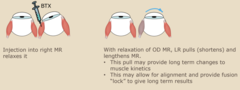
how is Botox used to treat ETs
injection into MR weakens MR
MOA of using Bupivacaine HCL (BUP) to tx. ETs
• Local anesthetic inj. into EOM to strengthen the muscle
- Myotoxic, causing necrosis of extra ocular muscle
- Initially, results in muscle weakening
- Muscle regeneration occurs during next 3-4 weeks
- Regenerated muscles have stronger myofibrils and increased muscle thickness
provides stable correction for 5-10 years

how is Bupivacaine used to treat ETs
injection into LR strengthens LR
how much deviation is Bupivacaine able to treat
5-10^
often mused as bilateral injection or with botox to increase treatment effect (15^)
T/F pharmacological treatment is better than surgery outcomes
False- drugs are used less often because they have an unpredictable effect due to pts metabolizing drugs differently
MOA of Cholinesterase Inhibitors in tx. of ETs
Echothiophate iodine (Phospholine Iodide) and Isoflurophate
-increase ciliary body sensitivity to Ach.
-Allows the eye to accommodate with w/ less Ach.
-Decreased accommodative effort reduces the amount of
accommodative convergence (reduces the AC/A)
- Drugs administered as an ointment or a solution at a
loading dose and then tapered over time
- May cause extreme sensitivity to muscle relaxants (general anesthesia) and iris cysts
- No longer used in current practice
Magnitude of residual ET =
•BO prism if patient is stable with prism
•VT to improve BI Ranges
•taper prism
Magnitude of residual ET =
•Monitor if asymptomatic
•Aggressive VT?
Magnitude of residual ET = >15Δ
Normal fusion potential = yes
What are our treatment options?
•BO prism (Fresnel) until surgery or Botox
Magnitude of residual ET = >15Δ
Normal fusion potential = no
What are our treatment options?
Surgery or Botox
when is an eso pt a poor prism candidate
if they adapt/ eat prism
would ultimately make pt more eso
when do you consider surgery for an eso
>15 ^
a ET pt decides to undergo a long VT program in the synoptophore, what other treatment could be useful during this time
full time, alternating occlusion
strabismic deterioration
angle of deviation that increases over time
recession
move EOM posteriorly on the globe to weaken pull
resection
move EOM anteriorly on globe/ shorten muscle to strengthen pull
What surgery is often used to correct ETs?
ET treated with recession
• Weaken pull of MR by moving insertion farther back on globe
ET treated with resection
• Strengthen pull of LR by moving insertion closer to limbus
-*Larger deviations may require bilateral surgery

What increases the risk of consecutive XT after surgery?
•Greatest risk for those with IOOA and amblyopia
•Onset of Consecutive XT often years after surgery
•Outcome wasn't associated with type of ET
which pts are strabismus surgery candidates?
large angle >10 ^
any direction of strab- eso, exo, hyper, hypo, torsional
comitant and incomitant
unilateral and alternating
constant and intermittent (w/ poorer control)
>6 mo
at what ages can you do strabismus surgery
>6 months
upper limit decided based on pts ability to tolerate anesthesia
EOM surgical process
•Outpatient procedure (elective)
•Done under general anesthesia
- No incisions on the eye lids or eye ball itself
- Doctor moves muscles to strengthen or weaken their pull
- The surgeon does NOT remove the eye ball

Plication
•Used to tighten muscle as alternative to resection
•Muscle body lifted off sclera and folded on top of itself to shorten muscle
•Less invasive and can be done with topical anesthesia
•May be used for small angle strab (

Adjustable Sutures
•Cut muscle leaving suture attached with knot
•Can adjust the tightness of the muscle within 24 hours
post surgically while the patient is awake
•Allows for subjective assistance from patient to help
align the eyes
•Typically reserved for adult patients
•Limited evidence this procedure improves outcomes

What to expect in terms of symptoms/ recovery after EOM surgery?
•Localized redness right after sx is common (subconj heme) but heals quickly
•Mild discomfort possible typically managed with Motrin
•Most patients can return to school or work within a few days
•Possibility of double vision following sx (usually short term)
what is the success rate of strabismus surgery
depends on how you define success
78% cosmetic (
____% surgically treated ETs decompensated 3 yrs post sx
21%
there is a higher rate of reoperation with strab surgery in __________ pts
older pts
make sure to still send your older pts to peds strab surgeon bc they do this sx all the time, not general OMD
What does the success rate of strabismus surgery depend on?
•type of strab, age, definitions of success, length of follow up, magnitude of the eye turn, and direction of eye turn.
•There's always a risk that the eye turn will come back or need another sx.
_________ pts typically have higher success rate with strab surgery
younger
Long term success rates of strabismus surgery appear to be about _____%
50%
Factors associated with better surgical outcomes
✓ Strabismus onset after 6 months of age, but still a young pt
✓ Shorter duration of strabismus before surgery
✓ normal fusional potential
✓ Smaller magnitude strabismus before surgery
✓ Purely horizontal strabismus
✓ Exotropia (not as favorable for Esotropia)
✓ No amblyopia
✓ Less post surgical residual strabismus
at the end of the day, EOM surgery is ____________
elective, not medically necessary
T/F if surgery is indicated do not delay referral to surgeon
True
Non-accommodative ET
magnitude of ET is altered by
What is non-accommodative ET? What are the 4 types?
- Early Onset
- Acute Acquired Comitant ET
- Divergence Insufficiency ET
- Consecutive
If the magnitude of the ET is altered by
non-accommodative ET
-ET is not exacerbated by accommodation
-Hyperopia and AC/A not the cause of the ET
What is the onset of early onset Non-accomm. ET?
6 mos - 5 years old
median age of diagnosis is 4 yo
2nd most common type of ETs
early onset non-accommodative ETs
Characteristics of Early onset Non-Accomm. ET
a) magnitude
b) distance vs. near deviation
c) refractive error
-Moderate angle ET (median 25Δ)
-Constant ET (rarely diplopia)
-Angle similar at distance and near
-Low hyperopia (
90% of all strabismus begins before age _________
6 yo
How do we manage Early onset Non-Accomm. ET
*usually treated w/ prism & sx.
first Rx specs for hyperopia and treat amblyopia
-
Prognosis of Early onset Non-Accomm. ET
-few achieve bifoveal fusion with high-grade stereopsis
-poorer prognosis for onset
-Chance of recurring ET or consecutive XT after surgery
Late Onset Non-Accomm ET aka
Acute Acquired Comitant ET
typical age of onset for Late Onset Non-Accomm ET
>5 yo
Characteristics of Acute Acquired Comitant ET
-Sudden onset
-moderate size (15-35Δ)
-comitant ET
-Horizontal Diplopia
-Onset >5yo
Classic (non-neurological) Etiologies of Acute Acquired Comitant ET
-Type I - Swan
-Type II - Burian-Franceschetti
-Type III - Bielschowski
**There is a non-classical but non-neurological cause = Decompensated Eso
Acute Acquired Comitant ET -Swan (Type I) Etiology
Sudden onset due to interrupted fusion (monocular occlusion or vision loss)
Acute Acquired Comitant ET -Burian-Franceschetti (Type II) Etiology
Result of physical or psychological stress causing large ET
Acute Acquired Comitant ET -Bielschowski (Type III) Etiology
associated with moderate to high myopes performing intense prolonged near work without glasses (convergence without accomm causing convergence spasm)
Acute Acquired Comitant ET - What are some Neurological Etiologies?
-Brain tumors
-Idiopathic Intercranial Hypertension
-Seizures
-Migraines
-Hydrocephalus
-Frequency of underlying neuro etiology in children is low
Acute Acquired Comitant ET- Risk Factors for Neuro Etiology
• Older children (mean age 7yo)→ adults
• Presence of Papilledema (only seen in about 1/3 of neuro etiology)
• Larger ET at distance
• Nystagmus (Chiari malformations, hydrocephalus, tumors)
• Inability to provide fusion with plus and/or prism
Non-Classic (non-neurological) Etiologies of Acute Acquired Comitant ET
decompensated eso (15-45^)
could be due to smartphones? due to high accommodation and short working distance
Studies have shown that smartphone usage can cause Acute Acquired Comitant Esotropia. What patients are at risk of this?
• ≥6 hours/day on smart devices (tablets/smartphones)
• Short working distances (20cm)
• Patients of all ages (predominantly teens to young adults)
• Myopic presbyopes who remove glasses to read
• Myopes may be higher risk, but all refractive errors represented