BIOL 349 Exam 3
 Call Kai
 Learn
 Practice Test
 Spaced Repetition
 Match
 Flashcards
 Knowt Play
1/128

There's no tags or description
Looks like no tags are added yet.
Name | Mastery | Learn | Test | Matching | Spaced | Call with Kai | Chat |
|---|
No analytics yet
Send a link to your students to track their progress
129 Terms
supervised learning variable(s)
x and y
supervised learning
given an observation x, what is the best label y?
supervised learning example(s)
classification, regression
unsupervised learning variable(s)
x
unsupervised learning
given a set of x’s, output their hidden structure
unsupervised learning example(s)
clustering
idea behind K-means clustering
a good clustering is one for which the within-cluster variation is as small as possible
within-cluster variation
measure of the amount by which the observations within a cluster differ from each other
pre-specify the number of clusters K
requirement of K-means clustering that can be a disadvantage
hierarchical clustering
alternate approach which does NOT require that we commit to a particular choice of K
most common type of hierarchical clustering
bottom-up/agglomerative clustering
bottom-up/agglomerative clustering refers to…
the fact that a dendrogram is built starting from the leaves and combining clusters up to the trunk

what do these images show?
hierarchical clustering algorithm
hierarchical clustering algorithm: step 1
start with each point in its own cluster
hierarchical clustering algorithm: step 2
identify the two closest clusters and merge them
hierarchical clustering algorithm: step 3
repeat steps 1 (identifying clusters as one point) and 2 (merging two closest clusters)
hierarchical clustering algorithm: step 4
ends when all points are in a single cluster

What does this image show?
Visualizing differential expression results using hierarchical clustering

what are the columns above?
groups of sample type separated into control vs overexpression

what are the labels at the bottom?
individual sample types
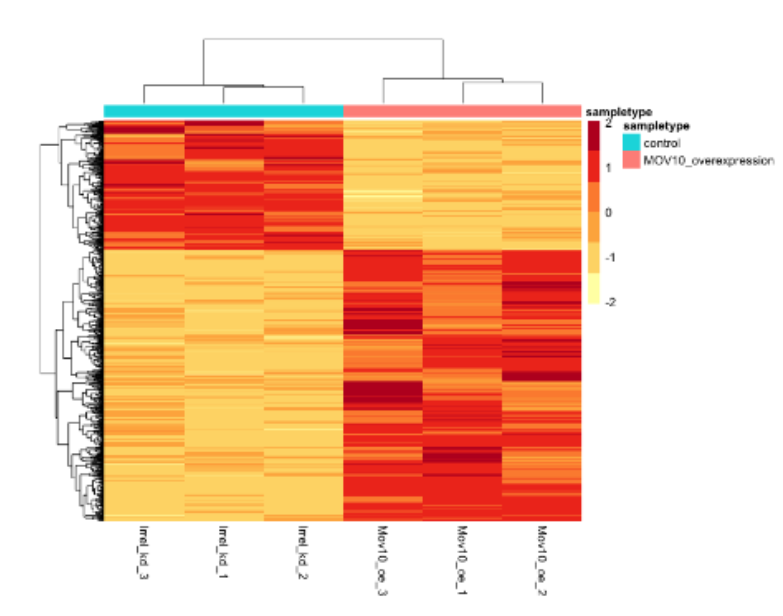
what are the rows representative of?
a specific differentially expressed gene

what does the colors and scale represent?
darker red/color indicates higher gene expression while lighter red/color indicates lower gene expression
TRUE OR FALSE: one transcription factor can regulate many different genes
TRUE
TRUE OR FALSE: multiple different transcription factors can be required to initiate or regulate a gene or multiple genes
true
TF binding motif
term describing the sequence recognized by a transcription factor
single regulator
gene has one regulator (TF)
repetitive motifs
gene needs multiple of one regulator (TF)
multiple regulators
multiple different regulators (TF) can bind to multiple different genes at the same time to control expression
co-occurring regulators
two or more different regulators (TF) overlap/bind to the same gene to control expression
what does the presence of co-occurring regulators suggest?
physical interaction between the regulators
ChIP-seq
Chromatin Immunoprecipitation Sequencing
step 1 of ChIP-seq
cross-linking
cross-linking
introduces stable covalent bond between TF and DNA
step 2 of ChIP-seq
sonication
sonication
breaks apart chromatin into smaller fragments
step 3 of ChIP-seq
IP (immunoprecipitation)
immunoprecipitation
antibody binds to TF to selectively isolate protein-DNA complex
step 4 of ChIP-seq
sequencing isolated DNA using next-generation sequencing (NGS) to map reads back to reference genome and identify binding peaks

where are the genes recognized by the TF?
the two peaks where reads pile up
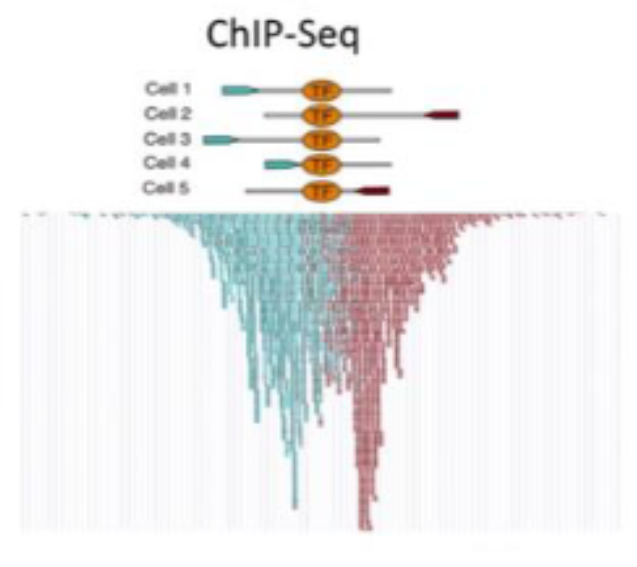
where is the sequence correlated to the TF?
the middle between the two peaks where it’s protected
DNA methylation is also known as…
5th base pair
DNA methylation process
cytosine is undergoes methylation to form 5-methyl cytosine
DNA methylation can only happen to…
cytosine
methylation impact on gene expression
gene expression repressed by TF competitors
unmethylated impact on gene expression
no impact; gene expression is not repressed
bisulfite sequencing
gold standard for genome-wide profiling of DNA methylation
bisulfite treatment changes…
unmethylated cytosine to uracil
bisulfite treatment does not change…
methylated C, which is protected by the methyl group
what step is after bisulfite treatment?
PCR to make DNA copies from the bisulfite-treated strands
Host defense is…
silence endogenous parasitic sequence caused by DNA methylation
Imprinting is due to…
gene expression silenced by DNA methylation
X-chromosome inactivation is due to…
DNA methylation silencing one of the two double X chromosomes
genomic related functions of DNA methylation in mammalian system
heterochromatin maintenance, chromosome stability, telomere length
TRUE OR FALSE: A function of DNA methylation in mammalian system is gene expression control.
True
histone code
epigenetic beacons for gene expression regulation
what three letters/numbers do histones start with?
H3K
histone modifications
used to mark different function of different region in genome
types of histone codes/modifications
enhancers, promoters, repressed genes, transcribed gene bodies
two types of ChIP-seq
TF
histone
TF ChIP-seq
tells where TF is bound to DNA
Histone ChIP-seq
where in DNA the histone interacts with DNA
lower methylation is correlated with…
is higher expression
DNA
naked, double helix
chromatin
DNA in its compaction structure in the cells
nucleosome
basic unit of chromatin, 146bp DNA wrapped around 8 histones proteins
regular TF ChIP-seq
sonication, antibody against TF
histone mark ChIP-seq
sonication or MNase, antibody against the histone modification
super enhancers from ChIP-seq
clusters of multiple, closely located enhancers that bind high concentrations of transcription factors and co-activators
The width of ChIP-seq signals from super enhancers are…
broad
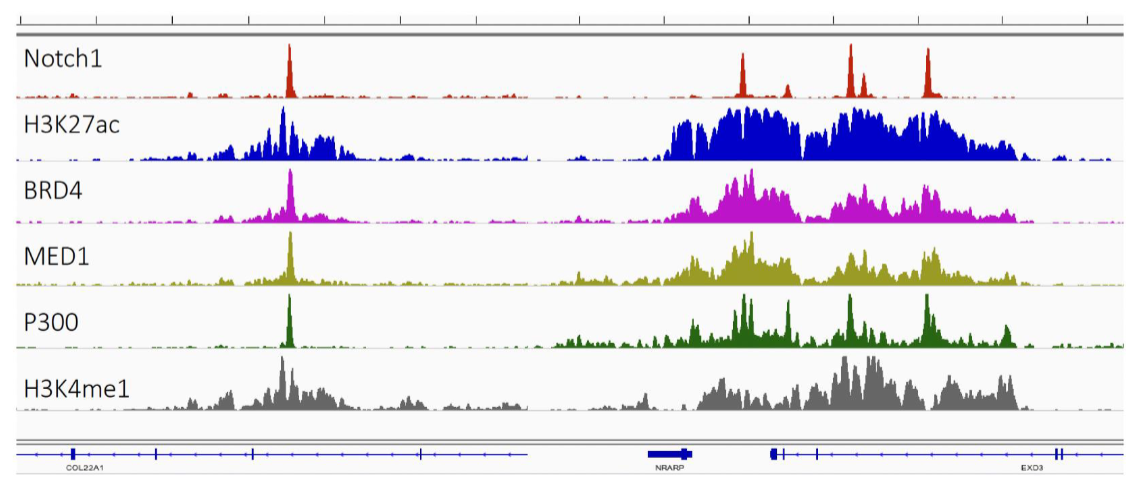
how many TF ChIP-seq in this image?
four

how many histone ChIP-seq in this image?
two

which side has the regular enhancer?
left

which side has the super-enhancer?
right

what does this image show?
separate fluorescence channels of different chromosomes present in the human cell nucleus with one image overlapping all channels

what does this image show?
a color map identifying where each labelled chromosome is located within the nucleus
What is Hi-C used for?
to investigate chromatin interactions genome-wide
Hi-C step 1
crosslink DNA
Hi-C step 2
cut with restriction enzyme
Hi-C step 3
fill ends and mark with biotin
Hi-C step 4
ligate
Hi-C step 5
purify and shear DNA; pull down biotin
Hi-C step 6
sequence using paired-ends
Hi-C is used to sequence…
DNA that is in touch with each other to observe their interactions
where does Hi-C take place?
in cell nucleus

This image is a…
Hi-C data matrix

What are the axes?
the location in the chromosome per kilobase (kb, so per 1000 bp)

What are the values in each square?
the interaction value between each position in the chromosome

What do the more red/pigmented data squares represent?
higher/more interaction between the corresponding positions in the chromosome

This image is…
TADs graphed
TADs
Topologically Associating Domains
Most TADs are…
stable in different cell types
TADs are conserved across…
species
Disruption of domain (TADs) structure is associated with…
limb malformation
conserved
high function

which potential function of TADs does this image represent?
gene co-regulation

which potential function of TADs does this image represent?
enhancer blocking

which potential function of TADs does this image represent?
boundary function

which potential function of TADs does this image represent?
blocking spread of transcription
Compartment A vs B: A tends to interact with…
A
Compartment A vs B: B tends to interact with…
B