Total Rewards Strategy and Compensation Systems
 Call Kai
 Learn
 Practice Test
 Spaced Repetition
 Match
 Flashcards
 Knowt Play
 Podcast
1/88

Earn XP
Description and Tags
Comprehensive vocabulary flashcards covering the key terms, compensation models, pay strategies, evaluation techniques, and benefits metrics from the Total Rewards lecture notes.
89 Terms
Total rewards
Direct and indirect remuneration approaches that employers use to attract, recognize, and retain workers; "remuneration" and "compensation and benefits" have the same meaning.
Direct Compensation (Pay Systems)
Involve cash based rewards. It includes wages, commissions, and cash achievement awards.
Indirect Compensation (Benefit and recognition programs)
Include non-cash rewards. Includes benefit programs and items like a company car, disability insurance, and noncash rewards.
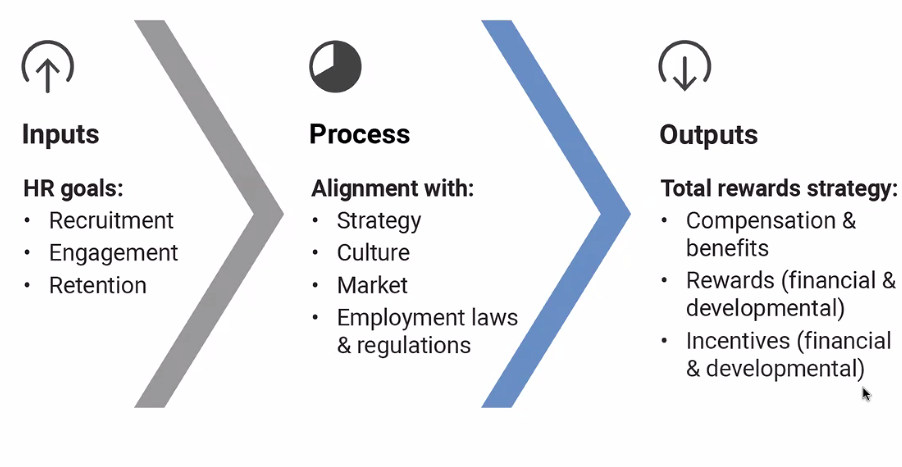
Total Rewards Strategy (Input output Model)
Is a plan or method implemented by an organization that provides monetary, benefits-in-kind, and developmental rewards to employees who achieve specific business goals.
How the organization will use its compensation tools to create and sustain a productive workforce and advance the organization’s strategy.
The inputs into the development of the total rewards strategy are HR’s goals for recruitment, engagement, and retention. HR then applies its expertise to align these inputs with the requirements of the organization’s strategy,
Benefits
Tangible payments or services provided to broad groups of employees to cover common issues (for example, retirement and paid time off) in addition to those required by law.
Compensation
Refers to all other financial returns (beyond any tangible benefits payments or services), including salary and allowances.
Perquisites (Perks)
Compensation provided on an individual basis in the form of goods or services (for example, automobiles and mobile devices).
Incentives or premiums
Payments in return for the achievement of specific, time-limited, targeted objectives; often calculated as a percentage of base salary and paid as lump sums or ongoing payments.
Compensation philosophy
A short (but broad) statement documenting the organization's guiding principles and core values about employee compensation. Guides the design and complexity of compensation programs. A well-designed compensation philosophy supports the organization's strategic plan and initiatives.
What we pay? how we pay? who we pay?
4 steps in developing a total rewards strategy
Assessment: Evaluate current rewards, employee needs, and organizational goals.
Design: Develop the rewards strategy.
Implementation: Put the strategy into action.
Evaluation: Measure effectiveness and make improvements.
Pay Equity
Sometimes called comparable worth, relates to the fairness of compensation and benefits paid to employees. Equity issues can be internal or external. An organization cannot effectively recruit new employees or retain existing ones without internal and external equity.
Internal equity
Occurs when employees feel that performance or job differences result in corresponding differences in rewards that are fair. In other words, employees think that they are being rewarded fairly according to the relative value of their jobs within an organization.
External Equity
Involves comparing an organization’s compensation levels and benefits to those of other organizations that are in the same labor market and that compete for the same employees. External pay equity exists when employees in an organization perceive that they are being rewarded fairly in relation to those who perform similar jobs in other organizations.
Lag pay strategy
A strategy that controls labor costs by setting pay below that of other organizations, which may be due to economic necessity, help offset costs, and is typically coupled with other benefits.
Match pay strategy
A strategy that offers wages and benefits similar to that of competition; referred to as externally competitive and represents the most common pay strategy.
Lead pay strategy
A strategy that offers higher wages or better benefits, justified by higher productivity from high-quality employees.
Lead-lag pay strategy
A pay strategy that leads the market during the first half of the fiscal year and lags in the second half.
Why is communicating a total rewards strategy important?
It helps employees understand the full value of their compensation and benefits, increasing buy-in, motivation, engagement, and retention. Effective communication supports organizational goals while balancing pay transparency, fairness, and privacy.
Total Rewards Communication Tools
Required Communication - Legally mandated information about pay, benefits, and retirement plans.
Voluntary Communication - Additional information to help employees understand their rewards.
Communication Plans - Written strategies explaining compensation and benefits policies.
Direct Communication - One-on-one discussions about pay, benefits, or employment changes.
Total Compensation Statements - Breakdown of an employee's total pay, incentives, and benefits.
Employee Self-Service (ESS) - Online access to pay, benefits, and personal records.
Consistent Key Messages - Clear, accurate communication across locations and cultures.

Legal Compliance
HR must ensure compensation and benefits comply with all applicable local, national, and international laws. Organizations may provide more than the law requires, but cannot provide less than applicable legal minimums. HR should research local requirements and consult experts to minimize legal risks.
Legal Compliance Complexities
Due diligence should include an understanding of relevant:
International standards and regulations
Extraterritorial application of national law - Which laws extend beyond its borders and apply To citizens of that country.
Application of national laws to international-owned subsidiaries operating within a nation’s borders.
Payroll Considerations
Payroll must be accurate, efficient, and legally compliant. Organizations can process payroll in-house, outsource it, or use a hybrid approach, but the employer remains responsible for compliance. HR and payroll must collaborate on pay, benefits, taxes, and employee changes.
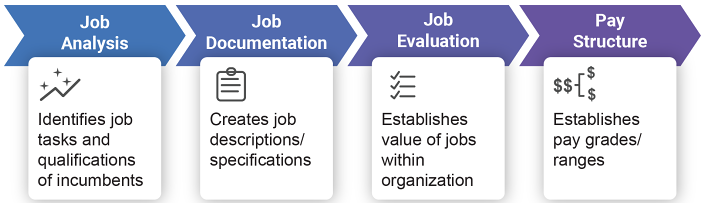
Steps in Designing a Compensation system
HR analyzes jobs to identify duties and required skills, evaluates each job's relative value, and researches market pay. HR then develops a pay structure aligned with organizational culture, values, and market needs.
Compensation is based on the value of the job, not the individual employee.
Job Analysis & Documentation
Studies the tasks, responsibilities, and conditions that are associated with a job and which personal qualifications are necessary for the performance of the job. The analysis looks at the job, not of the person or persons doing the job.
Results in the three deliverables:
Job Description
Job Specification
Job Competencies
Job description (Job Analysis)
A written description of the job and essential functions and requirements, including tasks, KSAs, responsibilities, and reporting structure.
What is the job?
Job specifications (Job Analysis)
A written statement of the minimum qualifications necessary to perform a job.
Who is needed for the job?
Job competencies (Job Analysis)
Clusters of highly interrelated attributes, including KSAs, that should be part of a competency model.
Job Classification
Job evaluation method in which descriptions are written for each class of jobs; individual jobs are then put into the grade that best matches their class description.
Job Evaluation
Determines the value and price of a job to place and compare it within an organization as well as attract and retain employees, supporting the total rewards strategy and addressing pay equity concerns.
Job-content-based job evaluation
Determines the relative worth and pay structure of different jobs based on assessment of their content and relationship to other jobs in the organization (may be nonquantitative like ranking and classification, or quantitative like the point-factor system).
Nonquantitative Job Evaluation Method
Strive to establish a relative order of jobs.
Job Ranking - Ranks job from most valuable to least valuable.
Job Classification - This method writes descriptions for each class of jobs. Individual jobs are then put into the grade that best matches their class description, based on the judgment of the evaluator.
Paired-comparison Method
Job evaluation method in which each job is compared with every other job being evaluated; the job with the largest number of “greater than” rankings is the highest-ranked job, etc.
Point Factor System
Job evaluation method that looks at compensable factors (such as skills and working conditions) that reflect how much a job adds value to the organization; points are assigned to each factor and then added to come up with an overall point value for the job.
It is the most systematic and analytical method and it includes documentation of the process. Other job evaluation methods do not have this.
Quantitative Job Evaluation Method
Evaluate specific factors on a scale and provide a score that indicates how valuable one job is compared to another.
Point factor system:
Identify compensable factors
Define factor levels
Assign points based on level of importance
Evaluate jobs
Set pay structure based on total point value
Market-based job evaluation
Determines the relative worth and pay structure of different jobs based on their market value or the going rate in the marketplace (also called "market pricing").
Remuneration surveys
Collect information on prevailing market compensation and benefits practices, including starting wage rates, base pay, pay ranges, other statutory and market cash payments (for example, overtime pay and shift differentials), variable compensation (for example, short- and long-term incentive plans), and time off (vacation and holiday practices).
Internal Surveys (Remuneration survey)
This also allows organizations to ensure that salaries are internally aligned, which means that comparable jobs and skill levels within the company are paid comparable wages, and it ensures that different jobs and skills are compensated appropriately to recognize their different requirements.
External Surveys (Remuneration survey)
Draws on extensive databases of incumbents and industry benchmarks and can provide real-time insights into total compensation levels, practices, and emerging trends.
Global market considerations
Global salary data may be limited, outdated, or difficult to compare. HR must evaluate data sources, availability, market changes, and job comparability to establish appropriate salary ranges. When reliable data is scarce, HR may need to make informed estimates (extrapolation).
Survey data analysis
Survey data must first be verified and may need to be aged, leveled, and/or factored for geography (location).
Aging (Survey data analysis)
The technique of using movement in market rates to adjust outdated salary data.
Leveling (Survey data analysis)
The process of adjusting salaries when surveyed jobs are similar but not identical to jobs in the organization. (ex. looking for 7 years of exp. but best candidate has 5 years of exp.)
Benchmarking
Initiatives ranging from informal networking and knowledge sharing to formal engagements with private firms that help identify gaps in policies and procedures compared to competitors and best practices.
Can improve an organization’s ability to attract, retain, engage, and reward talent.
Pay grades
Groupings of jobs that have approximately the same worth within an organization and pay the same rate or within the same pay range.
Pay ranges
Upper and lower bounds of possible compensation established for individuals whose jobs fall in a pay grade, using market survey data to determine the midpoint.
Compa-ratio
A calculation dividing the pay rate of an employee by the midpoint of the range (Compa-ratio=MidpointPay rate), where values below 1.00 signify pay below the midpoint and values greater than 1.00 signify pay exceeding the midpoint.
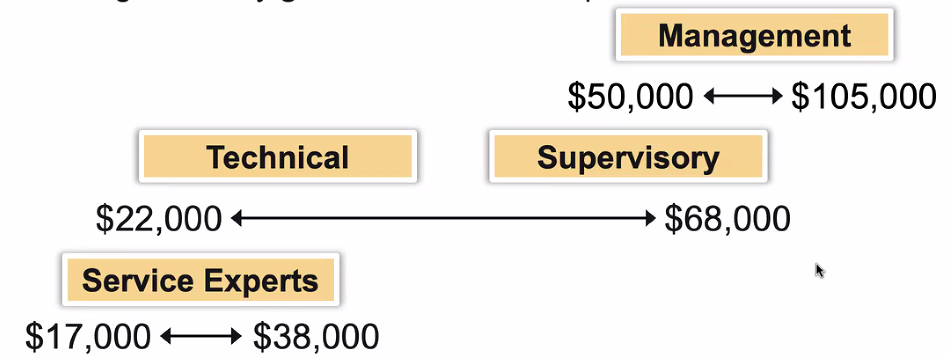
Broadbanding
Combines salary grades to create larger ranges, allowing people to move within their job without outgrowing the pay scale and avoiding too many grades with small midpoint differences. Reduces the number of job grades within an organization. This approach can be used to support de-layering efforts, which reduce the number of reporting levels within an organization.
Advantages: Simplifies pay structures, reduces management levels, and gives managers more flexibility.
Disadvantages: Less control over pay costs, fewer promotion opportunities, and greater risk of pay inequity.
SHRM takeaway: Broadbanding increases flexibility but reduces compensation control.
Wage and Hour Law Compliance
HR must comply with applicable laws governing minimum wage, overtime, equal pay, employee exemptions, work-hour limits, and breaks. Requirements vary by country and may be affected by collective bargaining agreements.
SHRM takeaway: Employers must also consider local tax laws and home- versus host-country requirements for international employees. Noncompliance can result in significant financial and criminal penalties.
Single- or flat-rate pay system
A base-pay system where employees receive the same rate of pay, regardless of performance or seniority; generally corresponds to target market survey data for the job.
Time-based step-rate system
A base-pay system where the pay rate is based on longevity, with increases occurring on a pre-determined schedule (automatically by percentage and time, affected by performance, or through a combination).
Performance-based or merit pay (P4P or PfP)
A base-pay system linked to measures of work quality or goals, requiring employers to defend practices and address global differences in incentives, risk, and individual versus collective performance.
A well-crafted and executed pay-for-performance program allows an organization to evaluate the return on labor expenses.
Productivity-based pay system
A base-pay system based on output, consisting of straight piece-rate (base plus) or differential piece-rate where the rate increases in steps after a standard is met.
Person-based pay system
A base-pay system in which employee pay is affected by their knowledge, skill, or competencies.
Pay Adjustments
General Pay Increases
COLAs
Seniority Increases
Pay Adjustment Matrix
Market Based Increase
Lump Sum Increase
Differential pay
Additional compensation based on when an employee works (time-based, such as night shift, overtime pay or on-call) or where an employee works (geographic differentials for labor costs, location attraction, or foreign assignments).
Incentive pay
Compensation designed to motivate employees to perform at higher levels by paying for performance beyond base-pay expectations on achievable goals an employee can influence.
Types of incentives
Three types of incentives reward performance at different levels:
Individual: Rewards personal performance (piece-rate pay, commissions, noncash rewards).
Group: Rewards team performance and cooperation (gainsharing, team bonuses).
Organization-wide: Rewards overall organizational success (profit sharing, stock ownership, company-wide bonuses).
Executive Pay
Includes a larger proportion of incentives than regular employee pay. Incentives are typically tied to overall organizational performance, including profitability, customer satisfaction, and strategic goals.
SHRM takeaway: Executive pay emphasizes performance-based incentives linked to organizational success.
Types of Executive Compensation
Annual Salary
Stock Options Plans
Stock Purchase Plans
Restricted Stock Grants
Phantom Stock
Restricted Stock Units
Performance Grants
Stock Option Plans
Executives may be given the option to purchase company stock at a pre-determined price for a certain period of time, usually five to ten years.
Stock Purchase Plans
This type of plan allows executives the opportunity to purchase shares at a discount or without paying brokerage fees.
Phantom Stock
This consists of cash awards designed to mimic shares of stock, without actually conveying equity via the granting of shares.
Restricted Stock Grants
The recipient cannot sell the stock from a restricted stock grant until a certain time period has passed. Typically the employee must remain with the company during this time period.
Restricted Stock Units
Often used to defer compensation of key executives until after they have retired, this amounts to a promise of a certain amount of stock once specified restrictions have been fulfilled.
Performance Grants
This stock-based compensation is tied to organizational performance.
Nonqualified deferred compensation plan
Allow organizations to provide additional benefits to a select group of key executives, which motivates them to stay with the organization.
Direct Sales Compensation
Three methods of compensating sales employees:
Straight Salary: Fixed pay; best for customer service-focused roles, long sales cycles, or difficult-to-measure sales.
Straight Commission: Pay based entirely on sales; encourages higher sales volume and controls costs.
Salary + Commission/Bonus: Most common method; combines stable pay with performance incentives.
SHRM takeaway: Sales compensation should motivate performance and align with organizational goals.
Compensation for Outside Directors
Outside board directors may receive retainers (base pay), meeting or committee fees, insurance benefits, executive perks, stock options, and deferred compensation.
SHRM takeaway: Outside directors receive compensation for their board service rather than regular employee duties.
Red-circle rates (Pay Variation)
Pay rates that are set above the established salary range maximum.
Ex. When long-term employees reach the maximum rate in their range or when promotion opportunities are rare
Green-circle rates (Pay Variation)
Pay rates that are set below the established salary range minimum.
Pay compression
A situation where there are small differences in pay between employees regardless of experience, skills, level, or seniority.
ex. when you bring someone new into the organization, and the company they're coming from leads the market from a compensation structure standpoint. And although they only have maybe 1 or 2 years of experience. We don't want to pay them more than a person in our own company that has more years of experience. We want to maintain some equity.
Global Benefits Variations
Employee benefits vary by country and fall into four categories:
Government-provided: Funded through taxes (health care, retirement).
Government-mandated: Legally required employer benefits (paid leave, holidays).
Voluntary: Additional benefits offered by employers (extra vacation, health coverage).
Market practice: Benefits offered to remain competitive (transportation, meal allowances).
SHRM takeaway: Benefits and their tax treatment vary across countries.
Benefits Needs Assessment
HR evaluates four areas to ensure benefits align with organizational goals and employee needs:
Organizational Strategy: Review market competitiveness.
Compensation Philosophy: Evaluate benefits budget and costs.
Workforce Demographics: Identify employee needs.
Benefits Utilization: Analyze existing benefits and usage.
SHRM takeaway: The final step is a gap analysis comparing organizational needs, employee needs, and existing benefits to identify improvements.
Paid-Time-Off (PTO) Benefits
Paid leave that supports employee well-being, productivity, and work/life balance. Requirements vary by country and local law.
Family-Oriented Benefits
Benefits that help employees balance work and family responsibilities, including flexible schedules, child care, elder care, and domestic partner coverage.
Domestic Partner Benefits
Benefits extended to eligible unmarried partners, such as health insurance, life insurance, parental leave, and retirement benefits. Eligibility varies by law and employer policy.
Voluntary vs. Involuntary Termination
Voluntary: Employee resigns or retires.
Involuntary: Employer ends employment due to performance, misconduct, restructuring, or workforce reductions.
Severance Packages
Compensation provided upon termination, often based on years of service, position, and local laws. May include salary continuation, lump-sum payments, and unused vacation payouts.
Termination Compliance
HR must follow applicable laws governing notice periods, termination reasons, severance, and consultation requirements. Noncompliance can result in significant penalties.
Outplacement Services
Employer-provided assistance helping terminated employees find new jobs through résumé support, career coaching, and interview preparation.
Unemployment Insurance
Temporary financial assistance for eligible workers who lose employment through no fault of their own. Benefits typically have waiting periods and payment limits.
Defined benefit plan
A retirement plan (sometimes pension) that promises payment of a pre-specified benefit amount at retirement calculated by a formula based on service and salary, where the employer bears the investment risk. No promises are made about the future value of the benefit.
Vesting schedule is set up. (Vesting is the process by which employees gain permanent claim to a portion or all of their benefit. Employees are always 100% vested in their own contributions; employer contributions usually vest over time.)
Defined contribution plan
A retirement plan where regular contributions to individual accounts are specified without a promised future value, leaving the employee with investment returns and bearing the investment risk.
Fiduciary duty
The legal obligation of one party (for example, an employer) to act in the best interest of another (for example, employees).
Fiduciary
The obligated individual or party entrusted with the care of money or property.
Social Security
Government programs providing financial protection through retirement, disability, survivor, unemployment, health, and basic assistance benefits.
Benefits costs as a percentage of total payroll costs
A metric reflecting the total costs of benefits divided by the total payroll costs for the organization (Total payroll costsTotal benefit costs), identifying the proportion of benefits expenses.
Health-care expense per employee
A metric calculated as Number of employees enrolled in health-care planTotal health-care expenses measuring the per capita cost of health care for a given fiscal year.
Insurance participation rate
A metric calculated as Total number of employeesNumber of employees enrolled indicating the percentage of employees enrolled in insurance benefits to assess benefit quality, value, and competitiveness.