MBB2 - Social Psychology
 Call Kai
 Learn
 Practice Test
 Spaced Repetition
 Match
 Flashcards
 Knowt Play
1/68

There's no tags or description
Looks like no tags are added yet.
69 Terms
SOCIAL PSYCHOLOGY
The scientific study of how people’s thoughts, feelings, and behaviours are influenced by the actual, imagined or implied presence of others (Allport, 1985)
THE POWER OF THE SITUATION (Kurt Lewin)
the behaviour of people is always a function of the field of forces around them
for humans is the situation they find themself in
human behaviour can be thought of as resulting from a combination of particular personal attributes in a particular situation
PERSON x SITUATION
INDIVIDUAL
relationship with the self
INTERPERSONAL
relationship with other individuals
INTRAGROUP
relationship with other people in our group
INTERGROUP
relationships with people in a different group
THE SELF
a consistent or unitary awareness of who we are that persists overtime
how we think of ourselves
what we like and dislike
habits we form
values we adhere to
how we behave
SOCIAL IDENTITY
the sense of self we gain from the group memberships we belong to
THE SOCIAL ME
what we know about ourselves from social relationships
we a person is in one context isnt necessarily the same person they are in another context
WORKING SELF-CONTEXT
the mechanism causing the social me
a subset of our self-knowledge is brought to mind given a context
the self relevant to relationships may be the mind’s prime focus in romantic contexts
SELF CATEGORIZATION THEORY
we categorize people into INGROUPS (groups we belong) and OUTGROUPS (groups we don’t belong)
how we construe these groups impacts our sense of self identity
CULTURAL IDENTITY
our sense of self is derived from groups we belong to that have a distinct culture (nationality, ethnicity, social class, etc)
can be fostered directly (through socialization efforts) or indirectly (through environmental exposure)
CULTURAL SELF CONSTRUAL - INDIVIDUALIST
the self is an autonomous entity separate from others, people should assert their independence and celebrate their uniqueness (e.g. my environment should change to fit me)
common in Western countries
separate from social context
promotes own goals
CULTURAL SELF CONSTRUAL - COLLECTIVIST
my self is fundamentally connected to other people, people should seek to fit in a community and fulfill appropriate roles (e.g. i should change to fit my environment)
common in East Asian, South Asian, African and Latin American countries
connected with social context
fit, occupy your proper place
THE SOCIOMETER HYPOTHESIS
things that make us feel good about ourselves (self-esteem) are also the things that make others accept and like us (belonging)
high self esteem signals social inclusion
low self esteem signals social exclusion
self esteem cues when we need to attend to social bonds
SOCIAL COMPARISON THEORY
TWO ASSUMPTIONS
we seek accurate self evaluations
comparisons with others help us reality check our own self-evaluations
TWO COMPARISONS
downward comparisons (can improve self eval)
upward comparisons (can worsen self eval)
SELF EVALUATION MAINTENANCE MODEL
TWO ASSUMPTIONS
we seek to maintain or improve our self eval
comparisons with others influence our self eval
TWO PROCESSES
reflection: other people improve our self eval - usually occurs when not relevant to the self
SELF EVAL GOES UP
comparison: other people worsen our self eval - usually occurs when relevant to the self
SELF EVAL GOES DOWN
both exacerbated with a closer other
BIRG-ing
basking in reflected glory
others success becomes our success
align ourselves publicly with successful others
saying ‘we’
motive fro enhancement: we want to feel good
CORF-ing
cutting off reflective failure
other’s failure become our failure
we distance ourselves publicly from others
motive for protection: we want to avoid feeling bad
THE BETTER THAN AVERAGE EFFECT
most people tend to view themselves positively
most people thing they are above average on a range of positive dimensions
LONELINESS
subjective feeling of distress when social relations are not going how we would like
lack of quality of social connections
associated with worse physical health
worse life satisfaction
greater social anxiety/negative emotions
BI-DIRECTIONAL impact on mental health
OSTRACISM
social shunning - any act of ignoring and excluding of an individual or group by and individual or group
GROUP REASONS
strengthen the group
protect the group
INDIVIDUAL REASONS
to feel more powerful or in control
DISCRIMINATION
how others treat us on the basis of our group membership impacts on our mental and physical health
increase stress and emotional reactions
negative coping responses
reduced access to resources
SOCIAL MEDIA - STIMULATION HYPOTHESIS
online interactions strengthen existing relationships and thus have a social benefit
stimulate wellbeing when it facilitates meaningful relationships
enhances self-disclosure which can improve relationships and wellbeing
SOCIAL MEDIA - DISPLACEMENT HYPOTHESIS
social media replaces offline face-to-face interactions, thus incurring social costs
bad when it replaces relationships or sleep which can lead to loneliness
can be addictive
bad when it promotes upward social comparison
SNAP JUDGEMENTS
judgements that we make quickly about people with very little information
THIN SLICING
the ability to find patters in events based on “thin slices”, or narrow windows of experience
PERSON PERCEPTION
how we perceive others is a complex process but judgements tend to be based on WARMTH and COMPETENCE
WARMTH: friend or foe? (kind, sincere, generous, helpful)
COMPETENCE: are they able to carry out their intentions towards me? (skill, efficiency, confidence, intelligent)
warmth judgments occur before competence judgements
INNUENDO EFFECT
tendency to infer qualities about people when we haven’t been giving concrete information
E.G. hearing someone is warm, and assuming they are incompetent
or heading someone is competent, and assuming they are cold
ALGEBRAIC MODELS (first impressions)
impressions formed on the basis of a mechanical combination of information about a passion
summative
averaging
weighted averaging
SUMMATIVE (first impressions - algebraic)
adding up of traits or qualities to form and impression of a person
AVERAGING (first impressions - algebraic)
averaging the traits or qualities of a person to form an impression, no one trait is having too significant of an effect
WEIGHTED AVERAGE MODEL (first impressions - algebraic)
averaging traits or qualities of a person to from an impression HOWEVER traits are given more weight based on how much we care about them
CONFIGURATION MODEL (first impressions)
BASED ON GESTALT PRINCIPLES : people combine information they receive about someone into an overall impression (can be different from a sum of traits)
central traits : influential in impression formation
peripheral traits : less influential
WHAT DO WE LIKE IN OTHERS?
familiarity
similarity
early on : actual similarity matters more
later on : perceived similarity matters more
attractiveness
THE CAPITALIZATION CYCLE
healthy patters of communication lead to stronger social bonds
share good news
others respond with enthusiasm
feel understood and validated
feel positive and better relationship
OBEDIENCE
social influence in which a person yields to explicit instructions or orders from an authority figure
increased by factors such as:
authority figure has high status
participants believe the authority figure is responsible for the actions
no clear-cut point to switch to disobedience
gradual escalation in situation
MILGRAM’S OBEDIENCE STUDIES
Experiments to examine how individuals could obey orders that instructed them to harm others
the teacher (naive participant) is instructed by the experimenter to run a series of learning trials, and administer an electric shock to the learner (confederate) in case of mistake
learners consistently made errors and reacted verbally and physically
the experimenter responded with escalating statements (‘you have no choice other than to go on’)

STANFORD PRISON EXPERIMENT
Phillip Zimbardo (1973) college students assigned to prison guards and prisoners
prisoners became emotionally disturbed
some guards began tormenting and abusing prisoners (about 30%)
Zimbardo actively encouraged guards to act in hostile ways
PERSUASION
the ability to convince someone
appeals to the head
appeals to the heart
PERSUASION - EMOTION BASED APPEALS
compliance is higher when people are in a positive mood
mood colours our interpretation of events
we want to maintain a positive mood once we’re in it
PERSUASION - REASON BASED APPEALS
persuasion attempts focused on changing cognitive bias’
NORM OF RECIPROCITY
when someone does something for us, we feel pressure to help in return
POWER OF COMMITMENT
once a choice has been made, people feel pressure from themselves and others to act consistently with that commitment (even if the commitment becomes increasingly costly)
DOOR IN THE FACE EFFECT
ask for a very large favour that will certainly be refused, then follow with a modest favour
the drop in size of the request makes people feel more compelled to respond positively
FUELLED BE RECIPROCITY
FOOT IN THE DOOR EFFECT
make a small request which most people will agree to, then follow up with a larger request
human behaviour is subject to momentum
FUELLED BY COMMITMENT
MAJORITY INFLUENCE
when most group members behave in a certain way, one tends to behave similarly
MINORITY INFLUENCE
even if there is a strong majority, a consistent minority in the group can affect group member’s behaviour
influenced by factors
anonymity
expertise and status
group size
group unamity
WHAT ENCOURAGES PEOPLE TO GIVE
social closeness
trust
democratic factors (women and older people tend to be more generous)
SOCIAL LOAFING
the tendency to exert less effort when working on a group task than if they were working on the task individually
WHY?
deindividuation : no one will know
equity : others wont so why should i
reward : no one will know what i did
more likely when motivation is low
SOCIAL FACILITATION
when working in a group increases productivity
co-action effects : we perform better when we do tasks with others
audience effects : we perform better when we are watched by others
because of physiological arousal and evaluation apprehension
more likely when motivation is high
more likely on simple tasks
ALTRUISM
prosocial behaviour that benefits others without regard to consequences for onself
motivations
social reward
alleviate personal distress
empathetic concern
COMPETITIVE ALTRUISM
if people are motivated by social reward, they may try to outdo one another in altruistic acts
SMOKE UNDER THE DOOR EXPERIMENT
in a waiting room for a study, smoke began coming out from under the door
one group alone
one group with 2 confederates trained not to respond
one group with 3 real participants
why did bystanders not intervene
diffusion of responsibility
pluralistic ignorance (uncertain about the legitimacy of the emergency because of a lack of reaction from others)
evaluation apprehension (people don’t want to seem foolish)

PREJUDICE
pre-judgement, when we judge someone for belonging to a group before having meaningful contact with them
an attitude or affective response (pos or neg)
DISCRIMINATION
favourable or unfavourable BEHAVIOUR or TREATMENT toward individuals based on their group membership
BLANANT PREJUDICE
explicit rejection of the outgroup
belief in inferiority
outward expression of negativity
PREJUDICE - ECONOMIC PERSPECTIVE
intergroup tension that arises from competition over the same resource
prejudice increases under conditions of economic difficulty
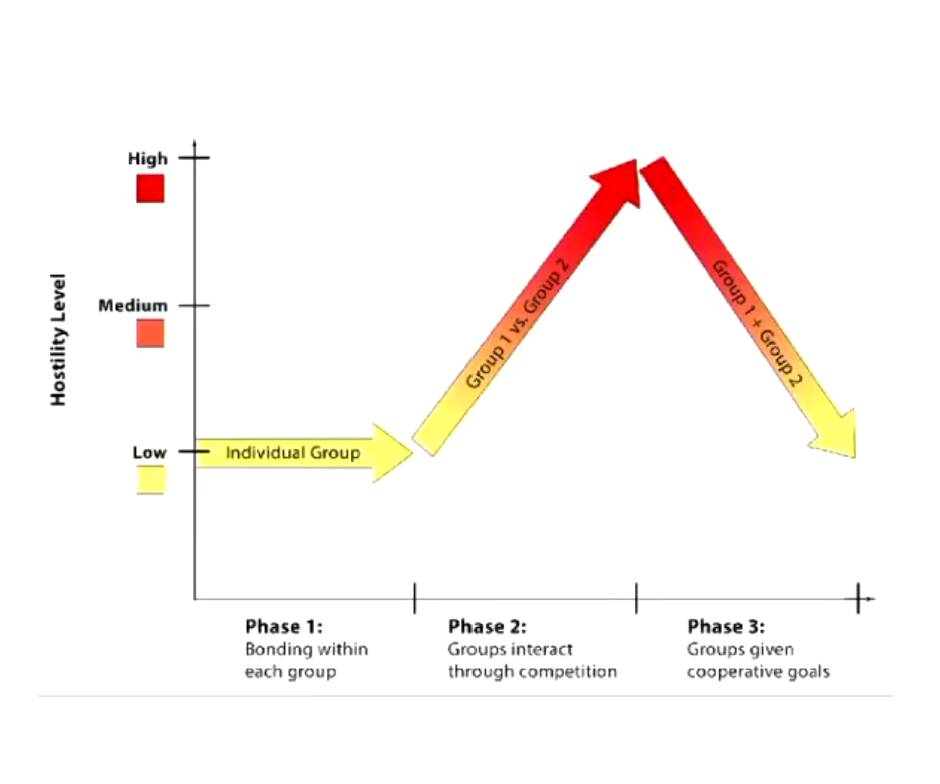
THE ROBBERS CAVE EXPERIMENT (BOY CAMP STUDIES)
boys allocated into 2 groups
stage 1 - ingroup information, team identity is formed
stage 2 - group conflict, groups compete for limited resources
stage 3 - conflict resolution, groups work together to achieve collective goals
PREJUDICE - THE MOTIVATIONAL PERSPECTIVE
hostility can emerge between groups even in the absence of direct competiton
can develop simple because another group exists
THE MINIMAL GROUP PARADIGM
study of prejudice by Tajfel (1970)
designed to reveal the minimal conditions required for intergroup favouritism
eg flipping a coin to decide groups, there is no real difference between the people
RESULT: people want the groups they belong to to succeed even if they are arbitrary
THE COGNITIVE MISER
people tend to favour simple ways of thinking, therefore we rely on cognitive shortcuts or prejudices to make assumptions about people
a by product of the human desire to categorise people and things
PREJUDICE REDUCTIONS
economic lens
reduce competition between groups
recategorisation
motivational lens
set ingroup norms against prejudice
normative influence
cognitive lens
weaken the effects of stereotypes by exposing people to different groups
intergroup contact