Week 4: Risk and Culture; Landslides
0.0(0)
Studied by 0 people Call Kai
 Learn
Learn Practice Test
 Spaced Repetition
 Match
Match Flashcards
 Knowt Play
Card Sorting
1/63

Earn XP
Description and Tags
Last updated 12:10 PM on 10/11/26
Name | Mastery | Learn | Test | Matching | Spaced | Call with Kai | Chat |
|---|
No analytics yet
Send a link to your students to track their progress
64 Terms
1
New cards
Patterns of Choice
There are 4 patterns describing how people choose to respond to a risk.
2
New cards
Pattern 1: Absorb
1. **Absorb**
* view the risk as unproblematic or deny it outright
* the probability is deemed too low to worry about
* fate is determined by the capacity to absorb less
\
Example: San Andreas fault
3
New cards
Pattern 2: Accept
2. **Accept**
* there is awareness of the hazard (no denial)
* passive attitude (there is little that can be done to reduce the impacts)
* hazards are often viewed as acts of God
\
Example: Nigeria drought
4
New cards
Patterns 3: Reduce
3. **Reduce**
* awareness of the hazard (no denial)
* action is taken to reduce impacts
* typically, there is reactive response and some preparation
* usually people stay in place
\
Example: Flooding events, snow and wind related hazards
5
New cards
Pattern 4: Change
4. **Change**
* there is awareness of the hazard (no denial)
* radical action may be taken (move away or change land use)
\
Example: Australia drought
6
New cards
Social amplification of risk
After many years of research on public responses to risk, no comprehensive theory exists to explain why apparently minor risk events (as assessed by experts) sometimes produce massive public reactions.
\
example of a hazard that typically evokes massive public reactions that are more severe than what the hazard likely warrants?
* could literally be any hazard, nuclear meltdown
\
Potentially negative impacts of such reactions
* slowed down growth of nuclear industry
\
example of a hazard that typically evokes massive public reactions that are more severe than what the hazard likely warrants?
* could literally be any hazard, nuclear meltdown
\
Potentially negative impacts of such reactions
* slowed down growth of nuclear industry
7
New cards
Evocative Hazards
These are hazards that typically induce much public reaction despite data suggesting they may create little risk
\- Ex: pesticides
\
Canadians take pride in having attractive lawns around their homes and many use lawn care products to maintain them.
\
However, pesticide use for lawn care has become an issue in many communities across Canada due to increasing awareness of the *potential* impact.
\- Ex: pesticides
\
Canadians take pride in having attractive lawns around their homes and many use lawn care products to maintain them.
\
However, pesticide use for lawn care has become an issue in many communities across Canada due to increasing awareness of the *potential* impact.
8
New cards
Banal Hazards
These are hazards that induce little public reaction even though they may have similar risks to some evocative hazards
\- ex.
According to a Consumers Union study, eating peanut butter (which contains an average level of 2 parts per billion of aflatoxin) once every 10 days presents a cancer risk of 7 in one million. Small as that may seem, it is higher than the estimated risk of cancer from most pesticides.
* cancer risk is higher than the banned pesticides - it doesn’t make sense
\- ex.
According to a Consumers Union study, eating peanut butter (which contains an average level of 2 parts per billion of aflatoxin) once every 10 days presents a cancer risk of 7 in one million. Small as that may seem, it is higher than the estimated risk of cancer from most pesticides.
* cancer risk is higher than the banned pesticides - it doesn’t make sense
9
New cards
Amplification of risk
* Involves hazards that have low probability as assessed by experts
* Elicit __strong public concern__
* Elicit __strong public concern__
10
New cards
Attenuation of risk
* Involves hazards that may have greater impacts and a relatively higher probability
* Elicit __weaker public concern__
* Elicit __weaker public concern__
11
New cards
Transmitter, signal and receiver
**Transmitter**
* generates and sends the message about the risk
\
**Signal**
* the message itself
\
**Receiver**
* the target audience for message signals
* The original signal may be considerably modified by the time it reaches the receiver
* generates and sends the message about the risk
\
**Signal**
* the message itself
\
**Receiver**
* the target audience for message signals
* The original signal may be considerably modified by the time it reaches the receiver
12
New cards
Signal Value
Signals can be prescribed values by the receiver.
* this is related to the characteristics of the event and the hazard it reflects
\
\
High signal values may suggest that a new risk has appeared or that the risk is different than previously understood.
eg.
* this is related to the characteristics of the event and the hazard it reflects
\
\
High signal values may suggest that a new risk has appeared or that the risk is different than previously understood.
eg.
13
New cards
Signal Value examples
A large accident that takes many lives may have a low signal value if it occurs as part of a familiar and understood system (such as a car crash).
\
A small accident in an unfamiliar or poorly understood system (nuclear power plant, laboratory) , may have a high signal value and cause concern since people may perceive risk is __**uncontrollable**__
\
A small accident in an unfamiliar or poorly understood system (nuclear power plant, laboratory) , may have a high signal value and cause concern since people may perceive risk is __**uncontrollable**__
14
New cards
Stigmatization
This is a process by which negative images are ascribed to places, technologies, or people.
\
The risk perception of a future event in the area could be altered simply because of past event there.
\
Example: Love Canal - Niagara Falls Spill, US
(completely cleaned up now, but the stigma is still there)
\
The risk perception of a future event in the area could be altered simply because of past event there.
\
Example: Love Canal - Niagara Falls Spill, US
(completely cleaned up now, but the stigma is still there)
15
New cards
Spread of impacts
Impacts can spread like ripples and often extend well beyond the local area
* entire countries, technologies (medications), industries can be affected (meat)
* entire countries, technologies (medications), industries can be affected (meat)
16
New cards
Secondary Impacts
* property values and insurance rates may change in response to an event
17
New cards
Risk perception Theories
Research Question:
Why do some people feel that some technologies (e.g., nuclear energy or chemical pesticides) are a major concern while other people feel that they are not a concern?
\
**There are 5 theories that attempt to explain this:**
* knowledge
* personality
* economic
* political
* cultural
Why do some people feel that some technologies (e.g., nuclear energy or chemical pesticides) are a major concern while other people feel that they are not a concern?
\
**There are 5 theories that attempt to explain this:**
* knowledge
* personality
* economic
* political
* cultural
18
New cards
Knowledge theory
How was this theory tested?
* education level
* self-reported knowledge
(People were asked to provide an estimate of annual fatalities from 8 technologies (aviation, nuclear energy, lawn mowers, etc)).
Their answers were then compared to actual fatality data.
\
**Hypothesis:**
* Greater knowledge of fatality data leads to a greater perceived threat from the technology
* education level
* self-reported knowledge
(People were asked to provide an estimate of annual fatalities from 8 technologies (aviation, nuclear energy, lawn mowers, etc)).
Their answers were then compared to actual fatality data.
\
**Hypothesis:**
* Greater knowledge of fatality data leads to a greater perceived threat from the technology
19
New cards
Personality theory
This theory was tested using validated measures and questionnaires developed by psychologists.
\
**Hypothesis:**
* there is a consistency between the personality type and the perceived threat from technological hazards
\
**Hypothesis:**
* there is a consistency between the personality type and the perceived threat from technological hazards
20
New cards
Economic theory
This theory is based on the annual income of the people tested
\
**Hypotheses:**
* the wealthy are more willing to take risks with technology because they may benefit more or have better access
\
The poor are less willing because they may deal with any associated burdens (pollution).
\
**Hypotheses:**
* the wealthy are more willing to take risks with technology because they may benefit more or have better access
\
The poor are less willing because they may deal with any associated burdens (pollution).
21
New cards
Political theory
This theory was tested by determining the political ideology of the subjects (through completion of a 20-question survey).
\
**Hypothesis:**
* personal views toward risk are related to the political party and policies) that people support
\
**Hypothesis:**
* personal views toward risk are related to the political party and policies) that people support
22
New cards
Cultural theory
This theory is based on the way of life of the people (urban, rural, retired, child-rearing, etc)
* It is supported by personal worldviews (i.e., the way the person believes the world operates or should operate).
\
examples:
* Hierarchal
* egalitarian
* Individualist
\
Hypothesis: The worldview is correlated to how the person perceives risk.
* It is supported by personal worldviews (i.e., the way the person believes the world operates or should operate).
\
examples:
* Hierarchal
* egalitarian
* Individualist
\
Hypothesis: The worldview is correlated to how the person perceives risk.
23
New cards
Hierarchical worldview
This view ^^defines boundaries between superiors and subordinates.^^
\
Examples of this view:
* strong patriotism
* support for country, right or wrong
* strong respect for authority (law, order and obedience are strongly valued)
* strict ethical standards
* concern about lack of obedience in youth
\
Examples of this view:
* strong patriotism
* support for country, right or wrong
* strong respect for authority (law, order and obedience are strongly valued)
* strict ethical standards
* concern about lack of obedience in youth
24
New cards
Egalitarian worldview
This view ^^centres on political solutions to inequality^^.
\
Examples of this view:
* belief that world conflict can be eliminated with a more equal distribution of resources
* support for gov’t efforts to reduce poverty
* support for high tax burdens on the wealthy
* a lack of trust in large corporations
\
Examples of this view:
* belief that world conflict can be eliminated with a more equal distribution of resources
* support for gov’t efforts to reduce poverty
* support for high tax burdens on the wealthy
* a lack of trust in large corporations
25
New cards
Individualism worldview
This worldview ^^emphasizes personal freedom and choice.^^
\
Examples of this view:
* constraints on individuals should be minimized (lack of support for heavy government regulation)
* belief that a welfare state destroys individual initiative
* continued economic growth and private profit are keys to quality of life
\
Examples of this view:
* constraints on individuals should be minimized (lack of support for heavy government regulation)
* belief that a welfare state destroys individual initiative
* continued economic growth and private profit are keys to quality of life
26
New cards
Study results
Tests of the 5 theories were performed in a study by Wildavsky and Dake; 134 people participated in the study.
27
New cards
Results: Knowledge theory
\
The results suggested that greater knowledge resulted in a greater perceived benefit from technological activities, but __**results were not statistically significant.**__
rejected hypothesis
The results suggested that greater knowledge resulted in a greater perceived benefit from technological activities, but __**results were not statistically significant.**__
rejected hypothesis
28
New cards
Results: Personality theory
Those who perceived technological activities as high risk had less aggressive personality types.
\
People with less aggressive personalities generally tend to avoid potential risk
\
__**hypothesis is true**__
\
People with less aggressive personalities generally tend to avoid potential risk
\
__**hypothesis is true**__
29
New cards
Results: Economic theory
__**The results were inconsistent**__ since there was little correlation between income and personal views toward the risks of technological activities.
\
\
30
New cards
Results: Political Theory
Those who identified as left-wing were more likely to see the technological activities as threatening
31
New cards
Results: Cultural theory
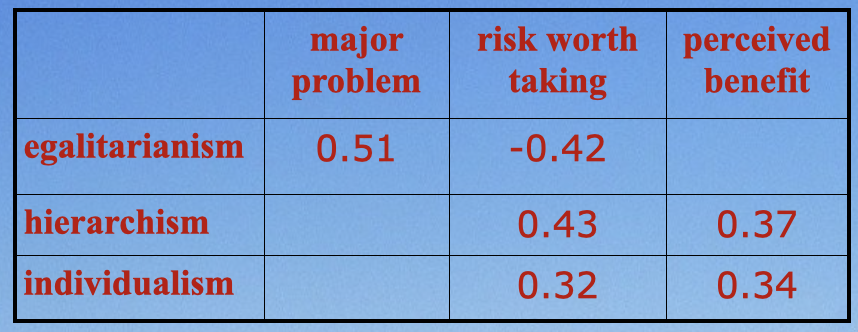
Only the highest correlations are listed on the table and all those listed are statistically significant.
32
New cards
Summary of results
\
which theory was the best explanation for perceived risk?
\
\
which theory was the best explanation for perceived risk?
\
**Theory** **Result**
Knowledge → Inconclusive
Personality → Conclusive
Economic → Inconclusive
Political → Conclusive
Cultural → Conclusive
\
The cultural theory was found to be the best explanation for how people perceived risk
Knowledge → Inconclusive
Personality → Conclusive
Economic → Inconclusive
Political → Conclusive
Cultural → Conclusive
\
The cultural theory was found to be the best explanation for how people perceived risk
33
New cards
World views and social conflict
The clash of worldviews can sometimes result in conflict whether the views are based on fact or not
\
Example:
* A wealth of scientific evidence shows warming average temperatures worldwide.
\
Environmentalists respond by lobbying governments to regulate emissions, but economic growth advocates cast doubt on the quality of the data
\
Example:
* A wealth of scientific evidence shows warming average temperatures worldwide.
\
Environmentalists respond by lobbying governments to regulate emissions, but economic growth advocates cast doubt on the quality of the data
34
New cards
Landslides
**Definition:**
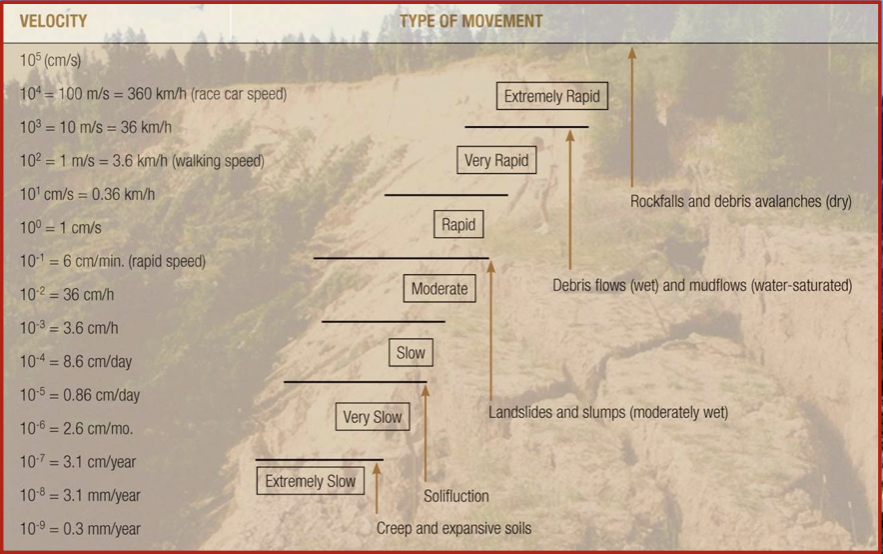
* downslope movements of rock or sediment as a result of gravity
Movement is classified as rapid if it can be detected by eye.
* downslope movements of rock or sediment as a result of gravity
Movement is classified as rapid if it can be detected by eye.
35
New cards
Classification of landslides
based on 4 variables:
based on 4 variables:
* mechanism of movement
* type of material
* amount of water present
* speed of movement
* type of material
* amount of water present
* speed of movement
36
New cards
3 basic mechanisms of movement
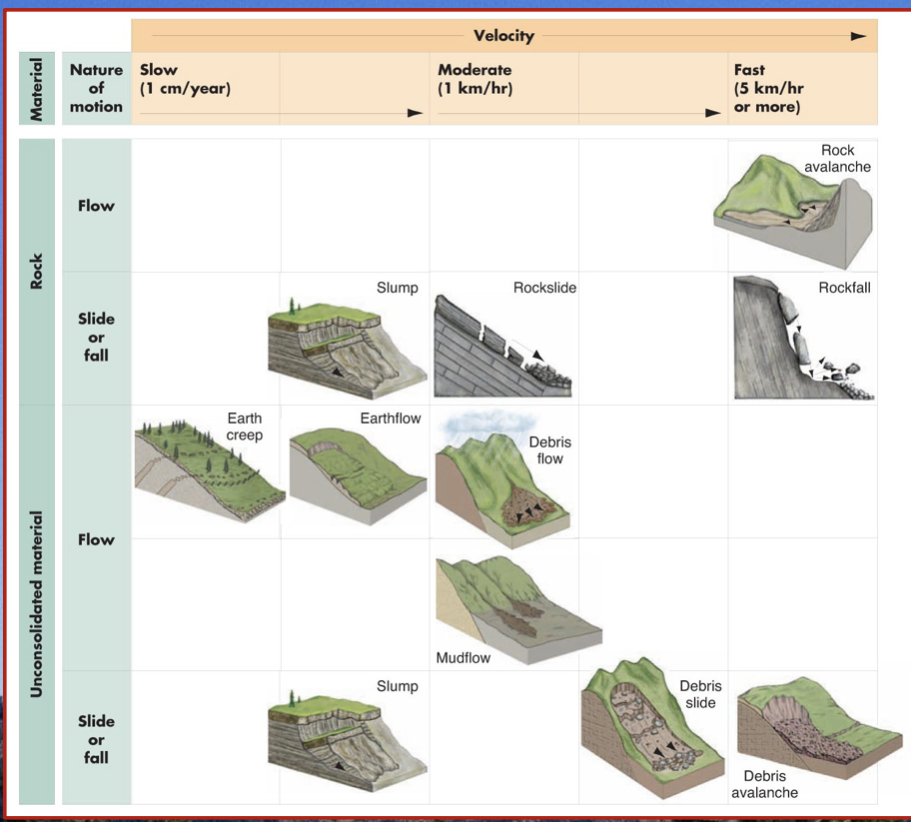
__**Fall**__
* Rock or sediment dropping off the face of a cliff
__**Slide**__
* downslope movement along a discrete failure plane
__**Flow**__
* Movement of particles semi-independently of one another, commonly with the aid of water
* Rock or sediment dropping off the face of a cliff
__**Slide**__
* downslope movement along a discrete failure plane
__**Flow**__
* Movement of particles semi-independently of one another, commonly with the aid of water
37
New cards
types of landslides
38
New cards
Rock fall
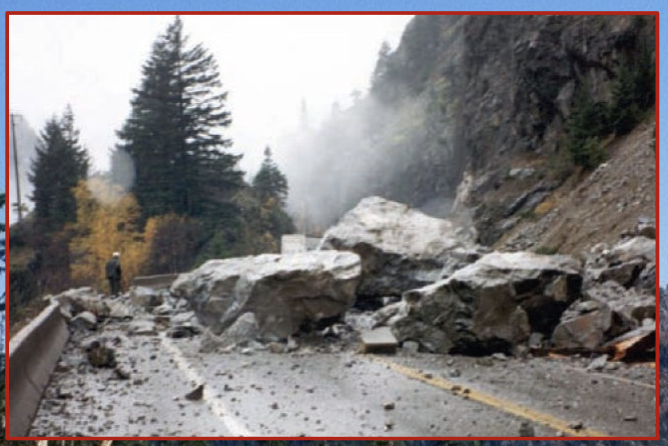
This mass movement is caused by a fall mechanism.
* it involves rock rolling down a steep slope or falling through the air
* it involves rock rolling down a steep slope or falling through the air
39
New cards
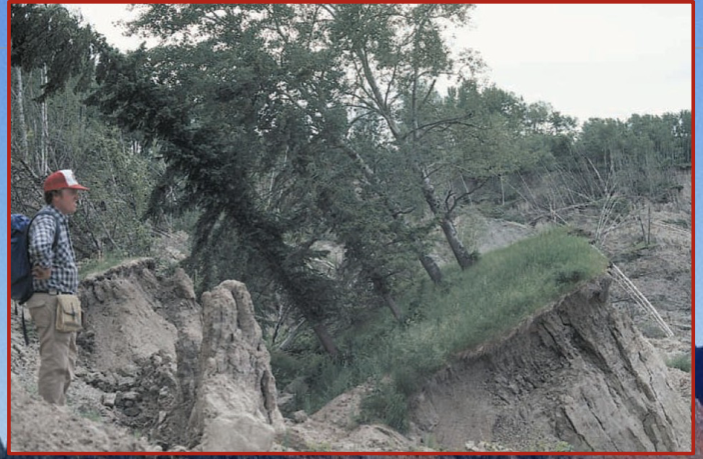
Slump
In this mass movement, the failure plane is **curved upward.**
40
New cards
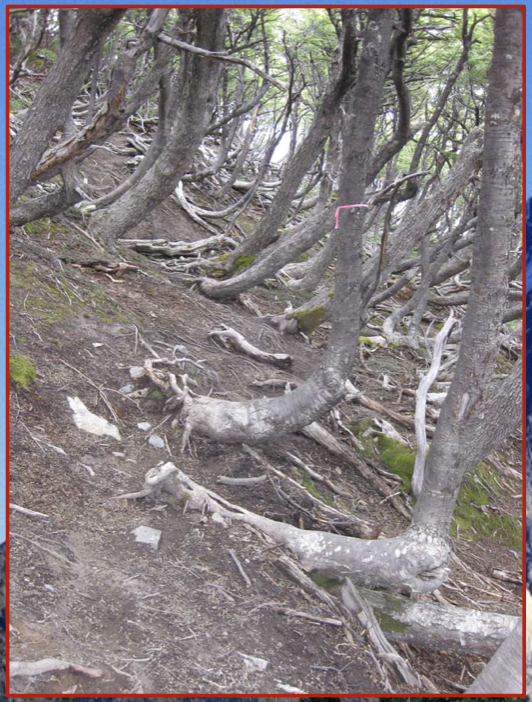
Creep
\
caused by what mechanism?
\
caused by what mechanism?
This mass movement is caused by a flow mechanism.
* speed of movement ranges from a few millimeters to a metre annually
* speed of movement ranges from a few millimeters to a metre annually
41
New cards
The 2 types of forces on slopes
The stability of a slope is based on the balance between two types of forces:
\
__**Driving Forces**__
* these move material downslope; they are based on the weight of the material from vegetation, water, etc
\
__**Resisting Forces**__
* These oppose downslope movement; they are based on the shear strength of the material.
\
__**Driving Forces**__
* these move material downslope; they are based on the weight of the material from vegetation, water, etc
\
__**Resisting Forces**__
* These oppose downslope movement; they are based on the shear strength of the material.
42
New cards
Factor of safety
Definition:
* the ratio of resisting to driving forces
* when the ratio is **over** 1, the slope is **stable**
* When the ratio is **under** 1, the slope is **unstable**
\
* If the factor of safety equals 1, resisting forces equal the driving forces.
* The forces are determined by relationships among material type, slope and topography, climate, vegetation, and water.
* the ratio of resisting to driving forces
* when the ratio is **over** 1, the slope is **stable**
* When the ratio is **under** 1, the slope is **unstable**
\
* If the factor of safety equals 1, resisting forces equal the driving forces.
* The forces are determined by relationships among material type, slope and topography, climate, vegetation, and water.
43
New cards
Role of material type
The degree of consolidation and the presence of weakness planes can increase the risk of landslides.
\
\
Slumps are most common in unconsolidated sediment
\
Translational movements often occur where sediment overlays bedrock; the failure plane is generally at the boundary between the soil and the bedrock.
\
\
Slumps are most common in unconsolidated sediment
\
Translational movements often occur where sediment overlays bedrock; the failure plane is generally at the boundary between the soil and the bedrock.
44
New cards
\
\
Slumps are *______* mass movements as opposed to ________mass movements.
\
Slumps are *______* mass movements as opposed to ________mass movements.
rotational
translational
translational
45
New cards
Role of slope and topogrophy:
\
The ______ the slope, the greater the driving force
\
The ______ the slope, the greater the driving force
steeper
\
\
46
New cards
slopes and the landslide type
\
STEEPEST slopes are associated with rock falls
MODERATE slopes are associated with flows
GENTLE slopes are associated with creep
STEEPEST slopes are associated with rock falls
MODERATE slopes are associated with flows
GENTLE slopes are associated with creep
47
New cards
Topographic relief
\
\
The height of a hill or mountain above the land around it
\
Dangerous landslides are more likely in areas of high relief.
\
The height of a hill or mountain above the land around it
\
Dangerous landslides are more likely in areas of high relief.
48
New cards
How to find relief
If the peak of a mountain 2750 metres in elevation and its base is 1550 metres in elevation, what is the relief of the mountain in metres?
answer = 1200
2750-1550
answer = 1200
2750-1550
49
New cards
Role of Climate
The climate of an area influences the amount of water that infiltrates and erodes the soil.
\
* in dry climates, vegetation is sparse, soil is thin and bare rock is exposed in many areas
* rock falls are more likely in those areas
\
\
In humid climates, soil is thick, and rock is generally covered with soil and vegetation.
\
Thus, flows and creep are more likely in those areas.
\
* in dry climates, vegetation is sparse, soil is thin and bare rock is exposed in many areas
* rock falls are more likely in those areas
\
\
In humid climates, soil is thick, and rock is generally covered with soil and vegetation.
\
Thus, flows and creep are more likely in those areas.
50
New cards
Role of Vegetation
Dense vegetation can slow surface erosion.
\
How?
* roots add strength and cohesion to the slope
* therefore improper deforestation often increases the frequency of landslides
\
How?
* roots add strength and cohesion to the slope
* therefore improper deforestation often increases the frequency of landslides
51
New cards
Role of water
Water saturates soil increasing the likelihood of flows.
* following long periods of deep-water infiltration, slumps can develop
\
Water can also erode the base of a slope therefore decreasing its resisting force.
* following long periods of deep-water infiltration, slumps can develop
\
Water can also erode the base of a slope therefore decreasing its resisting force.
52
New cards
Regions at risk
* Any location with significant variation in topography is at risk
* BC is most at risk in Canada
* BC is most at risk in Canada
53
New cards
The Frank Slide
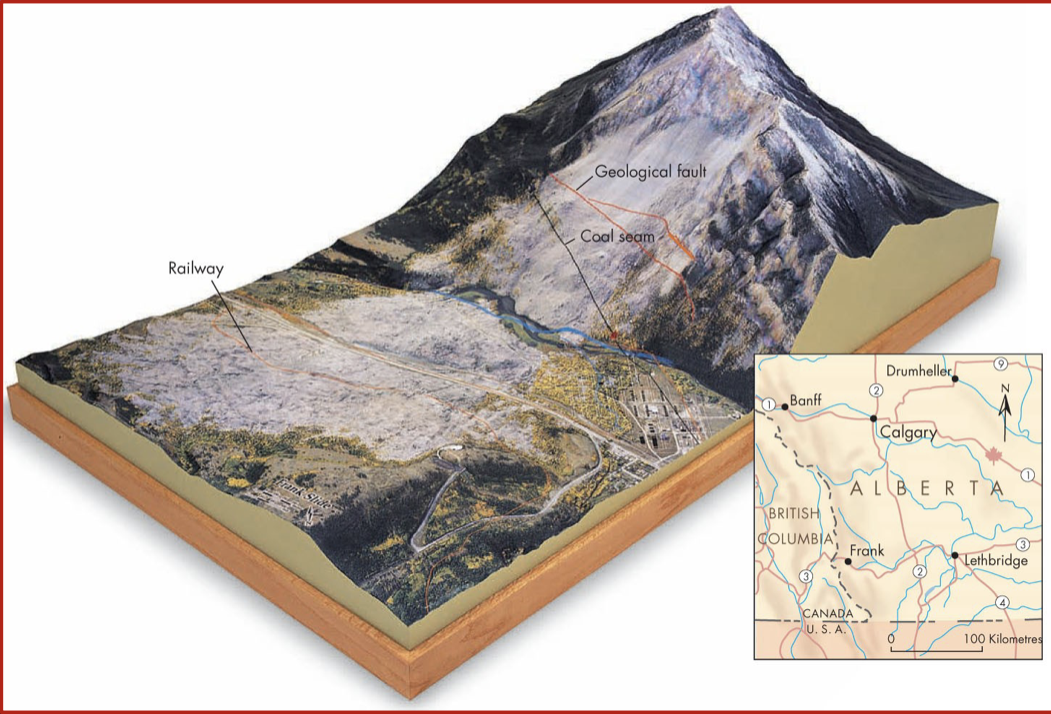
Canada’s most well-known landslide
* It occurred in 1903 on Turtle Mountain near Frank, Alberta.
* The landslide killed 76 people,
* dammed the Crowsnest River creating a lake,
* and buried 5km of railway
\
\
The exact cause of the landslide is unknown but glaciation, mining, and heavy snow are likely contributors.
* It occurred in 1903 on Turtle Mountain near Frank, Alberta.
* The landslide killed 76 people,
* dammed the Crowsnest River creating a lake,
* and buried 5km of railway
\
\
The exact cause of the landslide is unknown but glaciation, mining, and heavy snow are likely contributors.
54
New cards
Effects of landslides
Approximately 30 people killed by landslides annually in North America
\
Landslides can block railways and highways in isolated areas thus severely impacting travel.
* As urban areas continue to grow, property damage will increase.
\
Landslides can block railways and highways in isolated areas thus severely impacting travel.
* As urban areas continue to grow, property damage will increase.
55
New cards
Natural service functions (benefits)
Landslides can result in the development of new habitats in forests and aquatic ecosystems.
\
This produces an increase of biodiversity.
* Frank slide produced lake → more biodiversity
\
Landslides an carry sediments that contain valuable minerals which become concentrated at the base of the slope following an event
\
This produces an increase of biodiversity.
* Frank slide produced lake → more biodiversity
\
Landslides an carry sediments that contain valuable minerals which become concentrated at the base of the slope following an event
56
New cards
Human interaction with landslides
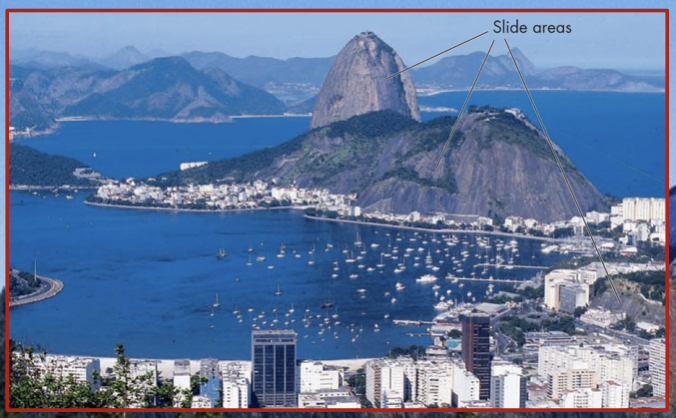
Grading of land surfaces for new home and building construction can increase probability of slope failure.
\
Timber harvesting and urbanization are currently the leading human causes for the increase of landslides
\
Timber harvesting and urbanization are currently the leading human causes for the increase of landslides
57
New cards
Timber harvesting
Clear-cutting and the construction of logging roads can cause landslides in geologically unstable areas.
\
A lack of surface vegetation and a lack of tree roots enhances soil erosion
\
A lack of surface vegetation and a lack of tree roots enhances soil erosion
58
New cards
Urbanization
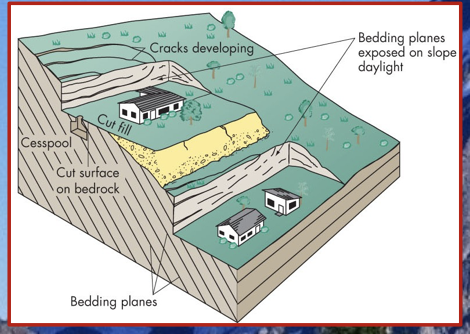
Modern engineering has allowed us to turn hilly slopes into flat land for construction.
\
Slopes are **destabilized** when rock is removed, lawns are watered, septic systems are installed, and buildings are constructed.
\
\
All of these add weight to the slope increasing the driving forc
\
Slopes are **destabilized** when rock is removed, lawns are watered, septic systems are installed, and buildings are constructed.
\
\
All of these add weight to the slope increasing the driving forc
59
New cards
Minimizing the landslide hazard
An important first step is recognizing where they are most likely to occur.
\
Features indicative of unstable slopes include:
* cracks on a hillside
* recessed crest of a valley wall
* large boulders or talus at a cliff base
* tilted trees
* exposed rock (should have soil on it)
* an irregular land surface at a slope base
\
Aerial photos are used to detect some of these features and then hazard maps can be produced.
\
Features indicative of unstable slopes include:
* cracks on a hillside
* recessed crest of a valley wall
* large boulders or talus at a cliff base
* tilted trees
* exposed rock (should have soil on it)
* an irregular land surface at a slope base
\
Aerial photos are used to detect some of these features and then hazard maps can be produced.
60
New cards
talus
Fragments of rock that have moved down a slope and accumulated at its base
61
New cards
Prevention of landslides
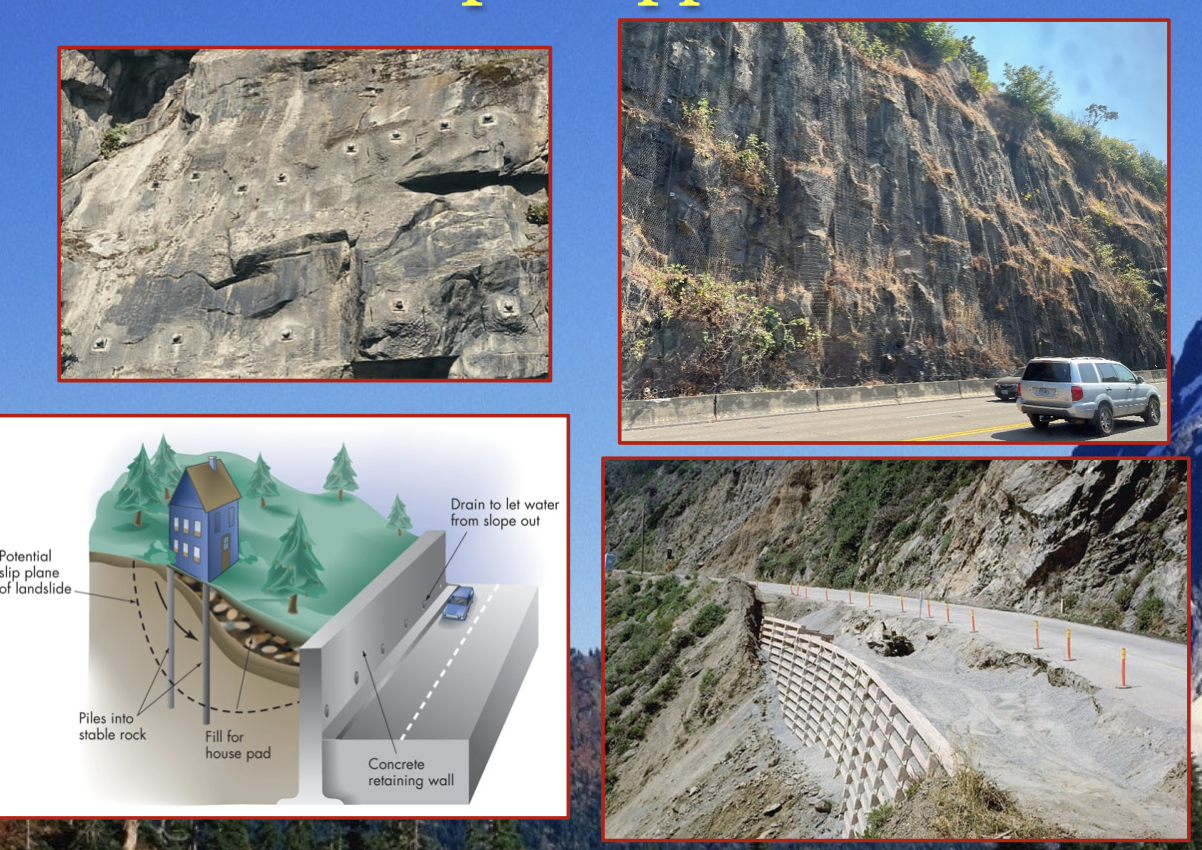
Complete prevention is impossible but certain engineering practices can minimize the hazard:
\
__**Drainage Control**__
* The objective is to remove excess water from the soil by pipes and drains
\
__**Levelling the slope**__
* Material from the upper slope can be moved to the slope base with modern technology
\
__**Slope supports**__
* Examples of these include retaining walls, rock bolts, and metal screens.
\
__**Drainage Control**__
* The objective is to remove excess water from the soil by pipes and drains
\
__**Levelling the slope**__
* Material from the upper slope can be moved to the slope base with modern technology
\
__**Slope supports**__
* Examples of these include retaining walls, rock bolts, and metal screens.
62
New cards
Landslide Warning systems
**Tiltmeters**
instruments used to detect movement along a slope.
\
**Rock fences**
Some rock fences along railways are linked in Western North America are linked to signal systems
\
**Rain gauges**
Rain gauges on slopes can identify when a precipitation threshold ha been reached
\
instruments used to detect movement along a slope.
\
**Rock fences**
Some rock fences along railways are linked in Western North America are linked to signal systems
\
**Rain gauges**
Rain gauges on slopes can identify when a precipitation threshold ha been reached
\
63
New cards
Perception of the landslide hazard
The relative infrequency of large landslides tends to reduce awareness of this hazard.
\
It is especially a concern where evidence of past events is not visible
People continue to build in areas prone to landslides
\
This requires adjustments in order to minimize deaths and property damage.
\
It is especially a concern where evidence of past events is not visible
People continue to build in areas prone to landslides
\
This requires adjustments in order to minimize deaths and property damage.
64
New cards
Adjustments to the landslide hazard
It is crucial to safely cite critical facilities (hospitals, schools, power plants, etc) away from landslide-prone areas.
\
Reducing water pressure by way of good drainage is the best corrective measure to counter the hazard since this will decrease the driving force
\
\
Analyzing landslide hazard maps and avoiding the purchase of a home in a hazardous area is the best way to reduce risk.
\
Reducing water pressure by way of good drainage is the best corrective measure to counter the hazard since this will decrease the driving force
\
\
Analyzing landslide hazard maps and avoiding the purchase of a home in a hazardous area is the best way to reduce risk.