Ch 7 chemical bonding and molecular geometry
 Call Kai
 Learn
 Practice Test
 Spaced Repetition
 Match
 Flashcards
 Knowt Play
1/11

There's no tags or description
Looks like no tags are added yet.
12 Terms
Metallic bonds
hold metal atoms together in metals.
Ionic bonds
hold ions together in ionic compounds.
Covalent bonds
hold atoms together in molecules.
more on metallic bonds
The electrons in a metal are shared among all the nuclei, so the electrons are delocalized. The electrons can shift throughout the entire metal.
metals’ unique properties.
Electrons are free to move throughout the solid
Pots and pans are usually made of metal because _____
metals conduct heat and
electricity as electrons flow through the metal.
Metals are malleable (can be pounded into flat sheets) and ductile (can be
drawn into a fine wire) because _____
electrons act as a glue, holding the
positively-charged nuclei together
ionic bonding
Metal atoms transfer valence electrons to nonmetal atoms. (positively charged metal cations and negatively charged nonmetal anions)
ionic bond:
electrostatic attraction between positively charged cation and negatively charged anion
Properties of Ionic Substances:
Ionic compounds exist as networks of ions, with cations surrounding anions, and vice versa.
To melt ionic compounds, every bond between each Na+ ion and the Cl- ions surrounding it must be broken, as well as bonds between each Cl- ion and the Na+ ions surrounding it.
A lot of energy is required to break all of these bonds.
Ionic compounds have relatively high melting points—much higher than water’s (0°C).
All ionic compounds are solids at room temperature. —> Ionic compounds do not conduct electricity when solid (ions are fixed in place), but they do conduct in the molten (liquid) and aqueous states (ions move around freely).
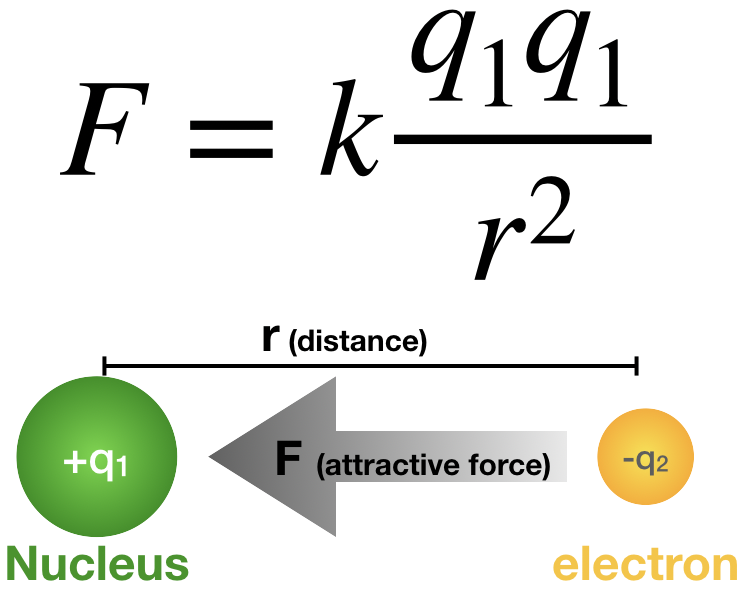
Coulomb's law
The strength of interactions between ions (given by the lattice energy=E) is
directly proportional to the product of the ions’ charges (Q1 and Q2) and inversely proportional
to the distance between their nuclei (d).