Psych 345 Drugs Pharmacology Kinetics
 Call Kai
 Learn
 Practice Test
 Spaced Repetition
 Match
 Flashcards
 Knowt Play
1/125

There's no tags or description
Looks like no tags are added yet.
126 Terms
Pharmacology
The study of drug actions and their effects on living organisms
Drugs before the 20th century
Mostly naturally occurring substances from plants
Ethnobotanists gave away medicines and advice for free
Neuropharmacology
study of drug-induced changes in nervous system cell functioning
Psychopharmacology
emphasizes drug-induced changes in mood, thinking, and behavior
Neuropsychopharmacology
identifies on chemical substances that interact with the nervous system to alter behavior, emotions, and cognition
- uses chemical agents as probes to gain understanding of the neurobiology of behaviour
Drug action
molecular changes produced by a drug when it binds to a target site or receptor
- the molecular changes alter physiological or psychological functions called drug effects
The site of drug action may be different to
the site of the drug effects
- drugs act at several target sites and have multiple effects
What does the statement "drugs are dirty" refer to in terms of drug action and effects?
Drugs act at multiple target sites and receptors at different sites and result in multiple drug effects
Therapeutic effects
the drug-receptor interaction produces desired physical or behavioral changes
- all other effects besides desired ones are side effects (can be both good or bad)
Drug side effects
physiological actions of medication other than those specifically desired - either good or bad
Specific drug effects
based on physical and biochemical interactions of a drug with a target site in living tissue - most often a receptor site to a NT system (GABA, glutamate)
Nonspecific drug effects
based on certain unique characteristics of the individual (mood, expectations, attitudes) - how you are/think changes how the drug works for you
How is a placebo/nocebo effect an example of a nonspecific drug effect?
Involve getting symptoms due to outside factors - knowledge or belief in what a drug will do for you can cause real physiological effects despite lack of chemical activity
- example of a brain-body interaction
Nocebo effect
a negative placebo effect due to the expectation of adverse consequences from receiving treatment
Benefits of placebos to evaluate the effectiveness of medications
can be an inexpensive treatment that avoids interactions with other medications
they eliminate they influence of expectations
Gold standard for experimental testing
double blind (both researcher and participant unaware of placebo), placebo control, randomized trial
What does a double blind experiment ensure
that the result of a treatment will not be coloured by overt or covert bias of the participant, experimenter or observer
Problems with placebos as treatment
limited staying power - effects tend not to last (SSRIs)
they do not effect everyone - 25-75% of people are non responders
Possible explanations for the placebo effect
Pavlovian conditioning, expectations of outcomes, social learning, genetic variants
Bioavailability
amount of drug at the site of action that is free to bind at target sites
Pharmacokenetics
the dynamic factors that contribute to bioavailability or factors that determine how drugs move throughout the body
Pharmacokinetic factors
1. Routes of administration
2. Absorption and distribution
3. Binding
4. Inactivation
5. Excretion

Drugs administration types
Oral, intravenous, intraperioneal, subcutaneous, intramuscular, inhalation
Absorption and distribution
Membranes of oral cavity, gastrointestinal tract, peritoneum, skin, muscles, lungs

Drug Binding
binds at target site on a neuron receptor or inactive storage depots in bone and fat
Drug Excretion
into feces, urine, water vapor, sweat, saliva
ADME
absorption, distribution, metabolism, excretion
What factors determine how quickly a drug reaches equilibrium in the body?
Concentration gradient and the blood flow of organs.
Which organs reach drug equilibrium the fastest?
Heart, liver, and kidneys.
Why do shotgunning beers have a greater impact than drinking them slowly?
Due to the speed of administration and absorption.
Which drug is highly fat soluble?
Marijuana.
What is the difference in behavior between water soluble and fat soluble drugs?
Water soluble drugs stay mostly in the blood, while fat soluble drugs enter adipose tissue.
What happens to drugs that are attached to plasma proteins vs free drugs?
They stay in circulation while free drugs cross into tissues
Drug effects depends on
How rapidly the drug reaches it's target (receptor sites) - concentration gradient, equilibrium, solubility
Frequency and history of prior drug use - though hard to study whether changes in brain are actually due to long term use
Non specific factors characteristic of individuals and their environment
FREQUENCY AND CHANGE US WHAT COUNTS
What is meant by "mindset, set, and setting"
Drug effects are dependent on one's expectations, the drug characteristics and one's environment
What is a vehicle?
What a drug is housed in that allows it to pass through barriers Ex. DMSO
What is DMSO?
Common vehicle to get drugs into system by bypassing lipid barriers and carrying drugs through the bloodstream transdermally
What are implantable controlled drug delivery systems?
administers drugs continuously for up toa month - can be used for schizophrenics who refuse drugs or have a history of stopping on their own
Why are vehicles so important?
They mediate the speed of the drug
Enteral methods of drug administration
Use the gastrointestinal tract - generally slow and produces variable blood levels
Parenteral methods of drug administration
include injection, pulmonary, and topical administration
Oral administration (PO)
-safe, self-administered, economical
- however drug must be resistant to destruction by stomach acid and enzymes Ex. insulin is not resistant and cannot be given orally
Absorption
the movement of a drug from its site of administration into the blood circulation
Factors that influence absorption
Amount of food in stomach, type of food, physical activity, intestinal-blood barrier, sex (men have more enzymes that break down alcohol than women)

First pass metabolism
the substance degradation of an orally administered drug caused by enzyme metabolism via the portal vein in the liver where they are chemically altered before the drug reaches the systemic circulation
- livers job is to enzymatically break down the drug so it can be water soluble and leave the body
How much of a drug gets taken out by the liver during first pass metabolism?
50%
Why is inhalation one of the most popular ways of drug administration?
Because it skips first pass metabolism in the liver
Rectal adminsistration
Placement of a drug filled suppository
- MAY avoid first pass metabolism depending on placement
- used for infants or patients who are vomiting, unconscious or unable to take orally
Intravenous injection (IV)
Most rapid and accurate method
- quick onset of drug effect can be a HAZARD, no time to correct an overdose or allergic reaction as drug cannot be removed by stomach pumping
- lends to drug abuse as drug reaches brain very rapidly
- uncertain doses + additives and lack or sterility can result in infectious diseases
Intramuscular injection (IM)
Slower, more even absorption
- absorption can be slowed by combining the drug with another drug that constricts blood vessels or alter it's solubility
Intraperitoneal Injection (IP)
Drug is injected through the abdominal wall into the space surrounding the abdominal organs
- rarely used with humans, common for small lab animals
- rich spot for absorption as there is lots of surface area
Subcutaneous injection (SC)
Injection just below the skin
- absorption is slow but can be variable
- can be slowed by vegetable oils, implantation of a pellet or delivery device
Inhalation
Drug is absorbed by the lungs rapidly due to the large surface area and many capillaries
- drug effect is rapid Ex. nicotine, TCH, crack cocaine
- gets past first pass metabolism!!
Topical administration
drug is applied to mucous membranes
- mostly local effects, but drug can also be absorbed into the bloodstream Ex. Lidocaine at the dentist
Sublingual administration
drug is placed under the tongue
- avoids gastric acid, enzymes, and first pass metabolism
Intranasal administration
can cause local effects such as relieving nasal congestion but can also have systemic effects
- MAY avoid first pass metabolism by bypassing the BBB, allowing high brain concentrations
- absorption occurs with cocaine snorting
- drug effect peaks in 15-30 minutes
- intranasal oxytocin for autism?
Transdermal
administration of drugs through skin patches for controlled and sustained delivery
- can be used for vaccinations
- also used for motion sickness, nicotine patches, nitroglycerin and hormones
- use vehicles like DMSO to cross the dermatome and lipid bilayer
Epidural injection
spinal anesthetics delivered directly to cerebrospinal fluid, bypasses the BBB
- research techniques include micro injection of drugs to discrete brain areas (intracranial) or ventricles (intraventricular)
Infusion pumps
implanted under the skin of the scalp, programmed to deliver a constant dose of antibiotic into cerebral ventricles
- used to treat brain infection; antibiotics normally do not cross the BBB
How do routes of administration affect bioavailability?
Alter the rate of absorption, the blood levels of a drug and therefore the amount of drug available to the receptors in the brain
Most important factor for determining plasma drug levels
The rate of passage through cell membranes - phospholipids
Phospholipids
Have a negatively charged region that is hydrophilic and two uncharged tails that are hydrophobic arranged in a bilayer
- proteins are inserted into it and serve as receptors or channels
- the molecular characteristics prevent most molecules from passing through unless they are fat soluble, while lipid soluble drug pass through by passive diffusion
Example of a lipid soluble drug that gets through membranes by passive diffusion
Alcohol
The greater the concentration gradient
the faster the diffusion
Confirmational change
receptors changing shape caused by electrical charge
Effect of lipid solubility on absorption
Increases drug absorption and determines how readily it will enter the brain Ex. heroin is more lipid soluble than morphine and is delivered to the brain faster
Which three drugs are the same structurally but change as they cross the blood-brain-barrier?
Heroin, codeine, morphine - heroin is more lipid soluble and gets to the brain faster while codeine is the slowest
Why are most drugs not lipid soluble?
Because they are weak acids or bases that ionize in water
- the extent of ionization depends on pH of the solution and an intrinsic property of the molecule (pKa)
What is pKa?
Measures the strength of an acid or base and indicates the pH at which 50% of the drug is ionized (hydrophilic) and 50% is non-ionized (lipophilic)
Why does level of ionization make a difference in bioavailibility?
Drugs that are weak acids ionize more readily in an alkaline environment and become less ionized in an acidic environment - pH of different body fluids affects drug movement
Other factors affecting absorption
Rate stomach empties- small intestine has more surface area and slower movement of material and thus more absorption can occur
Size and sex of individual- a larger person has more body fluid to dilute a drug (women tend to have less body fluid than males)
Highest concentration of a drug will occur where blood flow is greatest
Drugs can leave capillaries through pores, even if not lipid soluble
Drug redistribution
As plasma levels fall, drug concentration in highly vascularized organs will be greater than in the blood, so the drug will move from those organs back into the plasma to maintain equilibrium - can terminate action of a drug
as they get pulled out of the brain the drugs will get to the point they have no more effect
Cerebrospinal fluid (CSF)
clear fluid that fills that subarachnoid space around the brain and spinal cord, ventricles and canals
- circulates around the brain 6 times a minute
- plays a huge protective role (acts as cushion)
- is a bidirectional conduit (communication pathway)
Blood-Brain Barrier
the separation between brain capillaries and the brain/blood
- not the only barrier in the brain
- important as many substances in the blood fluctuate and would have disruptive effects on the brain if they could move freely between blood/brain/CSF
What chemical travels through the cerebrospinal fluid?
Oxytocin
Distinct morphology of brain capillaries
Are designed to to allow movement of material between blood and surrounding cells
Have no openings or pinocytotic sites; movement of water soluble molecules is minimized
Surrounded by glial feet - astrocytes
What does the BBB reduce diffusion of?
Water soluble (ionized) molecules
- does not impeded lipid soluble molecules
Brain area NOT isolated by the BBB
Area postrema of CTZ (chemical trigger zone) - cluster of cells in the brainstem that responds to toxins/bacteria in the blood and induces vomiting
Other brain areas NOT isolated by the BBB
posterior pituitary gland, pineal gland, circumventricular organ, median eminence
Example of drug that can cross the BBB
Physostigmine - used to treat intoxication from agricultural pesticides, increases the availability of the neurotransmitter acetylcholine
Neostigmine
Does not cross the BBB, increases acetylcholine peripherally - used to treat diseases such as myasthenia gravis (heart disorder) without CNS side effects
Placental barrier
a protective barrier between the baby's and mother's blood circulation
- not a very robust barriers
- potentially damaging effects include acute toxicity, teratogenic effects and shortage of oxygen
Why can drugs remaining in a newborn at birth have prolonged action?
incomplete metabolism due to incomplete development of the liver
Drugs that can cause acute toxicity in the fetus
Tranquilizers, anesthetics, alcohol, barbiturates, cocaine
Drugs that can deprive the fetus of oxygen
Alcohol, cocaine, carbon monoxide in cigarette and marijuana smoke
Teratogens
Agents that damage the process of development and induce developmental abnormalities
- drugs, x-rays, maternal infections
- effects depend on timing of exposure (most damage occurs in first trimester during formation of fetal organs - 3 months)
Advantages and disadvantages of oral administration
advantages - safe, self administered, economical, no needle related complications
disadvantages - slow and highly variable absorption, subject to first pass metabolism, less predictable blood levels
Advantages and disadvantages of intravenous administration
advantages - most rapid, accurate blood concentration
disadvantages - overdose danger, cannot be readily reversed, requires sterile needles, drug abuse
Advantages and disadvantages of intramuscular administration
advantages - slow and even absorption
disadvantages - localized irritation at site, needs sterile equipment
Advantages and disadvantages of subcutaneous administration
advantages - slow and prolonged absorption
disadvantages - variable absorption depending on blood flow
Advantages and disadvantages of inhalation
advantages - large absorption surface; very rapid onset
disadvantages - irritation of nasal passages
Advantages and disadvantages of topical administration
advantages - localized action and effects, easy to self administer
disadvantages - may be absorbed into general circulation
Advantages and disadvantages of transdermal administration
advantages - controlled and prolonged absorption
disadvantages - local irritation, useful only for lipid soluble drugs
Advantages and disadvantages of epidural administration
advantages - bypasses BBB, very rapid effect on CNS
disadvantages - not reversible, needs trained personnel
How are drugs eliminated?
Via biotransformation - metabolism, then excretion
Drug clearance from the blood
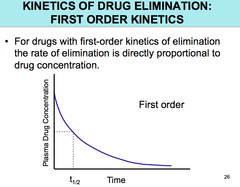
is usually exponential (first order kinetics)
- rate is concentration dependent
- can be calculated by half lives ( each results in half the drug coming out of your system
Half-lives of drugs
the amount of time required for removal of 50% of the drug
t1/2
How many half-lives until a drug with a 12 hr half life is functionally out of your system?
5-6 hrs for 50% of drug removal
Why does a drug's half life determine the interval between doses?
a drug given once a day should have a half life of about 8 hours - longer half life or taking more than once a day could lead to accumulation which increases potential side effects and toxicity
First order kinetics
Reaction rate is directly proportional to concentration