Units 1 and 2: 1491-1754
 Call Kai
 Learn
Learn Practice Test
 Spaced Repetition
 Match
Match Flashcards
 Knowt Play
1/64

There's no tags or description
Looks like no tags are added yet.
Name | Mastery | Learn | Test | Matching | Spaced | Call with Kai | Chat |
|---|
No analytics yet
Send a link to your students to track their progress
65 Terms
division of labor
the type of arrangement in which each worker specializes in a particular task or job--this was a direct consequence of agriculture.
Cahokia
Mississippian settlement near present-day East St. Louis, home to as many as 25,000 Native Americans
Pueblo Indians
Southwest US Indians, built large irrigation systems, adobe structures, and were reliant on irrigation systems for agriculture.
Great Basin
The area between the Rocky Mountains and the Sierra Nevadas. Dry desert, mostly, characterized by nomadic tribes.

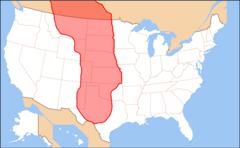
Great Plains
A mostly flat and grassy region of western North America, , characterized by nomadic tribes.
Iroquois Confederacy
An alliance of five northeastern Amerindian peoples (after 1722 six) that made decisions on military and diplomatic issues through a council of representatives. Allied first with the Dutch and later with the English, it dominated W. New England.
Powhatans
a group of Indians that helped the Jamestown settlers on the Atlantic Coast until relations eroded. They lived in mostly permanent dwellings called wigwams and relied heavily on agriculture.
Columbian Exchange
An exchange of goods, ideas and skills from the Old World (Europe, Asia and Africa) to the New World (North and South America) and vice versa.
Columbian Exchange, from "Old World" to Americas
smallpox, livestock (pigs, cows, sheep), bees, bananas, coffee, sugar
Columbian Exchange, from "New World" to Americas
tomatoes, squash, potatoes, chocolate
Effects of the Columbian Exchange on Europe
Better diet- new foods- live longer- better health-greater wealth and power for certain countries
Effects of the Columbian Exchange on The Americas
i. Livestock and agriculture affect terrain and environment
ii. European diseases, like
smallpox decimate 95% of native population
iii. Attempt to enslave natives fails due to native knowledge of land for escaping, unreliable
labor force, harsh conditions
Capitalism
an economic and political system in which a country's trade and industry are controlled by private owners for profit, rather than by the state.
Joint Stock Companies
businesses formed by groups of people who jointly make an investment and share in the profits and losses; Jamestown was settled by a joint stock company
Encomienda System
system in Spanish America that gave settlers the right to tax local Indians or to demand their labor in exchange for protecting them and teaching them skills.
Mulatto
A person of mixed African and European ancestry
Mestizo
A person of mixed Spanish and Native American ancestry.
Bartolome de Las Casas
First bishop of Chiapas, in southern Mexico. He devoted most of his life to protecting Amerindian peoples from exploitation. His major achievement was the New Laws of 1542, which limited the ability of Spanish settlers to compel Amerindians to labor.
Jamestown
First permanent English settlement in North America founded in 1607
Virginia Company
The first joint-stock company in the colonies; founded Jamestown; promised gold, conversion of Indian to Christianity, and passage to the Indies
Chesapeake Bay Colonies
Virginia and Maryland; known especially for the farming of tobacco

Frontier of exclusion
a term used by historians to describe the way in which colonists deal with indigenous peoples by pushing the indigenous people off the land to make room for the colonists. (i.e. English colonists)
Frontier of Inclusion
Accepting the Native American as part of society, whether by converting them to Christianity or by marring Native American women (i.e. French or Spanish colonists)
Indentured Servants
Colonists who received free passage to North America in exchange for working without pay for a certain number of years
Puritans
A religious group who wanted to purify the Church of England. They came to America for religious freedom and settled Massachusetts Bay.
Pilgrims
Group of English Protestant dissenters who wanted to completely separate from the church of England (also called "separatists"). They established Plymouth Colony in Massachusetts in 1620 to seek religious freedom.
Mayflower Compact
1620 - The first agreement for self-government in America. It was signed by the 41 men on the Mayflower and set up a government for the Plymouth colony.
Massachusetts Bay Company
A group of wealthy Puritans who were granted a royal charter in 1629 to settle in Massachusetts Bay
Rhode Island
A colony founded by Roger Williams, a banished Puritan, for the sake of creating a haven of religious tolerance.
Proprietary Colony
English colony in which the king gave land to proprietors in exchange for a yearly payment (i.e. Pennsylvania and Maryland)
Quakers (Society of Friends)
Religious group in England and America--settling mainly in Pennsylvania--whose members believed all persons possessed the "inner light," or the spirit of God; they were early proponents of the abolition of slavery, nonviolence, fair treatment of Native Americans, and equal rights for women.
Tobacco
Cash crop that made a profit and saved Jamestown. Its cultivation led to the growth in African slavery in the southern American colonies.
King Philip's War
1675 - A series of battles in New Hampshire between the colonists and the Wompanowogs, led by a chief known as King Philip. The war was started when the Massachusetts government tried to assert court jurisdiction over the local Indians. The local Indians were also resentful of evangelical "praying towns" in the area. The colonists won with the help of the Mohawks, and this victory opened up additional Indian lands for expansion.
Bacon's Rebellion
1676 - Nathaniel Bacon and other western Virginia settlers (mostly former indentured servants) were angry at Virginia Governor Berkley for trying to appease the Doeg Indians after the Doegs attacked the western settlements. The frontiersmen formed an army, with Bacon as its leader, which defeated the Indians and then marched on Jamestown and burned the city. The rebellion marked an early uprising against colonial leadership from Britain and also a shift from relying on indentured servants for labor to relying more on African slaves.
Spanish Mission System
The Spanish network of missions in the New World established to bring Christianity to Native Americans who were required to learn the Spanish language, as well as Christian teachings.
Middle Passage
A voyage that brought enslaved Africans across the Atlantic Ocean to North America and the West Indies
Pueblo Revolt
1680: Native American revolt against the Spanish in late 17th century; expelled the Spanish for over 10 years; Spain began to take an accommodating approach to Natives after the revolt
Mercantilism
An economic policy under which nations sought to increase their wealth and power by obtaining large amounts of gold and silver and by exporting more goods than they imported
Salutary Neglect
an English policy of relaxing the enforcement of regulations in its colonies in return for the colonies' continued economic loyalty
autonomy
independence
evangelism
Spreading a faith or religion to others
Enlightenment
A philosophical movement which started in Europe in the 1700's and spread to the colonies. It emphasized reason and the scientific method. Writers of the enlightenment tended to focus on government, ethics, and science, rather than on imagination, emotions, or religion. Many members of the Enlightenment rejected traditional religious beliefs in favor of Deism, which holds that the world is run by natural laws without the direct intervention of God.
Anglicization
the colonial american desire to emulate English society, including English taste in foods, customs, and architecture--a direct product of mercantilism
Imperialism
A policy of extending a country's power and influence through diplomacy or military force.
Navigation Acts
1660: Laws that governed trade between England and its colonies. Colonists were required to ship certain products exclusively to England. These acts made colonists very angry because they were forbidden from trading with other countries.
Economy of New England Colonies
depended on shipbuilding, whaling, and trade with the French West Indies; rocky soil made only small family farms possible
Economy of Middle Colonies
Trade and farming- Oats, Barley, Wheat. "Bread basket" of America
Economy of Southern Colonies
Rich soil and warm climate allowed for a long growing season and for the production of labor-intensive cash crops (tobacco, rice, indigo) that depended on slavery
Roger Williams
A dissenter who clashed with the Massachusetts Puritans over separation of church and state and was banished in 1636, after which he founded the colony of Rhode Island to the south
Homogenous
the same throughout
Motivations for European exploration
God spread Christianity
Gold find Gold and other treasure in new world and become wealthy
Glory be the most powerful nation, with the most number of colonies
Sepulveda
He argued that the Indians were less than human and benefited from serving the Spanish.
West Indies
Caribbean Islands that were used largely for sugar plantations; most of the slaves imported from African were brought to the West Indies or to South America
Plantation System
A system of agricultural production based on large-scale land ownership and the exploitation of labor and the environment. This system focused on the production of cash crops and utilized slave labor.
Triangular Trade
A three way system of trade during 1600-1800s Africa sent slaves to America, America sent Raw Materials to Europe, and Europe sent Guns and Rum to Africa
Racial Laws
A series of strict laws put in place in the southern colonies, particularly after Bacon's Rebellion, to prevent the uprising of African Slaves and to further dehumanize them.
Great Awakening
Religious revival in the American colonies of the eighteenth century during which a number of new Protestant churches were established.
Covert resistance to slavery
Method in which many slaves secretly resisted their enslavement through preserving cultural practices, slowing down their work, or sabotaging tools
Overt resistance to slavery
Method in which many slaves would publicly resist their enslavement through running away or causing a rebellion.
William Penn
A Quaker that founded Pennsylvania to establish a place where his people and others could live in peace and be free from persecution.
John Smith
Helped found and govern Jamestown. His leadership and strict discipline helped the Virginia colony get through the difficult first winter.
John Rolfe
Jamestown colony leader who showed that tobacco could be grown successfully in Virginia. His marriage to Pocahontas brokered a temporary truce between the Indians and the colonists in Jamestown.
Pocahontas
A native Indian of America, daughter of Chief Powahatan, who was one of the first to marry an Englishman, John Rolfe, and return to England with him; about 1595-1617; Pocahontas' brave actions in saving an Englishman (allegedly John Smith) paved the way for many positive English and Native relations.
Salem Witch Trials
1629 outbreak of witchcraft accusations in a puritan village marked by an atmosphere of fear, hysteria and stress.
Virginia House of Burgesses (1619)
First representative assembly in the American colonies. Representatives immediately began to enact laws and to safeguard the individual rights. Setting precedent in the colonies for individual rights protected by law (British law did not provide for individual rights.)