Ch 11 + 14 Physiology- Yui Hisanaga
 Call Kai
 Learn
Learn Practice Test
 Spaced Repetition
 Match
Match Flashcards
 Knowt Play
1/18

There's no tags or description
Looks like no tags are added yet.
Name | Mastery | Learn | Test | Matching | Spaced | Call with Kai | Chat |
|---|
No analytics yet
Send a link to your students to track their progress
19 Terms
What are the differences between special and somatic senses? What does it mean to say that stimuli can be processed consciously or unconsciously?
Special Senses: senses that you’re most familiar with: vision, hearing, taste, smell, equilibrium (balance)
Somatic Senses: touch, temperature, pain, itch, proprioception
Stimuli can be processed both consciously and unconsciously because consciously we can perceive if our muscles are contracted or not but we also do not perceive as easily our blood pressure, blood sugar levels, or pH.

What must occur for a sensory receptor to convert a stimulus into an electrical signal? What is that called? What is a receptor potential? What are simple, complex, social receptors? What are some 4 examples of sensory receptors?
Transduction must occur for a diverse stimuli to be converted into electrical information, that can be processed by the nervous system. This is called a receptor potential.
A receptor potential is a graded potential change that occurs in the membrane of a sensory receptor and may intiate an action potential or affect neurocrine secretion
Simple: Free nerve endings with unmyelinated axon
Complex: Enclosed nerve ending of connective tissue with myelinated axon
Special: Specialized receptor cell (modified epithelial cells) on top of a cell with myelinated axon
Sensory receptors:
Chemoreceptors: oxygen, pH, glucose
Mechanoreceptors: pressure of touch, BBB in arteries, vibration, sound
Photoreceptors: photons of light
Thermoreceptors: degrees of heat

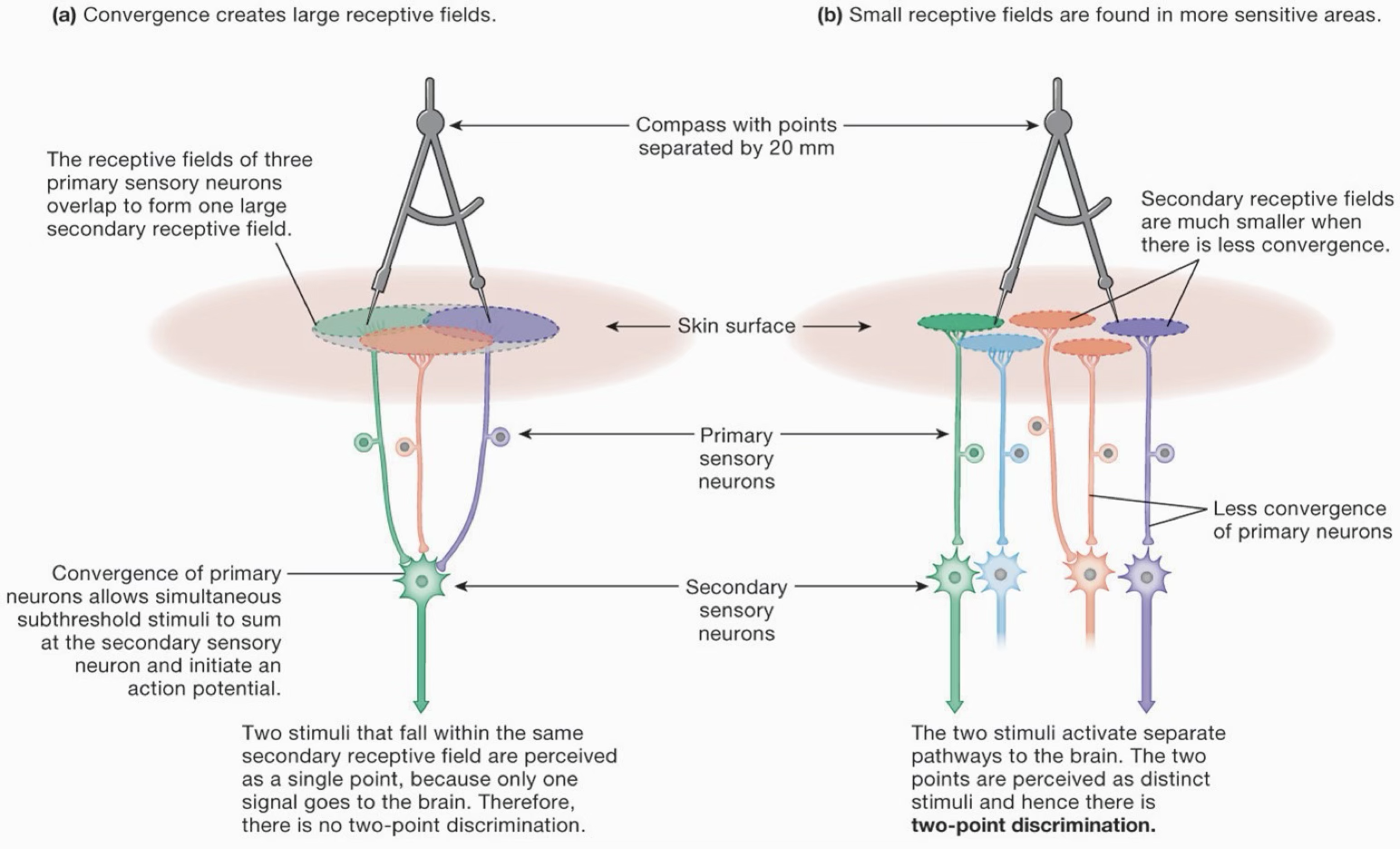
What are the 2 receptive fields? What is 2 point discrimination? What is an example of each? What determines the size of a receptive field?
Receptive fields of 3 primary sensory neurons overlap to form one large secondary field
Convergence of neurons in the secondary sensory neurons will initiate an A.P.
More convergence means larger fields (we perceive it as just one touch) so on back, forearm, etc.
Secondary receptive fields are much smaller
Less convergence in the secondary sensory neurons. The 2 stimuli process into 2 distinct pathways so this is called 2 point discrimination (can discern that 2 distinct points are touching the skin).
Used for more specific stimuli such as on lips, finger tips
Determined by how many primary neurons converge on a secondary neuron.
What are the 4 different properties of a stimulus that the CNS distinguishes between? Where does all of this stimulus go and what’s the exception? Why do we often see stars if we all hard in the back of our head? What happens if this pathway is disorientated?
Nature (modality): what you’re sensing
Location: where it’s coming from
Intensity: how intense (hot/cold, loud/quiet) something is
Duration: (how long or short it’s happening for)
All of the stimulus goes to the thalamus besides smell. We often see stars because the mechanical force can stimulate and activate photoreceptors. This means that if the pathway is cut off we can be able to “see smell” or “smell sights”

What is Lateral Inhibition?
Lateral inhibition:. increases the contrast between activated receptive fields and their inactive neighbors which helps to isolate location of the stimulus. The secondary neuron that receives strongest signal from it’s associated primary neuron inhibits the neurons close to it so the tertiary neurons only receive a signal from the most highly activated secondary neuron.
For example, pocking yourself with a pin can hurt not just the point but also to the surrounding stimulus but because of lateral inhibition the secondary neurons can cut off other pathways (make negative) to isolate it’s own.

What would the differences be in between a moderate stimulus and a longer and stronger stimulus?
Moderate: Action potentials are farther apart, doesn’t last as long. Less neurotransmitters are released.
Longer and stronger: Action potentials are closer to together and last longer. More neurotransmitters would be released.

What are Tonic Receptors? What are Phasic Receptors? What’s it’s purpose? What stimuli might tonic receptors monitor? What stimuli might phasic receptors monitor?
Tonic and Phasic Receptors help the body to adapt or cease to respond to stimuli.
Tonic Receptor: Slowly adapting receptors that fire rapidly when first activated, then slow and maintain their firing for the duration of the stimulus. *something happening
eg. continuing to step on a lego
Phasic Receptor: Rapidly adapt to a constant stimulus and turn off. *something changing
eg. wearing a watch and then not feeling it after a bit

What is perceptual threshold? What is habituation and central adaptation?
Perceptual Threshold: level of stimulus intensity necessary for you to be aware of a particular sensation. eg. there’s probably ants that are walking on the floor but you can’t sense or perceive it because it is too quiet
Habituation: Despite ongoing stimulus your body gets used to it. eg. living next to a train track.
Central Adaptation: Typically occurs in secondary and higher level neurons of a sensory pathway
What stimuli do touch receptors respond to?
Stretch, pressure, stroking movements, vibration, texture
What are thermoreceptors? What are nociceptors?
Thermoreceptors: free nerve endings that terminate in the subcutaneous layer of skin.
Nociceptors: respond to stimuli that can cause tissue damage. eg. intense heat, capasicin, local chemicals (K+, histamine) intiate reflexive protective responses and activate ascending pathways that become conscious perception (pain, itch)
Why is pain considered a subjective perception? What are afferent signals of pain? How can perception of pain be modulated?
Pain is highly individualized and may vary with emotion. It is not measurable.
Afferent signals from nociceptors to CNS
Ascend to thalamus and sensory areas of cerebral cortex
Branches can also be sent to limbic system and hypothalamus like distress, nausea, sweating, etc.
Perception of pain can be modulated
Descending neurons from thalamus may inhibit ascending nociceptor neurons
Fibers carrying other sensory information may help activate interneurons that inhibit nociceptor neurons
What does Referred Pain mean? What are some examples?
When visceral pain (pain from organs) is felt in areas far removed from the site of the stimulus due to convergence. When someone has a heart attack they feel the pain down their left arm.

What is the structure of Olfaction?
Odor
Mucus (made by olfactory glands)
Non-motile cilia/receptors
Olfactory neuron
Cribiform foramina
Olfactory bulb
Brain

How does the process of odorant receptors?
Odorant receptors are G protein-coupled receptors
Largest gene family in vertebraes
Special G protein (Golf) increase intracellular cAMP, causes depolariation
Different combinations of odorants are interpreted as different smells. eg. knowing the difference in smell between pizza and lasagna, uses a lot of the same ingredients but can tell the difference in which dish is what.
Odorant binds to receptor
Receptor activates Golf.
G protein activates adenylate cyclase
Adenylate cyclase converts ATP to cAMP
the cAMP will open a cation channel to allow the influx of Na+ and Ca2+ which causes depolarization, makes the inside of the cell more positive.

What is the difference in Gustation regarding Type II and Type III cells? What kind of cells are the receptors?
Type II: Smell, umami, bitter.
Type III: Sour:
Modified epithelial cells
Type II Cells: A tastant latches onto a GPCR and Gustductin (specialized G protein) pathway, which causes signal transudction and causes Ca+ triggers ATP formation, then action potentials are sent to brain
Type 3 Cells: H+ ion enter channels, Ca2+ signals triggers exocytosis, Serotonin is released then action potential potentials are sent to the brain
What is hearing? What is frequency and amplitude? How are each of them measured? How do you see them on the graph?
Hearing: perception of energy carried by sound waves (pressure waves with alternating peaks of compressed air and valleys of air molecules farther apart)
Frequency: pitch (Hz)
Amplitude: loudness (dB)
How tall they are: Amplitude
How far away each valley is: Frequency. eg. waves closer together: higher pitch
How does sound transduction work?
Sound waves strike the tympanic membrane, and become vibrations
The sound wave energy travels through the 3 bones of the middle ear
The stapes is attached to the membrane of the oval window, and these vibrations create fluid waves in the cochlea, travels through the vestibular duct first
Pushes on the vestibular membrane which passes energy into the endolymph fluid of the cochlear duct
Fluid motion moves basilar membrane. The hair cells bend and ion channels open, which creates a electrical signal that alters neurotransmitter release
This creates action potentials that travel through the cochlear nerve to brain
Remaining energy transfers across into tympanic duct, travels through round window and dissipate into middle ear.

What is the anatomy of a cross section of cochlear? How does action potentials increase or decrease in the ear? What is the organ that helps with this?
Tectorial membrane: inside of the cochlear duct
Organ of corti: right under the tectorial membrane
Stereocilia of hair cells are in contact with tectorial membrane and attached to one another by tip links
Movement of the tip links opens ion channels.
Hair cells bending in one direction- depolarization, more action pontials
Hair cells bending in opposite direction- hyperpolarization, signaling decrease

How does frequency have to do with the location of displacement?
The higher the frequency, it will displace the basilar membrane near the base
Medium frequency will displace the basilar membrane near the middle
Low frequency will displace the basilar membrane near the apex.
