2. Appetite and Body Weight Regulation
 Call Kai
 Learn
 Practice Test
 Spaced Repetition
 Match
 Flashcards
 Knowt Play
1/27

There's no tags or description
Looks like no tags are added yet.
28 Terms
why are appetite and food intake important?
to understand why we eat, what we eat and how much we eat
Food based non-communicable diseases are largely avoidable and are the result of food choices and poor dietary behaviors
The process of learning an eating behavior
We remember what give us energy
We remember what we like
This becomes our eating behavior = nutrition pattern
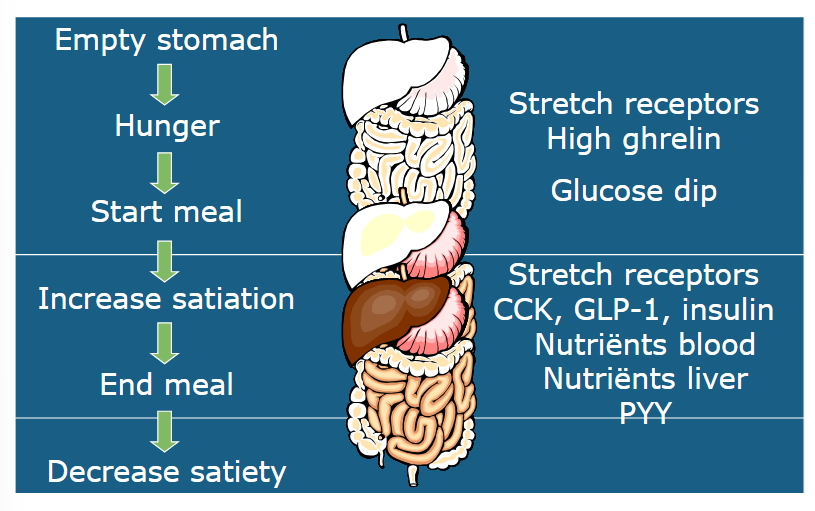
Metabolic processes leading to satiation and satiety
Satiation enforces us to stop eating → we know we have had enough.
The combination of stretch receptors, CCK, GLP-1 and insulin let our brains know we are satiated = end of meal
Pavlovian conditioning
Pavlovian conditioning (also known as classical conditioning) is a learning process where an organism learns to associate a neutral stimulus with a biologically significant stimulus, eventually producing an automatic response to the neutral stimulus alone
How does sensory learning occur?
Sensory signals (smell, vision, tast, texture) and signals from the food environment (sounds/colours) acquire their meaning through their association with the
consequences (post-ingestive physiological, psychological, social) of eating....
Sensitivity to hunger vs. satiation
People are more sensitive to deficiency of energy (hunger) than a surplus of energy (satiated) → eat more than you need in a world of plenty
Eating as a dis-continous behavior and its effect on energy
Periods of energy intake (eating occasions) followed by intervals of various durations
Energy homeostasis is achieved by matching energy intake with expenditure
Stability of body weight
We consume millions of kilocalories over the course of a few years, but the typical weight gain amounts to only a few thousand kilocalories of stroed energy
Food intake is highly variable from day to day and yet body weight is remarkably stable
The body defend against changes in body weight.
Energy intake homeostasis
Set-point theory
The idea that the body will take energy from a resevoir when there is not enough energy.
Whenever there is too much energy it is stored as a resevoir.
Set point is the weight range in which your body is programmed to function optimally. Set point theory holds that one’s body will fight to maintain that weight range.
Perturbations in body fat are corrected for by changing appetite and leading to increased energy intake until the perburation has been corrected.
Leptin in the set point theory
Leptin is secreted by adipose tissue in direct proportion to adiposity tissue (higher adiposity, higher leptin)
Central administration of leptin increases energy expenditure, increased lipolysis and reduced energy intake
When you gain weight - your leptin levels rise to correct for the indiscretion
High sensitivity to this resposne
Physiological vs. cognitive set point (set-point theory)
Set-point theory reduced the role of ‘food environment’ to physiology
Clearly this is not the case; strong environmental influences on energy intake
Physiological signals required to initiate eating are occasionally encountered (ghrelin/glucose etc.), however under most situations, environmental factors
(meal times, access to food, schedule) are what initiate eatingTherefore a combination of these two is what influences when and how much we eat.
The satiety cascade
Cascade:
I start to eat because of the availability of food and because of appetite
Then I eat until I am full - satiation
Signals are sent to brain → stretch receptors, hormones signal this
Additionally, stomach is full and is emptied
Food choice and intake are more strongly influenced by sensory and cognitive aspects of eating than the underlying nutritive properties of the food being consumed
Yet, chronic disease and ill-health are influenced by the prolonged exposure to diets with poor nutritive properties and high energy
Hunger
Hunger is a construct or intervening variable that connotes the drive to eat. Hunger cannot be measured directly but can be inferred from objective conditions.
Fullness
The absence of hunger, reflected in the feeling of ‘no hunger’ over time
Satiation
“The process that determines when we stop eating”
Satiety
The process that lead to the inhibition of furhter eating, decline in hunger and increase in fullness after a meal has finished (happens after a meal and meal to meal)
Satiation vs Satiety
Satiation | Satiety |
Within meals | Between meals |
Affects meal size | affects inter-meal interval |
Sensory, cognitive and early pre-absorptive signals | Late pre-absoptive + post-absorptive signals |
Mainly sensory and cognitive (expectations) properties of food | Nutrient properties of food |
Palatability
How much I would like to eat this food right now
Desire to eat
How great is my desire to eat right now
Reward value of food
How willing I am to work (pay more/wait) for a food reward
Prospective consumption
How much I think I can eat right now
Measurement of satiation
Standardize hunger
Ad libitum: offering of testfood; manipulate one property of food and keep other constant; (e.g. texture, energy density, macronutrient composition)
Measure how much people eat (g or kcal)
What is satiation influenced by?
Satiation is more strongly influenced by the food environment and short term factors such as visual cues, serving size or sensory properties
What is satiety influenced by?
Satiety is less influenced by immediate properties of the food, more influenced by energy and macronutrient content, food form, and individual differences in physiological responses to food intake.
How to equilibrate appetite at the beginning of a study?

Considerations when selecting an ad-libitum test meal

Measurement of satiety
Standardize hunger (overnight fasted)
Offer fixed amount of test food (=preload) in which you manipulate one property
Track hunger and fullness over time
Assess ad lib food intake during a test meal later
Time until next meal
e.g. 30 min, 60 min, 3 hours
What nutritional properties give most satiety?
Protein > carbs > fat > alcohol