Chapt. 11 Muscle Tissue Phyl 141
 Call Kai
 Learn
 Practice Test
 Spaced Repetition
 Match
 Flashcards
 Knowt Play
1/99

There's no tags or description
Looks like no tags are added yet.
100 Terms
Trapezius
Definition: Named for its trapezoid shape. Attaches skull, spine, spine of scapula, and clavicle. Function: Moves the scapula (retraction, elevation, depression).
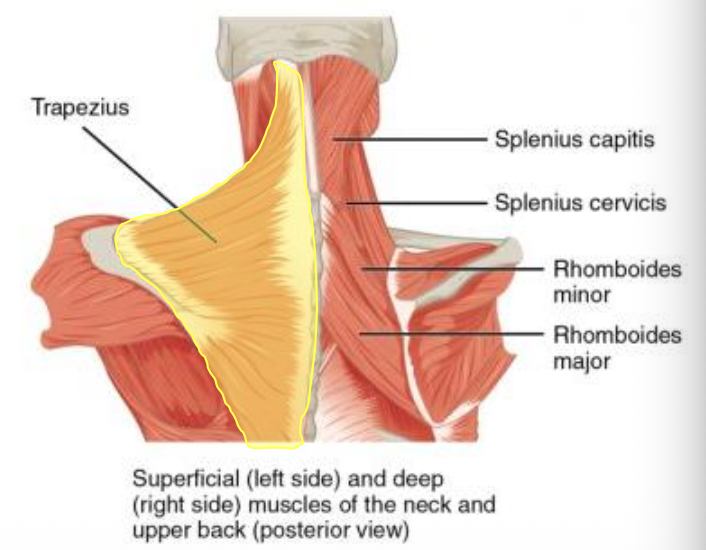
Rhomboid (major and minor)
Definition: Named for its rhomboid shape; has a major and minor version. Attaches scapula to spine. Function: Scapular retraction.

Levator scapulae
Definition: Named for elevating the scapula. Attaches scapula to spine. Function: Elevates the scapula.

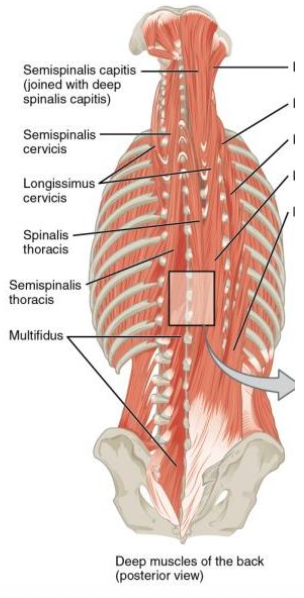
Deep back muscles
Definition: Erector spinae (3 muscles: semispinalis, longissimus, spinalis), interspinales (between spinous processes), intertransversarii (between transverse processes), and multifidus (one of the thickest muscles of the spine and lumbar region). Function: All either extend the spine/trunk or laterally flex the trunk/spine.

Rectus abdominis
Definition: Named for being a straight (rectus) abdominal muscle. Attaches xiphoid process and pubic bone. Function: Flexes the trunk/spine.

External and internal obliques
Definition: Named for being diagonal (oblique) abdominal muscles. The internal oblique is deep to the external oblique. External oblique fibers run medially inferiorly; internal oblique fibers run laterally inferiorly. Function: Laterally flex the trunk and small rotation.

Transverse abdominis (transversus abdominis)
Definition: Named for being opposite (transverse) to the rectus abdominis; deep to the internal oblique. Function: Compresses the abdomen.

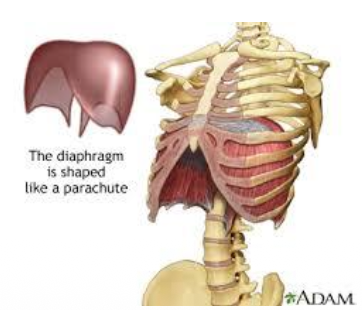
Diaphragm
Definition: Muscle attaching sternum, ribs, and spine. Function: Pushes organs inferiorly to help breathing.
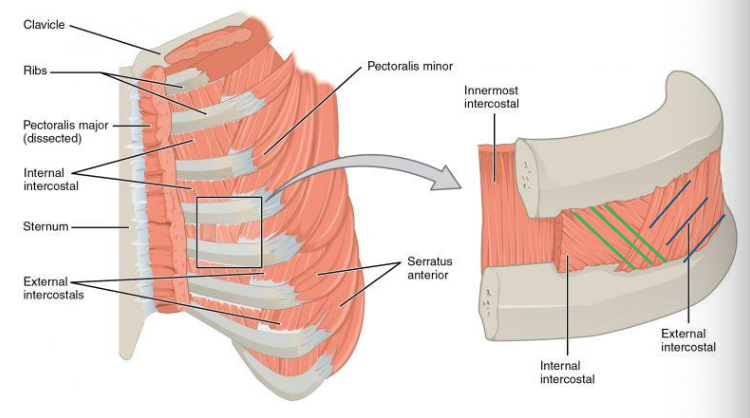
Intercostals
Definition: Named for being between (inter) the ribs (costal). Three types from superficial to deep: external, internal, innermost. Fiber orientation matches the external and internal obliques. Function: Elevate and depress the ribs for breathing.