Photosynthesis and Cellular Respiration Energy Cycle
 Note
 Call Kai
 Learn
 Practice Test
 Spaced Repetition
 Match
 Flashcards
1/18

Earn XP
Description and Tags
Vocabulary practice flashcards covering the chemical and biochemical processes of photosynthesis, aerobic cellular respiration, anaerobic fermentation, organelles involved, and the overarching energy cycle.
19 Terms
Photosynthesis
The process by which autotrophs (plants, protists, and some bacteria) use sunlight, water (H2O), and carbon dioxide (CO2) to produce oxygen (O2) and energy in the form of sugar (glucose, C6H12O6).
6H2O + 6CO2 ----------> C6H12O6+ 6O2

Cellular Respiration
The process of releasing cellular energy by breaking down food molecules (Glucose) in the presence of oxygen (O2) to produce ATP, carbon dioxide (CO2), and water (H2O).

Autotrophs
Organisms that can make their own food by utilizing photosynthesis, including plants, photosynthetic protists, and some bacteria.

Heterotrophs
Organisms that cannot make their own food and must consume other organisms or organic matter to obtain energy.

Chloroplast
The cellular organelle present only in plant and protist cells where photosynthesis takes place.
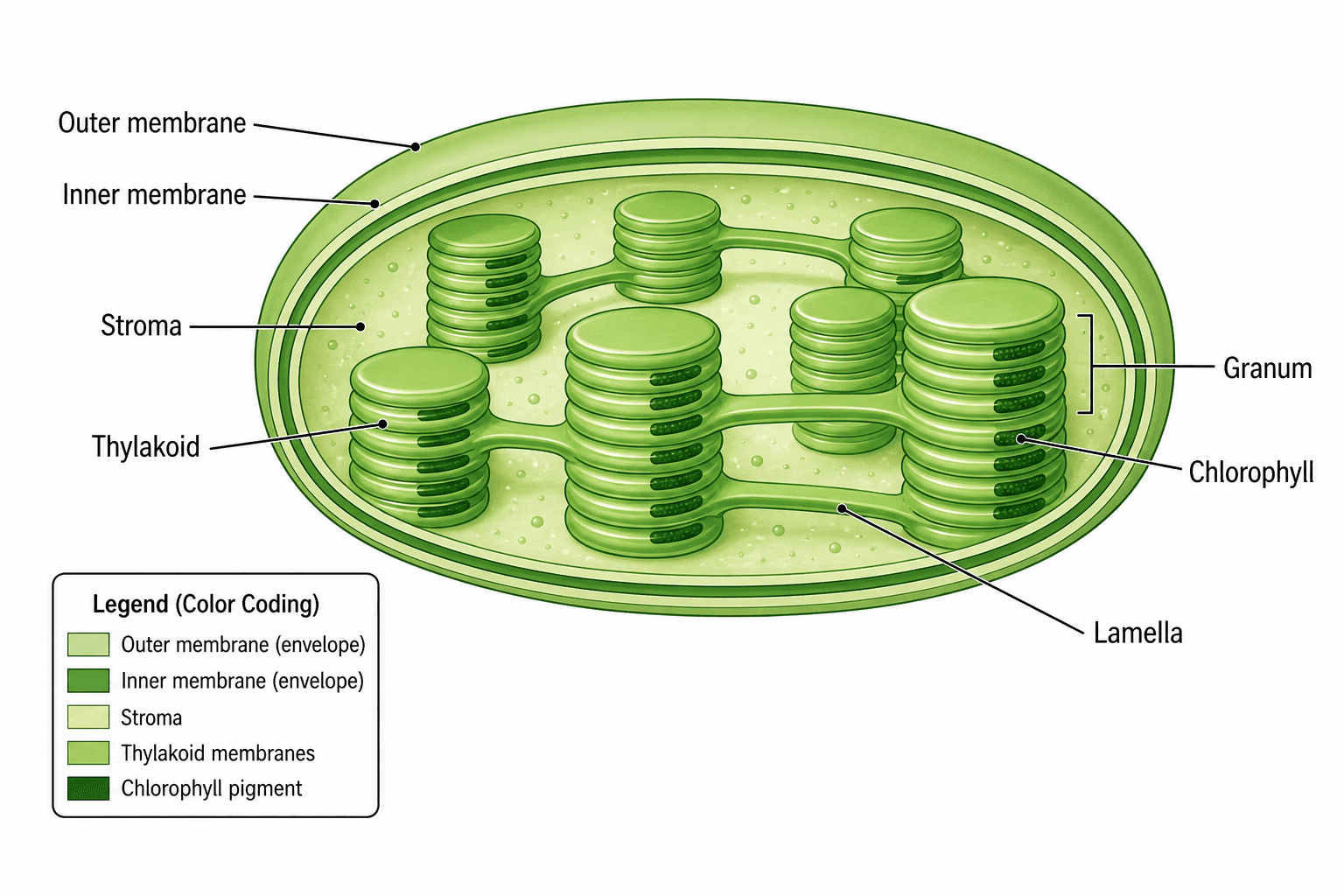
Chlorophyll
The primary photosynthetic pigment found in chloroplasts that absorbs blue/violet and red/orange light and reflects green light, giving plants their green appearance.


Chlorophyll a Absorption Spectrum
A wavelength absorption profile demonstrating high absorption peaks in the blue-violet range (400–450nm) and red-orange range (650–680nm), with near-zero absorption in the green light region (500–550nm).

Stomata
Microscopic openings on plant leaves that allow carbon dioxide (CO2) to enter and oxygen (O2) and water vapor (H2O) to exit.
The 5 Factors Affecting Photosynthesis
Key environmental conditions regulating the rate of photosynthesis, including
Available water supply
Temperature (which impacts enzyme function)
Light intensity
Color of light
Concentration of available CO2

Mitochondria
The organelles known as the 'powerhouse of the cell' where cellular respiration and ATP energy production take place.
Aerobic Cellular Respiration
A form of cellular respiration occurring in the presence of oxygen inside mitochondria that efficiently produces approximately 36ATP along with CO2 and H2O byproducts.
Anaerobic Respiration (Fermentation)
A cellular process that extracts energy from glucose without oxygen when mitochondria are absent or cannot be used, yielding a low output of only 2ATP.
Alcoholic Fermentation
A type of anaerobic respiration carried out by yeasts and certain microorganisms with the equation C6H12O6→Alcohol+CO2+2ATP, utilized in producing beer, wine, and bread.
Lactic Acid Fermentation
A type of anaerobic respiration occurring in active muscle cells (causing fatigue) and bacteria with the equation C6H12O6→2C3H6O3+2ATP, utilized in producing dairy foods such as yogurt and cheese.
Chemical Equation of Photosynthesis
6CO2+6H2O→C6H12O6+6O2, a light- and chlorophyll-driven reaction synthesizing glucose from carbon dioxide and water.
Chemical Equation of Aerobic Respiration
C6H12O6+6O2→6CO2+6H2O+36ATP, an oxygen-driven reaction releasing metabolic energy from glucose while producing carbon dioxide and water.
Anabolic Reaction (Photosynthesis)
A constructive metabolic reaction characterized by building complex glucose molecules from smaller reactants using energy, summarized by the mnemonic 'COWS GO' (CO2+H2O+sun→glucose+O2).
Catabolic Reaction (Cellular Respiration)
A degradative metabolic reaction characterized by breaking down glucose molecules to release stored ATP energy, summarized by the mnemonic 'GO COW!' (glucose+O2→CO2+H2O+ATP).

The Energy Cycle
The interdependent biological cycle wherein the outputs of photosynthesis (glucose and O2) serve as the inputs for cellular respiration, and the outputs of cellular respiration (CO2 and H2O) serve as the inputs for photosynthesis.