Lecture 7 - Leases and Events After the Reporting Period
 Call Kai
 Learn
 Practice Test
 Spaced Repetition
 Match
 Flashcards
 Knowt Play
1/34

There's no tags or description
Looks like no tags are added yet.
35 Terms
What is a lease, a lessor and a lessee?
Lease: A contract or part of a contract that conveys the right to use an underlying asset for a period of time in exchange for consideration
Lessor: The entity that provides the right-of-use asset and in exchange receives consideration
Lessee: The entity that obtains the right-of-use asset and in exchange transfers consideration
What is a right-of-use asset and an underlying asset?
Right-of-use asset: An asset that represents the lessee’s right to use an underlying asset for the lease term
Underlying asset: An asset that is the subject of a lease, for which the right to use that asset has been provided by a lessor to a lessee
What is a finance lease and an operating lease?
Finance lease: A lease that transfers substantially all of the risks and rewards incidental to ownership of an underlying asset
Operating lease: A lease that does not meet the definition of a finance lease
How do you recognise whether a contract contains a lease?
“A contract contains a lease if it conveys the right to control the use of an identified asset for a period of time in exchange for consideration”
Recognise and asset and a liability for all leases, unless they are short-term (less then 12 months) or of minimal value
What do minimal value items include?
Tables
Small personal computers
Telephones
Small items of furniture
No monetary value specified in the standard
When does the customer control/not control the asset’s use in a lease?
The customer controls the asset’s use if they have:
The right to substantially all of the identified asset’s economic benefits, and
The right to direct the identified asset’s use (can still exist if the lessor puts restrictions on its use within a contract, eg. capping a car’s maximum mileage)
The customer does not have the right to use an identified asset if the supplier has the practical ability to substitute the asset for an alternative and it would be economically beneficial for them to do so
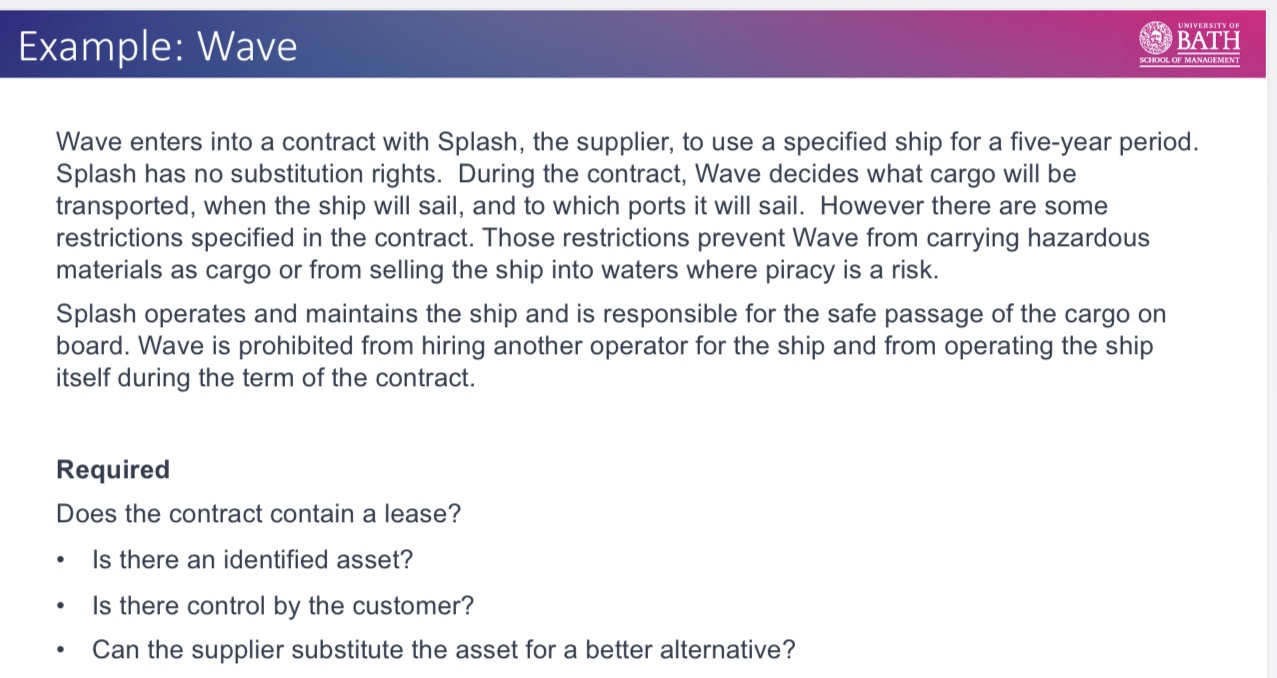


How is leasing different to renting?
Does the contract give control of an identified asset for a period of time in exchange for payment?
If yes, it is a lease
If no, it is a rental/service contract
The control over the asset is high when leasing but limited when renting
Renting is typically more short-term then leasing
Accounting treatment: Recognised on the SOFP as an asset/liability and recorded on the IS as an expense
How do you initially recognise a lease from the lessee’s POV?
Recognise as a lease liability and as a right-of-use asset
Describe the lease liability
Lease liability: Measured at PV of the lease payments that have not yet been paid
Lease payments include:
Fixed payments
Variable payments (depend on an index or rates, initially valued using the index or rate at the lease commencement)
Amounts expected to be payable under residual value guarantees - a guarantee made to a lessor by a party unrelated to the lessor that the value of the underlying asset at the end of a lease will be a specified amount
Options to purchase the asset that are reasonably certain to be exercised
Termination penalties, if the lease term reflects the expectation that this will be incurred
The discount rate should be the rate implicit in the lease, otherwise the entity should use its incremental borrowing rate
Describe the right-of-use asset
Right-of-use asset is initially recognised at cost and includes:
The amount of the initial measurement of the lease liability
Lease payments made at or before the commencement date
Initial direct costs
The estimated costs of removing or dismantling the underlying asset as per the conditions of the lease
What must be considered by the lessee to calculate the initial value of the right-of-use asset or liability?
To calculate the initial value of the right-of-use asset and liability, the lessee must consider the length of the lease term. The lease term must compromise:
Non-cancellation periods
Periods covered by an option to extend the lease if it’s reasonably certain to be exercised
Periods covered by an option to terminate the lease if it’s reasonably certain not to be exercised
What are current and non-current lease liabilities?
Current lease liabilities are amounts payable within the next 12 months
Non-current lease liabilities are amounts payable after more than 12 months

Calculate the initial carrying amount of the lease liability and right-of-use asset


Show the double entries needed for this question

How is the lease liability subsequently measured from the lessee’s POV?
The carrying amount of the lease liability is increased by the interest charge
Dr Finance cost (P&L)
Cr Lease liability
The carrying amount of the lease liability is reduced by cash repayments
Dr Lease liability
Cr Cash
How is the right-of-use asset subsequently measured from the lessee’s POV?
Measured using the cost model (*other measurement model may be chosen)
Cost less accumulated depreciation less impairment losses
If ownership of the asset transfers to the lessee at the end of the lease term then depreciation should be charged over the asset’s remaining useful economic life
Otherwise depreciation is charged over the shorter of the useful life and the lease term
What other measurement models are there for the right-of-use asset?
If the lessee measures investment properties at fair value, then IFRS 16 requires that right-of-use assets that meet the definition of investment property should also be measured using the fair value method
If the right-of-use asset belongs to a class of PPE that is measured using the revaluation model, then the entity may apply the IAS 16 PPE revaluation model to all right-of-use assets within that class
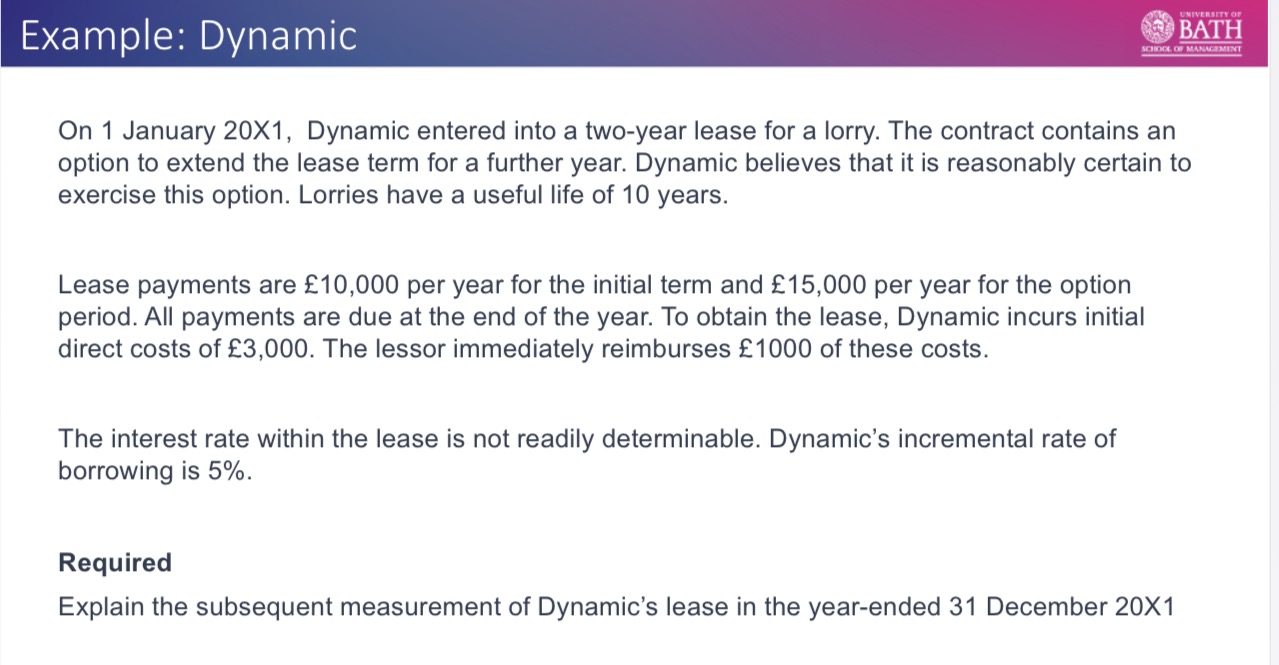

What are the double entries for this question?

What is important about the lease from the lessor’s POV?
A lessor must classify their leases as finance or operating leases
Finance lease: Substantially all the risks and rewards of the underlying asset are transferred to the lessee
Ownership is transferred to the lessee at the end of the lease
Classify as a finance lease if one or more of the following apply:
Ownership transfers to the lessee at the end of the lease.
The lessee has a purchase option below fair value and is reasonably certain to exercise it
The lease term covers the major part of the asset's economic life
PV of lease payments represents substantially all of the asset's fair value
The asset is specialised and only the lessee can use it without major modifications
The lessee compensates the lessor for losses if the lease is cancelled
The lessee bears gains or losses from changes in the residual value
The lessee can continue using the asset for a secondary period at substantially below-market rent


What is the initial treatment for a finance lease from the lessor’s POV?
The lessor will show assets held under a finance lease as a receivable. The value is calculated as the PV of:
Fixed payments
Variable payments (depend on an index or rate, valued using the index or rate at the lease commencement date)
Residual value guarantees
Un-guaranteed residual values
Purchase options that are reasonably certain to be expected
Termination penalties if the lease term reflects the expectation that these will be incurred
What is the subsequent treatment for a finance lease from the lessor’s POV?
The lessor will show lease receivable (SOFP) and finance income (IS)
The carrying amount of lease receivable is increased by the finance income earned which is also credited to the IS
Dr Lease receivable
Cr Finance income (P&L)
The carrying amount of the lease receivable is reduced by cash receipts
Dr Cash
Cr Lease receivable


What are the journal entries for this question?

How is the recognition and measurement carried out for an operating lease?
Recognition and measurement:
Lease payments are recognised as income on either a straight-line or systematic basis - apply another systematic basis if it is more representative of the pattern in which benefit from the use of the underlying asset is diminished
Recognise depreciation as per IAS 16 rules
Describe the history and importance of of lease accounting?
A standard for leases is important to prevent entities from under reporting lease liabilities (audit risk)
New standard IFRS 16 major change: All leases (operating and finance) to be capitalised
Old standard: Operating leases weren’t shown on the SOFP
Airline, retail & apparel, and shipping & transport companies have seen their total assets rise by an average of 14% as a result of the introduction of the new standard (EY - increased transparency)
IAS 10 requires the date of authorisation for issue:
To be disclosed
To identify who gave authorisation
To determine whether owners or others have the power to amend financial statements after issue
What are adjusting events?
Provide further evidence of conditions that existed at the balance sheet date
Before financial statements are authorised for issue by the directors
Reflect material items in the financial statements
What are non-adjusting events?
Indicative of conditions that arose after the balance sheet date
Do not reflect in the financial statements
Material non-adjusting events may require disclosure in notes to the FS to ensure that the FS aren’t misleading
How are non-adjusting events disclosed? (And a point about adjusting events)
Nature of the event
Estimate of the financial effect before taking account of taxation
Statement that is not practicable to make such an estimate
The taxation implications should be explained where necessary for a proper understanding of the financial position
For Adjusting Events: The entity should adjust amounts recognised in FS
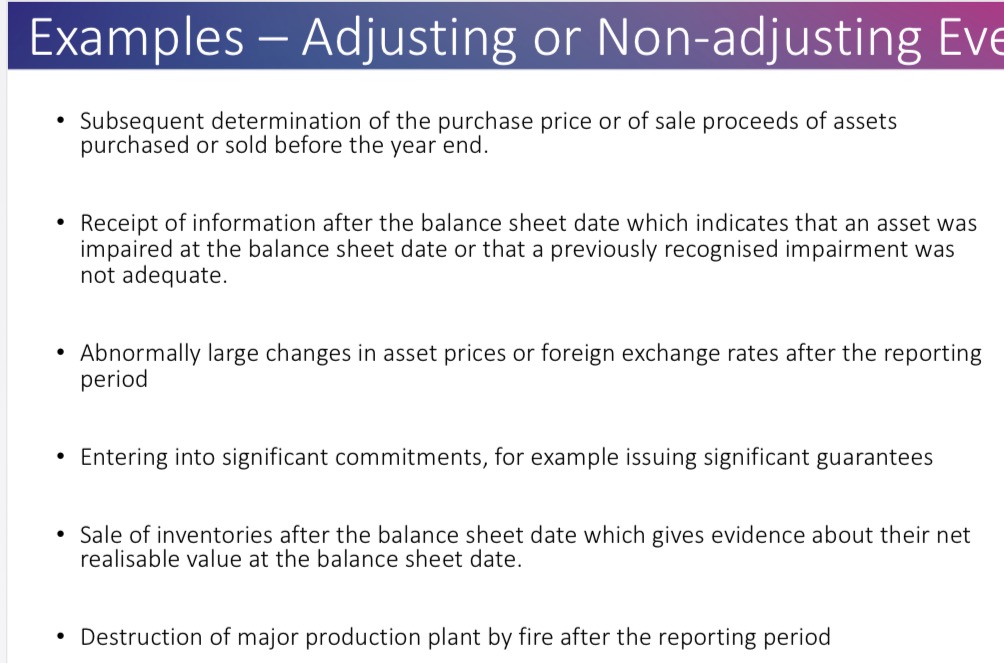
Which of these events are adjusting and which are non-adjusting?
1, 2 and 5 are adjusting
3, 4 and 6 are non-adjusting