Network+ Lesson 8: IP Routing
 Call Kai
 Learn
 Practice Test
 Spaced Repetition
 Match
 Flashcards
 Knowt Play
1/24

There's no tags or description
Looks like no tags are added yet.
25 Terms
Routing
- Choosing the path network traffic takes
- Done by routers using routing tables and algorithms
- Goal: most efficient path from source to destination
Routing Process
- Host A (192.168.100.10) sends to Host B (192.168.200.20) via router R1
- Host A > R1: dest IP = Host B, dest MAC = R1 G0/0
- R1 > Host B: source MAC = R1 G1/1, dest MAC = Host B
- Key: IPs stay the same end to end; MACs change at each hop

Routing Diagram Setup
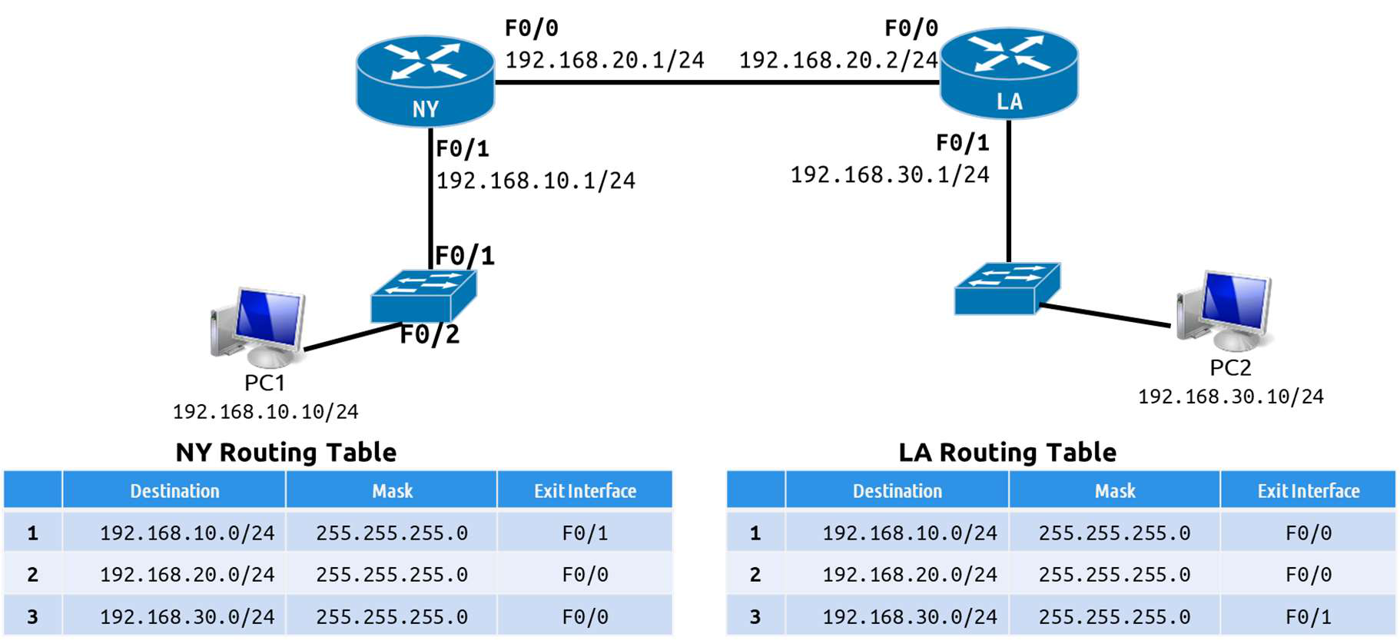
- PC1 192.168.10.10/24 - switch - NY router G0/1 192.168.10.1
- NY G0/0 192.168.20.1 ←> LA G0/0 192.168.20.2
- LA G0/1 192.168.30.1 - switch - PC2 192.168.30.10/24<→

Routing (NY and LA Routing Tables)
- Each router lists every network (/24, 255.255.255.0) and its exit interface
- NY: 192.168.10.0 out F0/1; 192.168.20.0 and 192.168.30.0 out F0/0
- LA: 192.168.10.0 and 192.168.20.0 out F0/0; 192.168.30.0 out F0/1
Static Routing
- Routes manually configured by an admin
- Simple for small networks
- Does NOT adjust to network changes; not scalableQ Routers share topology info using routing protocols
- Paths adjust automatically (link failures, congestion)
- Data takes the most efficient route
Dynamic Routing
- Routers share topology info using routing protocols
- Paths adjust automatically (link failures, congestion)
- Data takes the most efficient route
Routing (Types Hierarchy)
- Routing = static or dynamic
- Dynamic = IGP (interior) or EGP (exterior)
- IGP = distance-vector or link-state

Routing Protocol Categories
Interior Gateway protocols (IGP) are used by organizations to route their LAN in one location to their LAN in another. Example: NY branch router to LA branch router of the same organization. - Exterior Gateway protocols (EGP) are used by organizations to route one customer's WAN link to another customer's WAN link. Example: The Internet; every organization has a connection to many other organizations. - BGP (Border Gateway Protocol) is the only EGP protocol, and it is used to route the Internet. - Every organization has its own Autonomous System (AS), which is comprised of all their network locations interconnected.
Interior Gateway Protocol
Distance-vector is a hops-based routing protocol; it'll forward packets using the path with the fewest number of hops. - Link-state is a bandwidth-based routing protocol; it'll forward packets using the path with the highest bandwidth. - Table: Distance-vector - metric: fewest hops, max hops: 15, protocols: RIPv1, RIPv2, and IGRP. Link-state - metric: highest bandwidth, max hops: unlimited, protocols: IS-IS and OSPF.

Distance-vector - Hops
Diagram: R1-R2-R3-R4 linked at 1GB, R3-R5 at 100MB, R4-R5 at 1GB. - Distance-vector picks the path with the fewest hops: R1 - R2 - R3 - R5 (over the 100MB link).

Link-state - Bandwidth
Diagram: R1-R2-R3-R4 linked at 1GB, R3-R5 at 100MB, R4-R5 at 1GB. - Link-state picks the highest-bandwidth path: R1 - R2 - R3 - R4 - R5 (all 1GB links).

Routing Information Protocol (RIP)
One of the oldest distance-vector routing protocols. Uses hop count as a metric, with a maximum of 15 hops. - Versions: RIPv1: Classful protocol, no subnet information. RIPv2: Classless, supports subnetting, includes subnet mask info. Multicast updates and simple authentication. - Use Cases: Suitable for small to medium-sized networks. Limited scalability, slower convergence compared to modern protocols like OSPF and EIGRP.
Open Shortest Path First (OSPF)
Link-state routing protocol. Fast convergence and supports large networks. - Key Features: Hierarchical design with areas to optimize traffic. Updates sent only when topology changes, reducing overhead. Supports VLSM (Variable Length Subnet Masking) and CIDR (Classless Inter-Domain Routing). - Advantages: Efficient, scalable, and flexible. Provides load balancing and fault tolerance. Suitable for large, complex networks.
Enhanced Interior Gateway Routing Protocol (EIGRP)
Enhanced distance-vector protocol. Combines features of distance-vector and link-state protocols. - Key Features: Supports VLSM and CIDR. Sends partial updates only when changes occur. Uses metrics like bandwidth, delay, load, and reliability. - Advantages: Highly efficient, scalable, and quick convergence. Provides loop-free paths and load balancing. Suitable for medium to large networks, especially those with Cisco devices.
Metric
The metric is a value associated with routes, used by routing protocols to evaluate the cost of path traversal. - Lower metric values typically indicate more desirable routes. - Different routing protocols may use various factors, such as bandwidth, delay, hop count, or even custom values, to calculate this metric.
Border Gateway Protocol (BGP)
Essential for inter-domain routing on the internet. Uses path attributes to select the best route. - Key Features: Supports CIDR for efficient IP address allocation. Employs policies for route selection and advertisement. Uses TCP for reliable communication between BGP peers. - Advantages: Highly scalable and flexible. Manages large routing tables and complex policies. Crucial for ISPs and large enterprises with multiple connections to the internet.
Route Selection
Route selection is a critical process in network routing that determines the best path for data to travel from source to destination. - It uses specific criteria such as administrative distance, prefix length, and metric to choose the most efficient route.
Administrative Distance
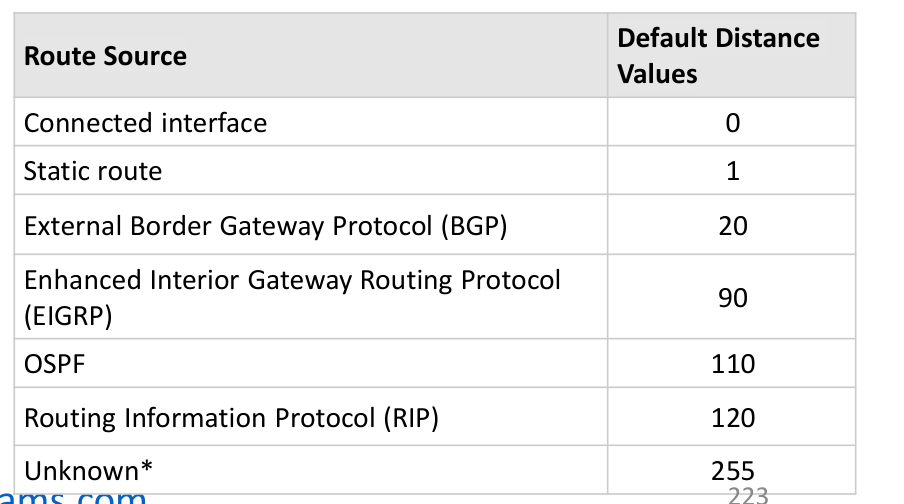
Administrative distance is a metric used by routers to rank the trustworthiness of routes received from different routing protocols. - Lower values indicate more preferred routes, helping routers decide which routes to use when multiple paths to the same destination exist from different sources. - Default distance values: Connected interface 0, Static route 1, External Border Gateway Protocol (BGP) 20, Enhanced Interior Gateway Routing Protocol (EIGRP) 90, OSPF 110, Routing Information Protocol (RIP) 120, Unknown* 255.
Prefix Length
The prefix length in networking specifies the number of contiguous bits of the network mask that are set to 1. - This notation is an integral part of CIDR and helps in defining network boundaries and available hosts within those networks, enhancing both routing efficiency and address allocation. - Example: 192.168.20.0/26
VRRP/FHRP
First-Hop Redundancy Protocols (FHRPs) are used to achieve high availability with multiple physical redundant routers. - HSRP (Hot Standby Router Protocol): Cisco proprietary redundancy protocol. - VRRP (Virtual Router Redundancy Protocol): Open standard redundancy.
Virtual IP (VIP)
A Virtual IP (VIP) address is an IP address that is not tied to a specific physical network interface on a device. - It is used to provide redundancy and load balancing for services hosted on multiple servers, allowing several servers to share the same IP address. - VIPs are commonly used in network load balancers and failover configurations to ensure continuous availability and scalability of critical applications and services.
VRRP/FHRP (Virtual IP Diagram)
Diagram: routers R1 (10.0.0.1) and R2 (10.0.0.2) share a virtual router VR with Virtual IP 10.0.0.10. - A host (10.100.100.100) behind the switch uses Gateway: 10.0.0.10 (the virtual IP).

Subinterface
A subinterface in networking is a virtual interface created by dividing a single physical interface into multiple logical interfaces. - This is commonly used in scenarios where multiple VLANs (Virtual Local Area Networks) exist on a single router or switch interface to manage traffic segregation and support various services or protocols over a single physical link.
Network Address Translation (NAT)
Network Address Translation (NAT) translates one IP address to another IP address. - NAT can be provided by a Router or Firewall. - Advantages: Conserves public IP addresses. Eliminates address overlap events with other LANs. Makes it easier to connect to the internet. Eliminates address renumbering if your network changes. - Disadvantages: Translation delays the forwarding of packets. Causes loss of end-to-end IP traceability. Certain applications will not function with NAT enabled.
Network Address Translation (NAT Types)
Static NAT (One-to-One): Translates one internal address to one external address; ONLY required if an internal host needs to be accessible from the Internet. - Dynamic NAT (Many-to-Many): Translates many different internal addresses to many different external addresses; NOT commonly used since it can limit internet access. - Port Address Translation (Many-to-One): Translates many different internal addresses to one external address; MOST commonly used to access the Internet; also known as overloading NAT or PNAT.