Material T8 - Degradation and Failure
 Call Kai
 Learn
Learn Practice Test
 Spaced Repetition
 Match
Match Flashcards
 Knowt Play
1/53

There's no tags or description
Looks like no tags are added yet.
54 Terms
Tribology
Friction, wear, lubrication (science of interaction between relative surfaces)

Asperities
Areas where surface degrades, more energy needed to overcome wear
Tribosystem
Two bodies moving against each other

Adhesion
Occurs between 2 clean surfaces in contact undergoing relative motion

Abrasion
Interaction of hard particle on a counterface, hard material scratches soft
Two-Body Sliding Abrasion

Three-Body Sliding Abrasion
Medium inbetween two bodies causing abrasion

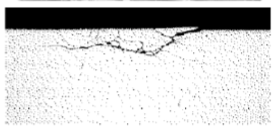
Surface Fatigue
Fatigue and crack formation due to repetitive alternating stress


Tribochemical Reaction
Formation of reaction products due to chemical reactions of surface - wear and corrosion
Adhesive Wear Suppressed
First stage of tribochemical wear

Destruction of Film in Contact, Adhesive Wear Suppressed
Second stage of tribochemical wear

Intense Corrosion by Anodic Dissolution between Fissures
Third stage of tribochemical wear
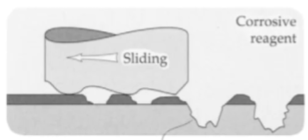
Unchecked Adhesive Wear, Rapid Corrosion on Exposed Surface
Fourth stage of tribochemical wear

Corrosion
Deterioration of a material due to reactions with the environment
Metal Corrosion
Formation of rust
Non-Metal Corrosion
Deterioration by sunlight or UV
Inorganic Materials
More correosive than organic materials (e.g. polymers)
Corrosion Process
Involves the movement of electrons from one atom/molecule to another
Oxidation
Metals lose electrons and become positive ions, occurs at the anode
Reduction
Ions generated from oxidation reaction form new materials (corrosion products), occurs at the cathode

Wet Corrosion Cell
Anode corrodes by loss of electrons, cathode consumes electrons
Electrode Difference
Energy required to add/remove electrons from metals
Electrochemical Series
Determined under standard conditions, values absolute for each element but CANNOT be used for alloys
Galvanic Series
True only for specified conditions (in seawater), dependent on electrolyte/temperature/pressure and CAN be used for alloys
More Active (Anodic)
Lower on the electrochemical/galvanic series
More Inert (Cathodic)
Higher on the electrochemical/galvanic series
Uniform Corrosion
Occurs uniformly over material surface, measured mm/year

Pitting Corrosion
Localised corrosion occurs in materials with coating (passive oxide or painted surface)

Intergranular Corrosion
Attacks between individual grains in polycrystalline materials

Welding of Stainless Steel
Common cause of intergranular corrosion
Galvanic Corrosion
Occurs when two dissimilar materials (metals) are in contact

Crevice Corrosion
Occurs when corrosive solution is trapped under crevice and causes localised corrosion

Physical Barrier, Cathodic Protection, Corrosion Inhibitors
Methods of preventing corrosion
Physical Barrier
Separate material from environment, use different coatings, or insulate metals from each other
Cathodic Protection
Galvanising, sacrificial anode, or impressed current
Sacrificial Anode
A more anodic (active) material is used to prevent a structure from corroding
Corrosion Inhibitors
Remove active species from environment, add low concentration additives (e.g. hydrazine)
Galvanising
Supplying electrons to push oxidation reaction backwards
Counter Electrode
Completes cell circuit but does not interact (made from inert conductor, e.g. platinum)
Reference Electrode
Measures the working electrode potential, has a very stable potential
Working Electrode
Sample intended to be tested for corrosion
Fatigure
Failutre due to cyclic stress
Beach Marks
Semi-circular and outward radiating fracture surface caused by fatigue
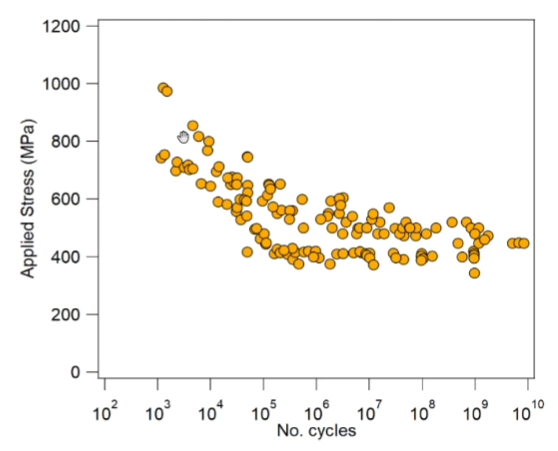
10^7 Cycles
‘Infinite’ lifetime strength for fatigue
Crack Nucleation
Determines low cycle fatigue
Crack Propagation
Determines high cycle fatigue
Fatigue Strength
Lower plateau at high no. of cycles
Creep
High temperature phenomena relative to melting point
Creep Rate
dε/dt, change in strain with time measured in s-1
Primary Creep
Slope (rate of creep) decreases w/ time
Secondary Creep
Steady-state (constant slope)
Tertiary Creep
Slope increases w/ time
Greater strain and earlier fracture
Effect of increasing temperature on creep
Creep Failure
Usually occurs along grain boundaries