Fuels & Heats of Reaction - Chpt. 21
 Call Kai
 Learn
 Practice Test
 Spaced Repetition
 Match
 Flashcards
 Knowt Play
1/42

Earn XP
Description and Tags
Also cover: IUPAC naming, structural formulas, Bond Energy, Neutralisation & Formation Questions
43 Terms
Hydrocarbon
Compound containing carbon and hydrogen only
Fossil Fuels
Fuels formed from the remains of plants and animals that lived millions of years ago
Gradation in physical properties
Boiling points increase with molecule size due to increased van der Vaals forces
Greater number of electrons in electron cloud allow temporary dipoles to form more easily
1. series of compounds of similar chemical properties
2. show gradations of physical properties
3. have general formula
4. have similar method of preperation
5. each number differs from the previous by a CH2 unit
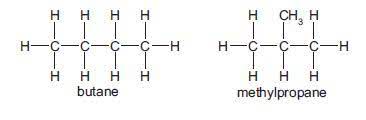
Example of a Structural Isomer & draw structure
Butane and Methylpropane
General Formula for Alkanes
Cn H2n+2
General Formula for Alkenes
Cn H2n
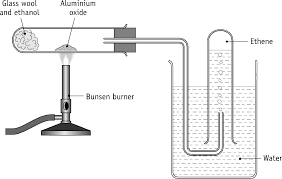
How to prepare ethene
Used for clothes: polyethene
Ethanol soaked glass wool end of test tube; aluminium oxide in centre heated gently by bunsen burner (flame not on ethanol or only get ethanol vapour passing over aluminium oxide and not converting to ethene)
Gas collected in test tube; first tube discarded as only contains air displaced from apparatus
Delivery tube taken out of water before turning of bunsen burner to prevent suck-back (cold water could crack boiling tube)
Tests on Ethene
Gas: colourless with sweetish small; insoluble in water but dissolves in organic solvents, eg. cyclohexane (same as methane)
Combustion: Yellow luminous slightly smokey flame (produces water & CO₂), limewater turns milky as Ca(OH)₂ + CO₂ → CaCO₃ + H₂O
Bromine: Bromine water red to colourless as double bond is broken (1,2-dibromoethane or 2-bromoethanol when bromine water): test for unsaturation
Acidified KMnO₄: Purple to colourless as double bond breaks: test for unsaturation
General Formula for Alkynes
Cn H2n-2
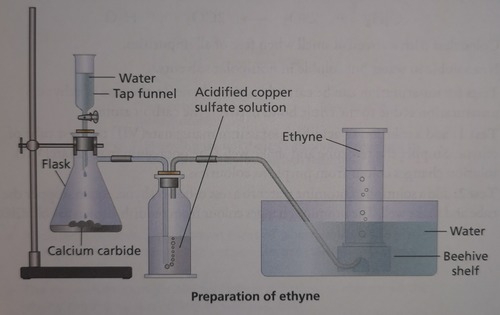
Prepration of Ethyne
No naked flames (ethyne is explosive)
Used to artificially ripen fruits
Set up apparatus, calcium carbide in buchner flask, with water in tap, acidified copper sulfate solution next, which removes impurites (hydrogen sulfide, phosphine, and ammonia), and then a water bath to trap ethyne.
Calcium Carbide fizzes in buchner flask, turning from sandy to white solid, buchner flask becomes warm
CaC₂ + 2H₂O → Ca(OH)₂ + C₂H₂
Tests for Ethyne
Gas: Colourless sweetish smelling gas (with impurities smells bad), insoluble in water, soluble in cyclohexane
Combustion: Luminous smoky flame (produces water and CO₂)
Bromine: Red to clear: unsaturated
Acidified KMnO₄: Purple to clear: unsaturated
Aromatic compounds
Compounds that contain benzene ring structure in molecules eg. Methylbenzene (C₇H₈ - preferred as non-carcinogenic) & Ethylbenzene (C₈H₁₀)
Steps in fractional distillation
After analysis, crude oil is heated to 600C
Bubble caps slow rate vapour rises through fractionating collumn, allowing for better seperation
Vapour molecules condenses & are collected in trays
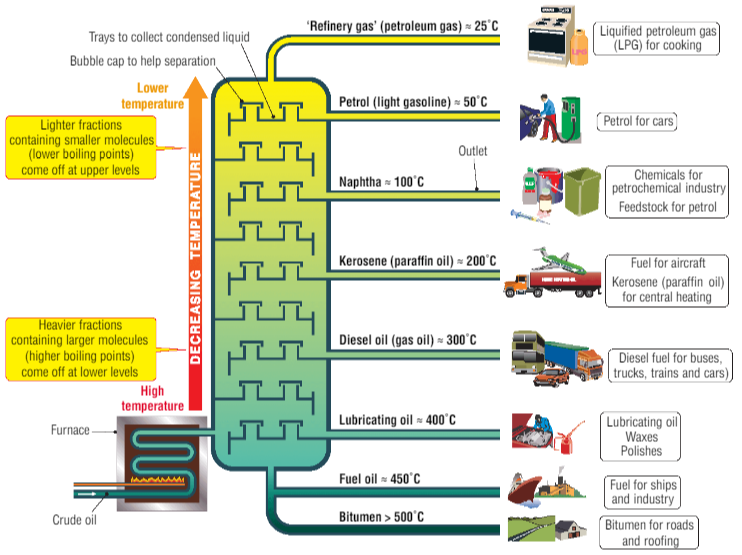
Refinery/Petrolium gas
Methane, ethane, propane, butane
Used in domestic gas
Mercaptans (sulfur compounds) are added to add smell and propane and butane are pressurised into LPGs (Liquified Petroleum Gas)
Petrol (light gasoline
C5 - C10
Used as motor fuel
Naphtha
C7 - C10
Some is used in petrol due to the overlap, some used for petrochemicals such as medicines, plastics and solvents
Kerosene/Paraffin oil
C10 - C14
Domestic heating oil, aircraft fuel
Deisel/Gas
C14 - C19
Fuel for cars, buses, trucks, trains & domestic oil
Lubricating oil
C14 - C35
High boiling range so cannot be used for fuel. Used as lubricant to reduce wear and tear of engines
Fuel oil
C30 - C40
Used to power ships, power stations & heating plants
Bitumen
C35
Black tar on roads, waterproofing & Roofing
Factors Affecting Octane No.
Length of carbon chain
Degree of branching
Cyclical Structure
Why is tetraethyl lead not used anymore
Poisoned the metal catalysts in the catalytic converter
How to Increase Octane No.
Isomerisation: Changing straight-chain alkanes into isomers; heated in presence of catalyst, chains break, rejoin in branched chains (pentane and hexane)
Catalytic Cracking: Braking down of long-chain hydrocarbon molecules by action of heat and catalysts into short-chain molecules for which there is greater demand
Dehydrocyclisation: Use of catalysts to form ring compounds
Adding Oxygenates: Adding methanol, ethanol and MTBE
1. Steam reforming of natural gas by reacting methane w steam (CH4 + H20 = 3H2 + CO)
2. Electrolysis of water. Produced in oil when dehydrocylisation happens (H2O = H2 + ½O2)
To Determine Heat of Reaction of Hydrochloric Acid w Sodium Hydroxide
Steps
Known volume hydrochloric acid solution placed in polystyrene cup with thermometer in each, temp. recorded
Sodium hydroxide solution added quickly to hydrochloric acid solution; lid placed on, stirred continuously, max temp. recorded
Explinations
For better result, solutions of HCl and NaOH used are stronger, otherwise temperature rise would be too small to accurately measure
Steps to improve accuracy
Accurate thermometer that reads to 0.1 degrees/attached to datalogger
Burette could be used instead of a graduated cylinder to measure, however not to mix as it would be too slow
Lid minimises heat loss, ensuring all heat given out is recorded
Quick addition of base avoids heat loss
Avoid splashing, as any loss of liquid would lead to inaccurate readings
Calculations
Heat given out = mass (kg) x specific heat capacity (J kg⁻¹ K⁻¹) x rise in temperature (t₂ - t₁)