8/24 - Equine IBD
 Call Kai
 Learn
Learn Practice Test
 Spaced Repetition
 Match
Match Flashcards
 Knowt Play
1/21

There's no tags or description
Looks like no tags are added yet.
Name | Mastery | Learn | Test | Matching | Spaced | Call with Kai | Chat |
|---|
No analytics yet
Send a link to your students to track their progress
22 Terms
Small
Which intestines in the horse serve to do absorption of CHOs, fats, and proteins? This is done through the villi brush border, and results in malabsorptive syndrome if it is not successful.
Weight Loss
What clinical sign/condition is the hallmark of small intestinal malabsorptive syndrome?
Suggestive
Is low TP and low albumin diagnostic or suggestive for malabsorptive syndrome?
Proximal
Endoscopy can only be done in which section of the equine small intestine, proximal or distal?
Acute
Which type of SI disease (acute or chronic) presents with moderate-severe colic, dilated SI loops, and copious gastric reflux?
Chronic
Which type of SI disease (acute or chronic) presents with weight loss but good appetite, intermittent mild colic, and thickened SI walls?
No
Does the SI of the horse have bands like the small colon does?
IBD
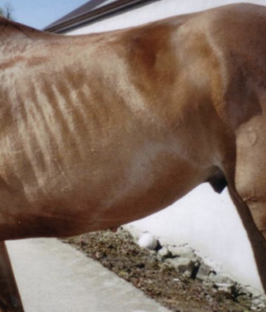
Clinical signs of what condition (abbreviated) include progressive weight loss despite good appetite, protein-losing enteropathy, hypoalbuminemia, peripheral edema, lethargy, performance loss, intermittent mild colic, and possibly diarrhea? Edema is usually in the ventral abdomen, not the limbs. It has 5 categories.
Histopathology
What test/procedure is the only definitive diagnosis for IBD in horses?
Granulomatous Enteritis
Which type of IBD is also called GE and mainly affects young horses? Standardbreds are predisposed, and it involves macrophages. M. avium has been implicated and it is caused by an abnormal host inflammatory response.
Macrophages
What cells are involved in granulomatous enteritis IBD?
MEED
Which type of IBD (abbreviated) is multisystemic and mainly affects young horses? Dermatitis is common in this condition, as well as diarrhea and tissue eosinophilia. It may be a hypersensitivity response and is diagnosed using rectal biopsy. There will be primarily eosinophils, along with lymphocytes and macrophages.
Eosinophil
Which cells will be the primary ones involved in MEED IBD?
Enterocolitis
Which type of IBD is also called eosinophilic enteritis, and is characterized by inflammatory eosinophilic infiltration at the intestinal mucosa both diffuse and focal?
Diffuse
Which type of enterocolitis IBD is in the small and large intestines, causing chronic weight loss and diarrhea?
Focal
Which type of enterocolitis IBD is idiopathic and involves acute colic signs but no chronic weight loss?
IFEE
Which type of IBD (abbreviated) is also called IFEC and is different from typical IBD cases? There is no weight loss and proteins are normal. Acute severe colic is the most common clinical sign, and surgical decompression will treat this condition. The cause is unknown.
Lymphocytic-Plasmacytic
What enterocolitis is a type of IBD that is rare and has a grave prognosis? There is no age, breed, or gender predisposition, and signs are similar to granulomatous enteritis. Histology on rectal biopsy will present lymphocytes and plasma cells in the lamina propria, plus villous atrophy. Malabsorption will occur, though albumin may not always be low.
24
Ideally, patients should be fasted how many hours before the glucose absorption test? 10% glucose is given through an NG tube and samples are taken every 30 minutes. An elevation of over 85% between 60-120 minutes is expected in normal horses.
Dexamethasone
Which corticosteroid, in an immunosuppressive dose, is the treatment for IBD? If this is unsuccessful then prognosis is poor. Prevention includes decreasing exposure to dietary, parasitic, and environmental antigens, plus differentiating the type of IBD, and removing intramural masses?
Small Intestine
Biopsy of what tissue is done to diagnose granulomatous enteritis and enterocolitis?
Rectum
Biopsy of which tissue is done to diagnose MEED and lymphocytic-plasmacytic enteritis?