Genomics Quiz Questions for the Exam
 Call Kai
 Learn
 Practice Test
 Spaced Repetition
 Match
 Flashcards
 Knowt Play
1/94

There's no tags or description
Looks like no tags are added yet.
95 Terms
What is the primary function of DNA in a cell?
Storing genetic information
Which enzyme is responsible for synthesizing a new DNA strand during replication?
DNA polymerase
Which nitrogenous bases pair with each other
DNA: Thymine to Adenine, Cytosine to Guanine
RNA: Uracil to Adenine, Cytosine to Guanine
What is the main product of transcription?
RNA
What is the main product of translation?
protein
During translation, ribosomes use ____ as a template to synthesize proteins.
mRNA
Which organelle is the primary site of protein synthesis?
ribosome
A mutation that changes one nucleotide in a DNA sequence is called a:
point mutation
What is the role of helicase during DNA replication?
Unwinding the DNA double helix
Which statement correctly desccribes the relationship between DNA, RNA, and protein?
DNA is transcribed into RNA, which is translated into protein
Which type of RNA carries amino acids to the ribosome during translation?
tRNA
Which method defines Sanger sequencing?
Chain-terminating dideoxynucleotides with capillary electrophoresis

A hallmark step of Illumina sequencing is:
bridge amplification forming clonal clusters on a flow cell

Oxford Nanopore primarily detects bases via:
Changes in ionic current as nucleic acids traverse a pore

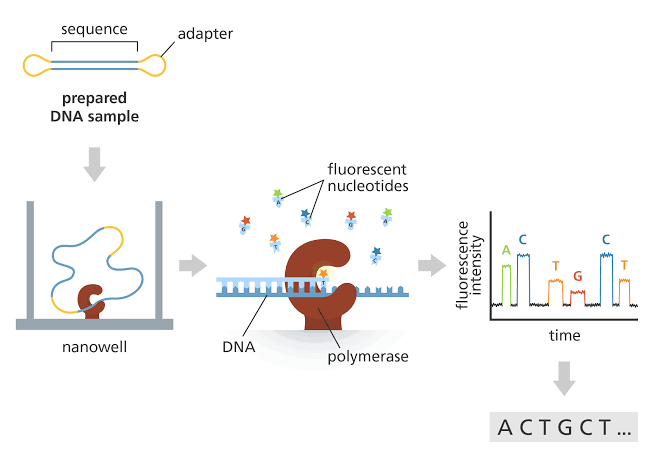
PacBio sequencing is best described as:
Single-molecule fluorescence of nucleotide incorporations with laser detection
Shotgun genome sequencing most directly depends on:
De novo assembly of overlapping reads into contigs and scaffolds

In a genome assembly N50 is:
The shortest contig length needed to cover 50% of the entire genome assembly
In a whole-genome project, you sequenced a 3.2 Gb genome and obtained 400 million reads, each of which was 150bp long. What is the approximate average coverage (depth) of the genome?
19
Which statement correctly distinguishes contigs and scaffolds?
Scaffolds are ordered/oriented sets of contigs and may include gap Ns
Synteny between two species refers to
Conservation of gene order across chromosomal regions
Lineage-specific alternative splicing primarily leads to:
Proteome diversification enabling lineage or tissue specific functions
Which chromatin features indicate active promoters/enhancers?
DNase 1 hypersensitivity and histone acetylation (ex: H3K27ac)
Standard human DNA profiling primarily relies on:
Short tandem repeat (ex. microsatellite) length polymorphisms
Which statement correctly contrasts transposition and retrotransposition?
DNA transposons typically cut-and-paste: retrotransposons use a copy-and-paste mechanism
In human genetics, what is a “trait”?
Any measurable characteristic or phenotype of an individual
What is the primary goal of a genome-wide association study (GWAS)?
To find variants associated with a trait across the genome
Which best defines a single nucleotide polymorphism (SNP)?
A single base change at a specific genomic position common in a population
In GWAS results, “effect size” typically refers to:
Measurement of the statistical association between a specific genetic variant (ex. SNP) and a trait
The increasing allele for a quantitative trait is:
The allele that raises the measured value of the trait per copy
If you test 1,000,000 independent SNPs which Bonferroni-corrected significance threshold is closest to standard practice?
5×10^-8
In statistics, variability in a trait refers to:
The spread or dispersion of trait values across individuals
In GWAS, heritability is best described as:
The percent differences of a trait between individuals due to DNA differences
A polygenic score is:
A weighted sum of trait-increasing alleles across many loci
In a case-control GWAS, an odds ratio of 1.5 for allele indicates:
The allele increases odds of disease by 50% per copy
A haplotype is best defined as:
A set of alleles at multiple loci that tend to be inherited together on the same chromosome
Which scenario best illustrates confounding in a GWAS?
Population stratification leads to allele frequency differences correlated with both ancestry and the trait
If two SNPs are in strong LD (r²=0.9) which is most likely true?
One can often “tag” the other for association purposesMolecular evolution is best described
Molecular evolution is best described as:
The study of changes in DNA, RNA, and protein sequences over evolutionary time
Two genes are considered homologs if they:
Share a common evolutionary ancestor
Orthologs are genes that:
Arise by speciation and are usually found in different species
Paralogs are genes that
Result from gene duplication events
Conserved regions in proteins are often important because they
Often contain amino acids essential for structure or function
Apoptosis refers to
Programmed cell death
A proto-oncogene is:
A normal gene that can promote cell growth or division
An oncogene is usually formed when
A proto-oncogene becomes abnormally activated or overexpressed
Tumor suppressor genes normally function to
Prevent or regulate cell growth and division
Speciation is the process by which
One species splits into two or more distinct species
Natural selection occurs when
Individuals with advantageous heritable traits leave more offspring
A synonymous mutation is one that
Does not change the encoded amino acid
Which example best describes a.chromosomal inversion
A chromosome segment is reversed in orientation within the same chromosome
Exon shuffling supports the modular nature of proteins because it
Allows protein domains encoded by exons to be recombined into new gene arrangements
In sequence alignment identity refers to
The percentage or fraction of positions with exactly the same residue or nucleotide
In sequence analysis similarity is uaually broader than identity because similarity
Includes exact matches as well as conservative substitutions with similar biochemical properties
A global alignment is designed to
Align two sequences from beginning to end across their full lengths
A local alignment is most useful when
Only a region or domain within two sequences is similar
A dot matrix or dot plot is used to
visualize regions of similarity between two sequences
A scoring matrix in sequence alignment is used to
Determine how favorable or unfavorable residue substitutions are
BLOSUM62 is commonly used to
Score amino acid substitutions in protein sequence alignments
BLAST is best described as a tool that
searches sequence databases for regions similar to a query sequence
BLASTP is used to compare
A protein query sequence against a protein sequence database
BLASTN is used to compare
Nucleotide sequences against nucleotide databases
In BLAST the E-value represents
the expected number of alignments with a similar score that could occur by chance in a database search
A lower E-value generally indicates that a BLAST hit is
more likely to be biologically meaningful and less likely due to chance
A gap penalty is used in sequence alignment to
penalize the introduction or extension of gaps in an alignment
The raw score of an alignment is
The alignment score is calculated directly from matches, mismatches, substitutions, and gaps
Protein primary structure refers to
the linear sequence of amino acids in a polypeptide chain
protein secondary structure mainly includes
alpha helices and beta sheets stabilized by backbone hydrogen bonds
protein tertiary structure describes
the three-dimensional shape of a single polypeptide chain
X-ray crystallography determines protein structures by
measuring how protein crystals diffract X-rays
NMR spectroscopy is especially useful because it can
study proteins in solution and provide information about structure and dynamics
Cyrogenic electiron microscopy or Cryo-EM is commonly used to
image frozen biological molecules or complexes using elctron microscopy
In protein structure predication “ab initio” methods attempt to
predict structure from basic physical principles and sequence information, often without using a close template
Statistical and knowledge-based protein prediction methods generally rely on
patterns learned from known protein structures and sequence structure realtionships
Neural networks are useful in protein structure prediction because they can
learn complex patterns from large datasets of protein sequences and structures
AlphaFold2 is best known for
predicting protein three-dimensional structures from amino acid sequences with high accuracy for many proteins
Intrinsically disordered proteins (LDPs) are best described as
proteins that lack a single stable three-dimensional structure under physiological conditions
Intrinsically disordered regions (IDRs) are
flexible regions within proteins that do not adopt one fixed structure
Post-translational modification refers to
Chemical modification made to proteins after they are synthesized
The transcriptome is
the complete set of RNA transcripts produced by a cell or organism under specific conditions
The proteome is
the complete set of proteins expressed by cell,tissue, or organism under specific condition
A response element is
a DNA sequence that binds regulatory proteins and helps control gene expression
A microarray is commonly used to
measure the expression levels of many genes simultaneously using hybridization to probes
RNA seq is used to
measure and analyze RNA transcripts using high throughput sequencing
2D gel electrophoresis separates proteins mainly by
Isoelectric point and molecular weight
LC-MS is commonly used to
Identify and quantify proteins or peptides using liquid chromatography and mass spectrometry
A phylogeny is best described as
A hypothesis about the evolutionary relationships among organisms or genes
A molecular clock is base on the idea that
mutations or sequence changes may accumulate at an approximately regular rate over time
Divergence time refers to
The time when two lingeages last shared a common ancestor
Evolutionary distance generally measures
the amount of evolutionary change separating two sequences or taxa
A distance matrix is used in phylogenetics to
store pairwise evolutionary distances between sequences of taxa
A rooted tree differs from an unrooted tree because a rooted tree
shows the direction of evolutionary time from a common ancestor
An unrooted tree shows
evolutionary relationships without specifying the common ancestory or direction of time
In phylogenetic analysis, an outgroup is used to
Help root a tree by providing a reference lineage outside the group of interest
UPGMA assumes that
Evolutionary rates are equal across all lineages
Neighbor Joining is a method that
Builds a phylogenetic tree from a distance matrix without requiring a strict molecular clock