BIO chp 6 RS
 Call Kai
 Learn
Learn Practice Test
 Spaced Repetition
 Match
Match Flashcards
 Knowt Play
1/76

There's no tags or description
Looks like no tags are added yet.
Name | Mastery | Learn | Test | Matching | Spaced | Call with Kai | Chat |
|---|
No analytics yet
Send a link to your students to track their progress
77 Terms
Skeletal system:
Consists of Bones, cartilage, and ligaments
tightly joined to form strong, flexible framework for the body
Cartilage
the embryonic forerunner of most bones, covers many joint surfaces in the mature skeleton
(covers bones/joints ends)
Ligaments
hold bones together at the joints
(bone to bone)
Tendons
structurally similar to ligaments but attach muscles to bones
Functions of the skeleton
HEMP BADS
Support:
Movement: muscles pull on bones to move
Protection: protect organs
Blood formation: red bone marrow produces blood cells
Electrolyte balance: reservoir of calcium and phosphate
Acid-base balance: pH change, absorb/release alkaline salts
Hormone Secretion: bones secrete osteocalcin and lipocalcin 2, stim. insulin secretion, inc. insulin sensitivity, respond to stress
Detoxification: bones absorb metals/elements, releases them more slowly for excretion
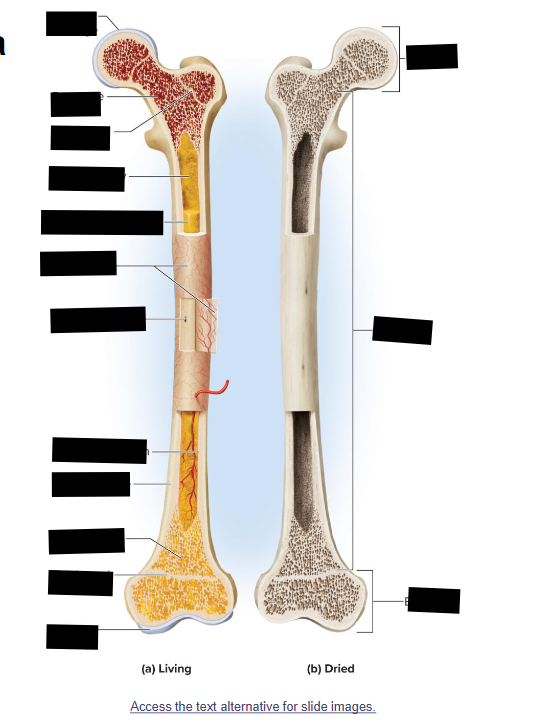
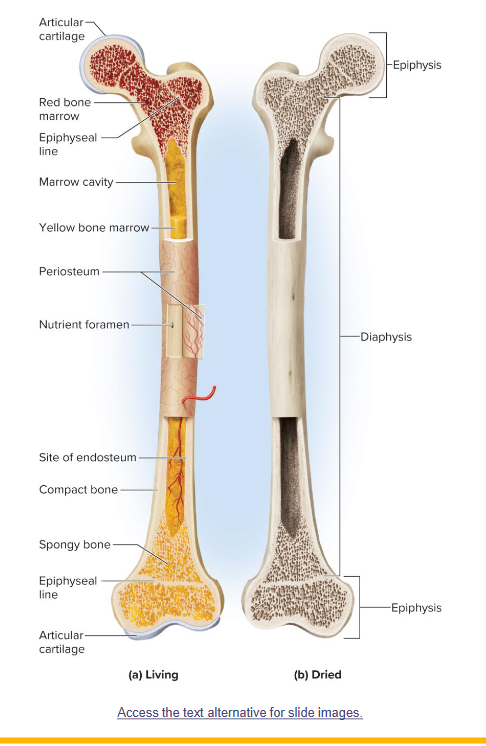
Features of a long bone
CSDEEPNEA
Cool Students Do Exams Every Period, Never Ending Assignments
Compact (cortical bone)
Spongy (cancellous) bone
Diaphysis
Epiphysis
Epiphyseal plate
Periosteum
Nutrient foramina
Endosteum
Articular cartilage
Compact (corticle) bone
dense outer shell of bone
surrounds the medullary (marrow) cavity
Medullary (marrow) cavity: hollow space containing bone marrow
Songy (Cancellous) bone
loosely organized bone tissue within the ends (epiphyses) of the bone
Diaphysis
Shaft of the bone, In long bone provides leverage
Epiphysis
expanded portion at each end
provides strength to the joint
increased surface area for attachment of tendons and ligaments
Epiphyseal plate
Hyaline cartilage separating marrow cavities of epiphysis and diaphysis
present in only children and adolescents aka growth plate
bones grow in length here
Perosteum
outer sheath of dense irregular connective tissue
some of its collagen fibers penetrate into bone matrix as perforating fibers
has tough outer fibrous layer of collagen. And a inner osteogenic layer of bone forming cells (imp. for growth & healing)
provides strong attachment and continuity from muscle to tendon to bone
Nutrient formania
holes where blood vessels of periosteum penetrate into the bone
Endosteum
internal surface covering
composed of reticular connective tissue with cells that deposit osseous tissue and others that dissolve it
Articular cartilage
hyaline cartilage at the ends of most adjoining bones.
enables it to move more easily, with aid of synovial fluid
Osteoclasts
type of bone cell
bone dissolving macrophages
In endosteum and osteogenic layer of periosteum
Osteoclasts job
osteolysis: bone breakdown actions of osteoclasts (pathological/disease causing)
Resorption: breakdown of bone by osteoclasts (normal process)
Osteoclasts Looks
Large cells
formed by fusion of many stem cells
multinucleated
ruffle boarder
What do osteoclasts secrete onto the bone surface
hydrochloric acid (HCI)
What does hydrochloric acid (HCI) do
dissolves minerals of bone matrix
Lysosomal enzymes in Osteoclasts………
digest proteins; digest organic components of bone matrix
Matrix of osseous tissue
stony material surrounding osteocytes and lacunae
gives bone flexibility and strength
1/3 organic
2/3 inorganic
Organic components
Primary collagen (strong)
Also, glycosaminoglycans, proteoglycans, and glyocoproteins
I
Inorganic components
primarily hydroxyapatite (calcium phosphate salt)
Also, calcium carbonate and small amounts of other minerals
In each lamella, the collagen fibers “______“ down the matrix in a……..
“corkscrew”
helical petter like the threads of a screw
How is the bone stronger and able to resist tenson in multiple directions
The helices coil in one direction in one lamella and in the opposite direction in the next lamella
Bone resist tension (bending) helix is…
loosely coiled like threads on a wood screw
In weight bearing areas helix is…..
more tightly coiled like they the closely spaced threads on a bolt, and the fibers are more nearly transverse
Primary features of spongy bone
Lattice of silvers of bone called spicules (rods/spines) and trabeculae (thin plates and beams)
Porous appearance; spaces filled with bone marrow
Matrix contains lamellae, but not in concentric layers and no osteons
Trabeculae arranged along bones lines of stress
Does spongy bone or compact bone have more surface area exposed to osteoclast action
Spongy bone
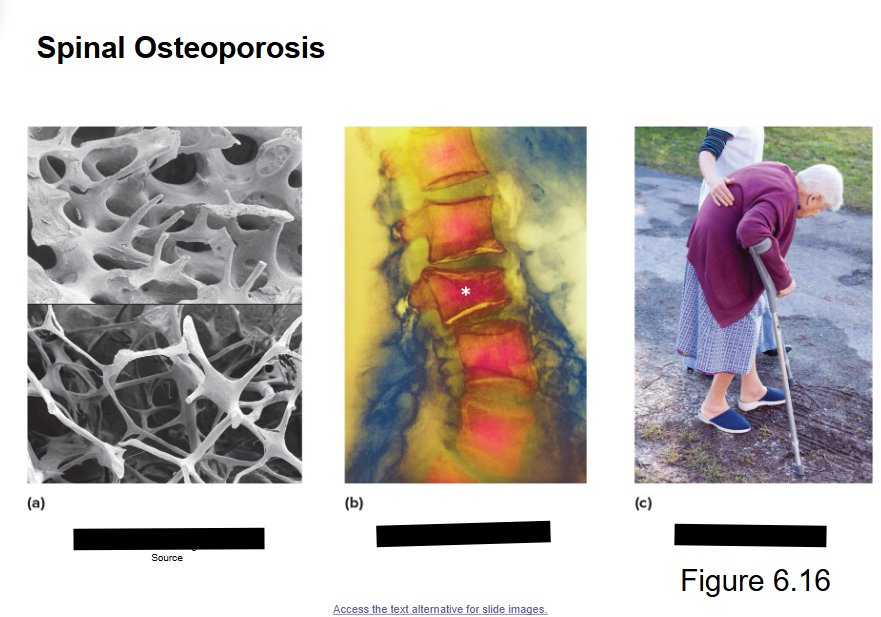
Most osteolysis therefore involves the spongy bone, and from a pathological standpoint, so does osteoporosis
true
INTRAMEMBRANOUS OSSIFICATION
Produces flat bones of skull, part of mandible and most of clavicle
Stages of Intramembranous ossifcation
Mesenchyme condenses into sheet of tissue permeated by blood vessels; mesenchymal cells become osteoblasts that secrete osteoid tissue (prebone)
Minerals (primarily calcium phosphate) crystalize on collagen of osteoid; osteoblasts promote this mineralization and become trapped in the matrix to become osteocytes
Spongy bone becomes a honeycomb of trabeculae; mesenchyme adjacent to developing bone condenses to form fibrous periosteum on each surface
Osteoblasts beneath periosteum create zones of compact bone on each side of spongy bone
Many bones have _____ shapes with ______ centers of ossification
complex, multiple
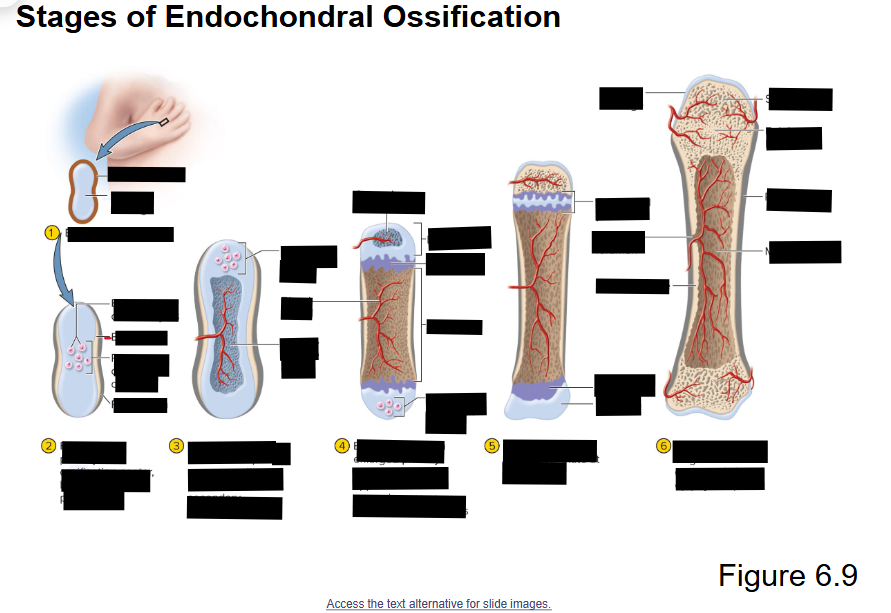
Steps of endochondral ossification in a simple bone, a metacarpal bone:
mesenchyme develops into hyaline cartilage covered with perichondrium; perichondrium produces chondrocytes, and cartilage model grows
Primary ossification center forms; chondrocytes enlarge, die and walls calcify; osteoblasts deposit bone collar and perichondrium is a periosteum
Blood vessels invade ossification center; osteoclasts create primary marrow cavity; metaphysis (cartilage to bone) present at each end and secondary ossification center forms
secondary marrow cavity forms at end of bone
infancy and childhood: epiphyses fill with spongy bone, cartilage limited to articular cartilage and epiphyseal plate
Epiphyseal plate persists until adulthood and serves as growth plate
By late teens to early twenties, cartilage within epiphyseal plate is consumed and bones grow no longer
Metaphysis
growth zone at the junction between the diaphysis and epiphysis of along bone
cartilage is replaced by osseous tissue and bone grows in length

Bone resorption primarily stimulated by one hormone
Parathyroid hormone
Parathyroid hormone
causes osteoblasts to release osteoclast-stimulating factor that stimulates osteoclasts to resorb bone
Prim purpose is to maintain appropriate level of blood calcium
Aging skeletal system - changes with age
Loss of bone mass, strength
After age 35-40 osteoblasts become less active, creates imbalance between bone deposition and resorption
Osteopenia and osteoporosis
After age 40 women lose _____ of their bone mass per decade and men lose about ____.
8%,3%
Bone loss from jaws is a contributing factor in …..
tooth loss
With age bones become more _____ as ______ synthesize less protein. Fractures occure more ___ and heal more ____.
brittle, osteoblasts, easily, slowly
Arthiritis
family of joint disorders associated with aging
Osteopenia
net loss of boneO
steoporosis
loss of bone is severe enough to compromise physical activity and health
Stress fracture
break caused by abnormal trauma
Pathological fracture
break resulting from a stress that normally wouldn’t fracture a bone
Bone more susceptible because weakened by disease such as osteoporosis
Bone is also classified according to direction of …
fracture line
Closed reduction procedure
procedure to fix a fracture; broken parts aligned without surgery
like wearing a cast
Open reduction-internal fixation (ORIF)
surgical repair with plates, screws pins
Classification of Fractures: Closed
skin is not broken (simple fracture)
Classification of Fractures: Open
Skin is broken; (compound fracture)
Classification of Fractures: Complete
Bone is broken into two or more pieces
Classification of Fractures: Incomplete
Partial fracture that extends only partway across bone; pieces remain joined
Classification of Fractures: Nondisplaced
The portions of bone are still in correct anatomical alignment
Classification of fractures: Displaced
portions of bone are out of anatomical alignment
Classification of Fractures: Comminuted
bone is broken into three or more pieces
Classification of fracture: Greenstick
bone is bent toward one side and has incomplete fracture on opposite side
Classification of Fractures: Hairline
Fine crack in which sections of bone remain aligned; common in skull
Classification of fractures: Impacted
one bone fragment is driven into the marrow cavity or spongy bone of the other
Classification of fractures: Depressed
broken portion of bone forms a concavity, as in skull fractures


There s a net loss of bone by age
40
Osteopenia
measurable decline in bone density
spongy bone is affected because it has the greatest surface area for osteoclast to work one
Osteopenia Risk factors
sex, body build, ancestry, age, sedentary lifestyle, poor dietary, smoking, excessive alcohol consumption
Osteoporosis
bones are eroded enough that they easily fracture
Osteoporosis can result in
spinal deformities, such as hyperkyphosis (exaggerated thoracic curvature), leading to fractures of hips, wrist & spine.
For women osteoporosis rises sharply after ______ due to loss of _____
menopause, estrogen
Assessment of bone density:
bone densitometry, or the DEXA (dual energy X-ray absorptiometry) scan. Gold Standard
Osteoporosis treatment revolves around
drugs to stimulate bone deposition (osteoblasts) or slow its resorption (osteoclasts)

Acromegaly
result of adult growth hormone hypersecretion, resulting in thickening of the bones and soft tissue, especially noticeable in the face, hands, and feet
Osteitis deformans (paget disease)
excessive osteoclast proliferation and bone resorption, with osteoblasts attempting to compensate by depositing extra bone. this results in rapid, disorderly bone remodeling and weak, deformed bones.
osteitis deformans usually passes unnoticed, but some cases it causes pain, disfiguration, and fractures. It is most common in males over the age of 50
Osteomyelltis
inflammation of osseous tissue and bone marrow as a result of bacterial infection.
often fatal before the discovery of antibiotics and is still very difficult to treat
Osteosarcoma
Bonce cancer affecting especially the limb bones of adolescents and young adults
large tumors near the knee, with death, if not quickly treated usually resulting from metastasis to the lungs