Blood group genetic
 Call Kai
 Learn
 Practice Test
 Spaced Repetition
 Match
 Flashcards
 Knowt Play
1/180

There's no tags or description
Looks like no tags are added yet.
181 Terms
genome
all genetic information of a cell
genomics
study of the entire genome of an organism
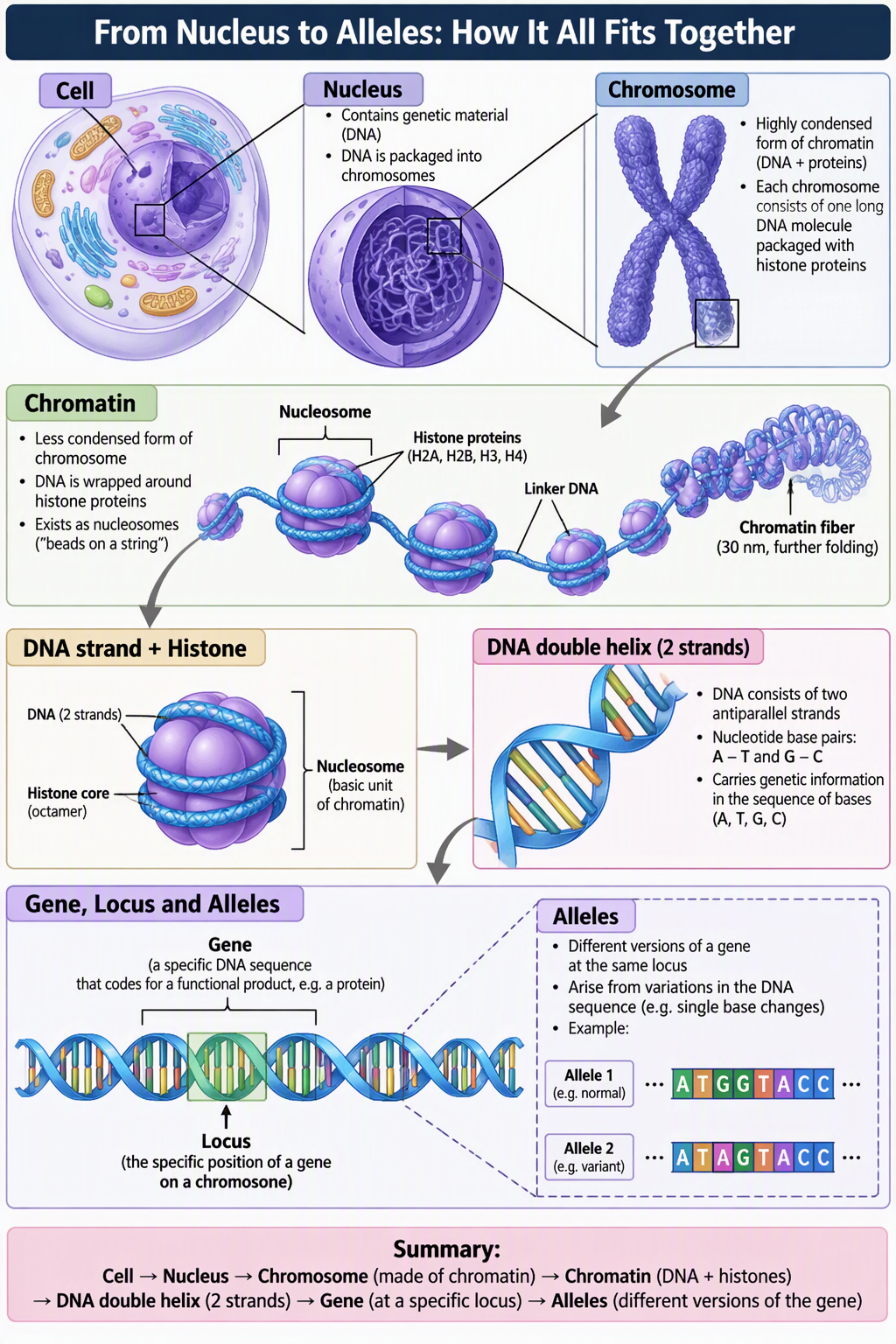
Gene
Function unit of heredity (inheritance of characteristics from one generation to the next) of any trait (genetically determined characteristic or condition)
segement of deoxyribonucleic acid (DNA) within a chromosome that codes for a molecule that has a function
locus
fixed position on a chromosome, such as position of a gene or genetic marker
alleles
one of several alternative form of a gene
haplotype
a group of alleles that tend to be inherited together
ex RHD and RHCE
somatic cell
cells in the body except sex cell
46 chromosomes = 22 pairs autosomes + 1 pair sex chromosomes [23 pairs total: each pair from one paternally (dad side) and one maternally (mom side) homologous chromosome]
cell divison through mitosis
Gametes (germ cell)
sex cell: egg or sperm cell
23 chromosomes = 22 autosomes + 1 sex chromosome (male XY and female XX), not pairs.
Gametes are genetically unique because homologous chromosomes undergo crossing over in Prophase I and assort independently in Metaphase I
cell divison through meiosis
homologous chromosomes = chromosome pair
Same size and shape
Same genes in the same locations (loci)
One chromosome came from mom
One chromosome came from dad

chromosome
contain genetic material (DNA) to maintain the life of cell and the organism
Common: made up of one linear double strand DNA molecule. Each has a centromere (constricted region). Telomeres are protective DNA caps at the ends of chromosomes. p arm (= petite short arm)_ and q arm (long)
Different: in overall size, location of centromere and DNA content
Chromatin => chromasome => 2 chromatid
Pseudoautosomal Region (PAR)
Pseudoautosomal regions are small matching areas near the ends of the X and Y chromosomes.
They are located next to the telomeres, but they are not the telomeres themselves.
Humans have two:
PAR1: near the ends of the short arms, Xp and Yp
PAR2: near the ends of the long arms, Xq and Yq
PARs allow the X and Y chromosomes to pair and exchange DNA during male meiosis.
Genes in PARs are present on both X and Y and usually escape X-inactivation.
an example of a gene located in PAR1: CD99
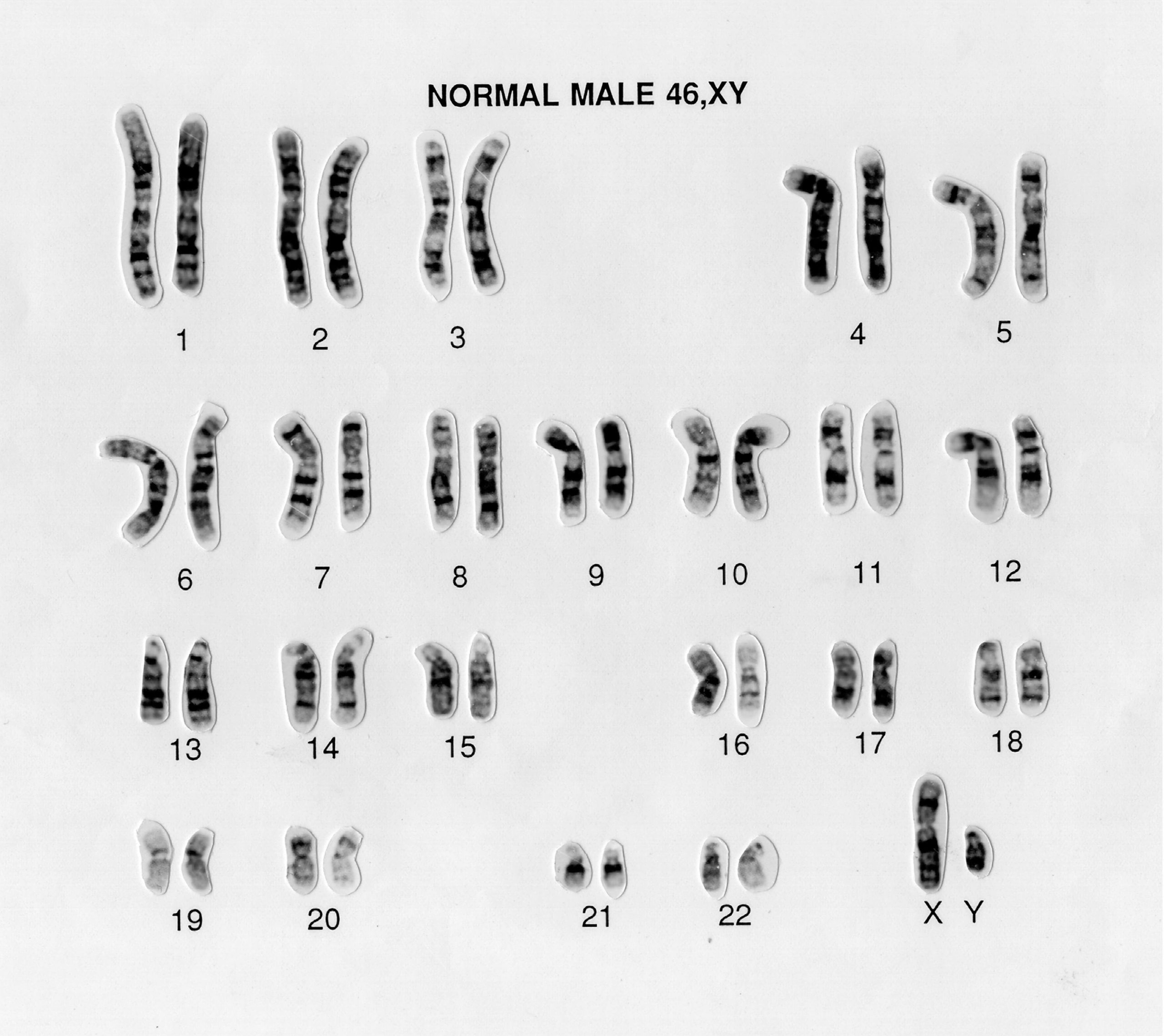
karyotype
represent the chromosome complement of a person
Male 46, XY
Female 46, XX
cytogenetics
study of chromosome

heterochromatic (hetero- different; chromatic: color)
regions rich in adenin (A-apple) and thymine (T- tree). Tight pack DNA- gene is mostly inactive and stained dark with giemsa stain
Euchromatic (Eu- true/ good)
rich in guanine (G-garare) and cytosine (C- car). loose pack DNA- gene in active form and stained light with giemsa stain

Mitosis
somatic cells divide for growth and repair
single cell rise to two identical daughter cells (same sets of chromasomes)
Diploid (2N) = 23 pairs

meiosis
occur only in germ cells that are intendeded to become gametes (haploid 1N)
it’s a process of cell division and replication that leads to the formation of haploid gametes
diversity through 2 mechanism: independent assortment and crossing over
independent assortment
each daughter cell randomly receives either maternally or paternally derived homologous chromosomes
crossing over
exchange genetic material between homologous chromosome pairs
X chromosome inactivation (lyonization)
dosage compensation by inactive X chromosome at early stage of embryonic development. only one X cell need for function
example: XK- get shut off like normal X gene, so a carrier female is a mosaic: Kx+ cell and Kx- (McLeod) cell are both appear
escape X inactivation
a gene on the inactive X chromosome stays active and continues producing its protein.
first gene found: XG gene, and CD99
polymorphism
at one locus, there are two or more alleles in the population; each allele carried by > 1% of people ( <1% consider rare variant not polymorphism)
ex: highly polymorphic: RH and MNS
low polymorphic: FY and CO
an allele can be polymorphic in one population and absent in another. Ex FY*02N.01, an allel that swithes off the FYb in red cells is polymorphilic in african (>70%) but not found in other population
mutation- inherited (germline)
present in every cell. Can passed on to offspring
acquired mutation (de-novo)
occur spontaneously or be brought by agent like radiation (UV, X-ray) or chemical
mutation
where: within a gene or intergenic regions (between gene)
How:
Mutation
Type: inherited (germline) or acquired
where: within or between (intergenic region) gene
Effect: silent (no effect) or alter the gene
Mutation rate: how often DNA changes occur. In humans, the average rate is about 1.3 × 10⁻⁸ mutations per base pair per generation, and it varies with parental age, sex, the type of mutation, and where in the genome the DNA is located.
Germline mutation
present in every cell and can passed on to off spring
Acquired mutation
occur spontaneously or be brought by an agent (X-ray, UV) or chemical
genetic variation
single base-pair (bp) SNV = one DNA base changed. create most blood group antigen differences
insert/ deletion Indel = DNA bases inserted or deleted.
Structural variant = large DNA segments deleted, inserted, duplicated, or rearranged.
SNP (Single Nucleotide Polymorphism)
SNP (Single Nucleotide Polymorphism) > 1%
Single Nucleotide Variant (SNV)
A change in one DNA base (nucleotide).
Most blood group polymorphisms are caused by SNVs.
One nucleotide change can create a different antigen.
Effects of SNVs in Coding Region
Mutation Type | Effect | Blood Bank Significance |
|---|---|---|
Synonymous (Silent) | DNA changes, amino acid unchanged | Usually no antigen change |
Missense (Nonsynonymous) | DNA changes, amino acid changes | Often creates a new antigen |
Nonsense | Creates stop codon | Protein shortened or absent create null phenotypes. |
allele
Different forms of the same gene at a specific locus
Example:
ABO has A, B, and O alleles.
Memory Tip:
Gene = recipe
Allele = version of the recipe
How many alleles does a person usually inherit for a blood group gene?
Two
One from mother
One from father
genotype
The alleles a person inherits.
Genotype determined by DNA-based testing
Example:
A/O
A/B
KEL01/KEL02
JKA/JKB
ABO*A/O
KEL01/KEL02
phenotype
The antigens expressed on the red cell.
the phenotype is the antigen pattern detected on RBCs by serologic testing.
Example:
Genotype | Phenotype |
|---|---|
A/O | Group A |
A/B | Group AB |
O/O | Group O |
What is the relationship between genotype and phenotype?
Genotype produces the phenotype.
Genes → Protein/Antigens → Phenotype
JK*A/JK*A => Jkᵃ antigen produced => Jk(a+b−)
homozygous
Two identical alleles at a locus.
Examples:
A/A
JKA/JKA
KEL02/KEL02
Memory: Homo = same
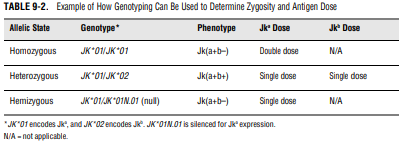
heterozygous
Two different alleles at a locus.
Examples:
A/O
A/B
JKA/JKB
Memory: Hetero = different
hemizygous
Only one copy of a gene is present.
Example:
One RHD gene deleted
RHD / deletionTwo alleles are present, but only one works.
Example:
Normal RHD + RHD pseudogene
antithetical antigens
Antigens encoded by different alleles at the same locus.
Examples:
K / k
Jkᵃ / Jkᵇ
Fyᵃ / Fyᵇ
M / N
Are genes allelic or antithetical?
Genes = allelic
Antigens = antithetical
Why is "homozygous for k antigen" incorrect?
Because alleles are homozygous, not antigens.
✅ Correct:
Homozygous for KEL*02 allele
Double dose of k antigen
What is antigen density?
The number of antigen sites expressed on RBCs.
More gene copies → more antigen expression.
higher antigen density: homozygous. antigen is inherited from both parents.
Example:
Genotype: JK*A/JK*A
Phenotype: Jk(a+b−)
dosage effect
An antibody reacts more strongly with homozygous (double-dose) cells than with heterozygous (single-dose) cells.
Which blood group systems commonly show dosage?
Kidd, Duffy, MNS, and Rh antibodies.
What is a genetic trait?
The observable expression of one or more genes.
Examples:
Blood type A
D-positive status
Jk(a+b−)
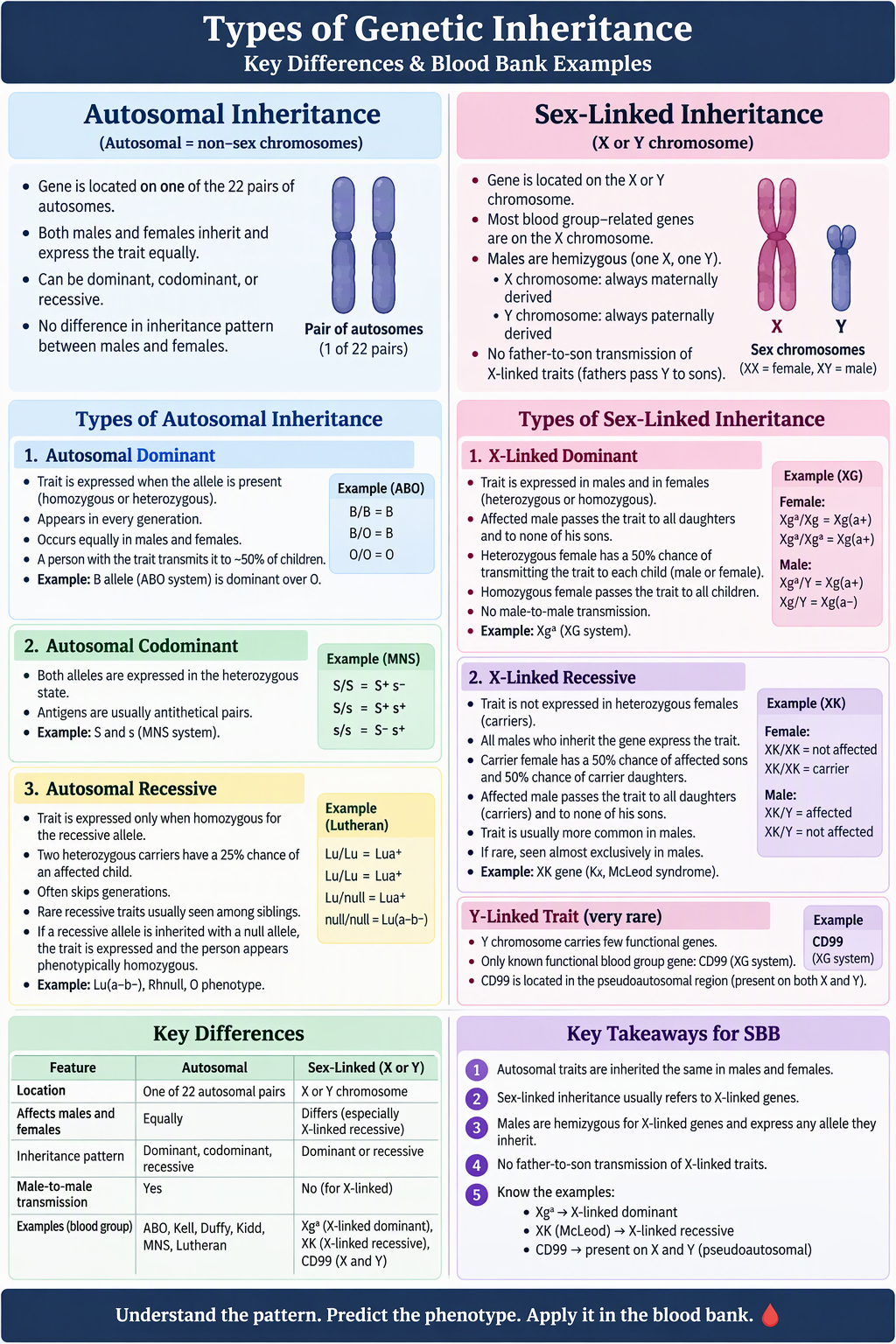
What determines how a trait is inherited? What is the first and second question to ask when studying inheritance?
Location of the gene
Autosome → Autosomal inheritance
X chromosome (sex-linked) → Sex-linked inheritance
Pattern of inheritance
Dominant → One allele needed
Recessive → Two alleles usually needed
What is an autosome?
Any chromosome that is not a sex chromosome.
Humans have:
22 pairs of autosomes
1 pair of sex chromosomes (XX or XY)
What is an X-linked (sex-linked) gene?
A gene located on the X chromosome.
Inheritance differs between males and females because:
Females = XX
Males = XY
Where are most blood group genes located?
On autosomes

Which blood group systems are X-linked?
Xg blood group system
XK blood group system
These are inherited through the X chromosome.
What is a dominant trait?
Only one copy of the allele is needed for expression.
exp: A/O => group A
What is a recessive trait?
Two copies of the allele are usually required for expression.
exp O/O => group Oc
Two copies of the allele are usually required for expression.
What does autosomal inheritance mean?
The gene is on an autosome.
Males and females inherit the trait equally.
What does X-linked inheritance mean?
The gene is on the X chromosome.
Inheritance differs between males and females.
males often affected more by X-linked traits because male has only one X. Whatever allele is present on that X chromosome will be expressed.
What is a family study?
A study that follows the inheritance of a genetic trait through family members.
Examples:
Blood group antigens
Genetic disorders
Rare blood group alleles
What is a pedigree?
A diagram showing family relationships and the inheritance of a trait across generations.
Memory Tip: Pedigree = Family Tree for Genetics
What is the purpose of a pedigree?
To determine how a trait is inherited.
Examples:
Autosomal dominant
Autosomal recessive
X-linked inheritance
What information does a pedigree show?
Family relationships
Who expresses the trait
Who does not express the trait
How the trait is transmitted

What is the "affected" individual in a pedigree?
A person who expresses the trait being studied.
Example:
Has the antigen
Has the disease

What does "proband" mean?
The family member whose case initiates genetic investigation.
plural term for probands: Propositi - Used regardless of gender.
What is autosomal dominant inheritance?
A trait is expressed whenever the relevant allele is present, whether the person is homozygous or heterozygous (One copy of the allele is sufficient for expression).
How does an autosomal dominant trait appear in a pedigree?
It appears in every generation.
The trait occurs with equal frequency in males and females.
the chance that a person with an autosomal dominant trait will pass it to a child: 50%
Examples: The B allele is dominant over O.
B/O → Group B
B/B → Group B

Autosomal Codominant Inheritance
When two different alleles are present, the products of both alleles are expressed.
example: Antithetical antigen pairs like Ss
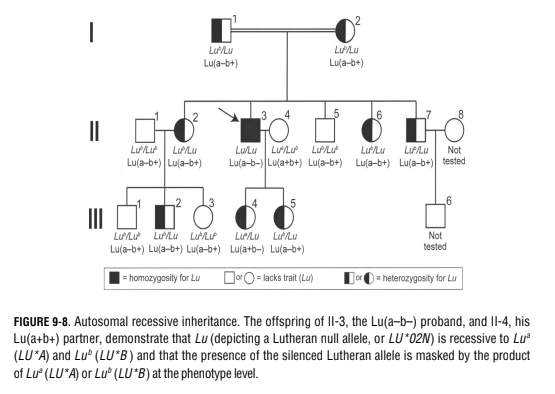
Autosomal Recessive Inheritance
expressed only when a person is homozygous for the recessive allele from both parent(obligate carrier) (geno: hemozyous) or one recessive allele and one null allele (geno: heterozygous)
probability that two heterozygous carriers will have a homozygous child: 25% (1/4)
Where is a rare recessive trait usually found in a family?
Among siblings rather than in multiple generations.
In onsanguineous mating (Mating between blood relatives)
What common recessive ABO allele demonstrates this?
The O allele.
What is a null phenotype?
A phenotype in which no blood group product is expressed.
Lu(a−b−)
Rhnull
O phenotype
What is a null allele (Amorph)?
An allele that produces no detectable product.
What is a sex-linked trait?
A trait encoded by a gene located on the X or Y chromosome.
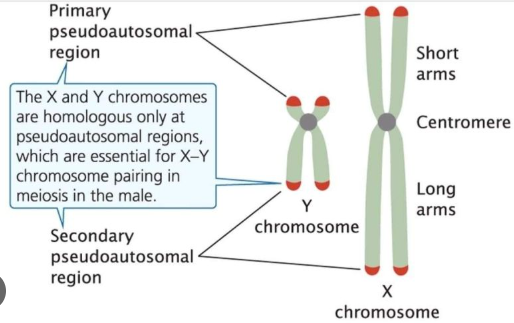
cow many functional blood group genes does the Y chromosome carry, and which one?
Only one known: CD99 of the XG system.
Unlike most X genes, which have no homolog on the Y chromosome, CD99 is present on both X and Y chromosomes, in the pseudoautosomal region.
genes XG and CD99, located in pseudoautosomal region 1 (PAR1) of the sex chromosomes. The Xg glycoprotein is encoded by the X chromosome only, while the CD99 glycoprotein is encoded by both X and Y chromosomes
What does "sex-linked inheritance" generally mean in practice?
Inheritance of genes carried by the X chromosome.
X-linked inheritance can be dominant or recessive
What sex chromosomes does a male have, and where does each come from?
One X chromosome (always maternally derived) and one Y chromosome (always paternally derived).
What does hemizygous mean?
Only one chromosome — and thus one copy of a gene — is present, as in males for genes on the X or Y chromosome.
type of Sex-Linked Inheritance
usually talk about X chromosome as Y chromosome are rare and only CD99 is known of
Type odf X link inheritance
Sex-Linked Dominant Inheritance
Sex-Linked Recessive Inheritance

Who expresses an X-linked dominant trait?
Males who are hemizygous (His single X chromosome to all his daughters — all daughters express the trait; none of his sons receive it.)
and females who are heterozygous (50% for each child, whether son or daughter) or homozygous (All her children express the trait) for the gene.
Which blood group antigen is the passage's X-linked dominant example?
The Xg(a) antigen (XG blood group system), encoded by an allele on the X chromosome.
What first suggested Xg(a) was X-linked?
The prevalence of the Xg(a+) phenotype differed by sex: 89% in females and only 66% in males.
Note: Females have two X chromosomes — two chances to carry the dominant allele — while males have one.
Disruption of a GATA-binding motif in the XG gene recently linked to differential expression of Xg(a)
What is sex-linked recessive inheritance?
A trait encoded by a sex chromosome that is not expressed in carriers of a single copy, such as heterozygous females.
Mom is usually a carrier (or homozygous for the trait) pass to son (50%)
An affected male transmits the trait to all of his female offspring. (Affected male → carrier daughters → affected grandsons.)
X-linked recessive traits are usually seen in males because males have only one X chromosome; heterozygous females have one normal X that masks the recessive allele and are typically carriers rather than affected
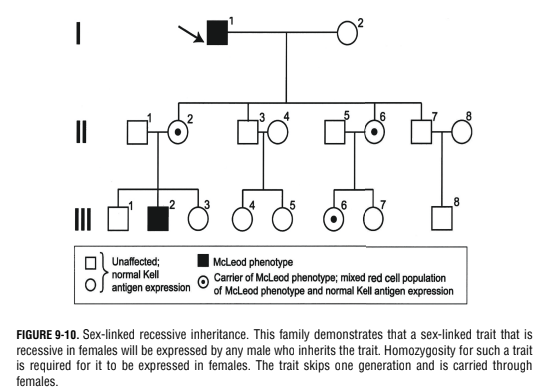
Which gene is the passage's X-linked recessive example, and what does it encode?
The XK gene, which encodes the Kx protein.
What do deleterious mutations in, or deletions of, XK cause?
The McLeod phenotype — red cells lack the Kx antigen and have reduced expression of KEL antigens.
Late-onset clinical or subclinical myopathy; neurodegeneration and central nervous system manifestations; chronic granulomatous disease; and acanthocytosis, frequently along with compensated hemolytic anemia.
More than 30 different XK gene mutations associated with a McLeod phenotypec
Only Male

What does the principle of independent segregation refer to?
The separation of homologous chromosomes and their random distribution to the gametes during meiosis.

term
Term | What it describes | Human example | Blood bank example |
|---|---|---|---|
Haploid (1N) | One set of chromosomes | Sperm or egg | A gamete carrying DCe |
Diploid (2N) | Two sets of chromosomes | Most body cells | A person with DCe/dce |
Haplotype | The allele combination on one chromosome | One HLA haplotype inherited from mom | DCe, Dce, dcE, dce |
Genotype | The combination of both haplotypes | HLA-A2/A24 | DCe/dce |
Homologous chromosomes | Maternal and paternal copies of the same chromosome | Chromosome 1 from mom + chromosome 1 from dad | One chromosome carrying DCe and the other carrying dce |
Homozygous alleles of a gene | Same allele on both homologs | AA | FYA/FYA |
Heterozygous alleles of a gene | Different alleles on the homologs | Aa | FYA/FYB |
Hemizygous | Only one allele present | Male with X-linked gene | XᴴY or XʰY |
What is the principle of independent assortment?
Alleles determining various traits are inherited independently from each other.
The inheritance of one allele (e.g., a B allele, on chromosome 9) does not influence the inheritance of another allele (e.g., an M allele, on chromosome 4).
STRUCTURAL VARIATION
Linkage and Crossing Over
Linkage Disequilibrium
What is linkage?
The physical association between two genes located on the same chromosome and inherited together.
Note: Linked genes are the exception to independent assortment — they do not assort independently.
example:
RHD and RHCE, encoding the antigens of the RH system — both on chromosome 1, linked loci that do not assort independently. R1R1, R2R2, R0,…
What is crossing over?
The exchange of genetic material between homologous chromosome pairs. - Shuffle genetic material.
A segment from one chromatid (and any associated genes) changes places with the corresponding part of the other chromatid (and its associated genes); the segments are rejoined, and some genes will have switched chromosomes.
Genes on the same chromosome can still recombine.
Close genes → low recombination frequency (RHD/RHCE)
Far-apart genes → higher recombination frequency (FY and KN)
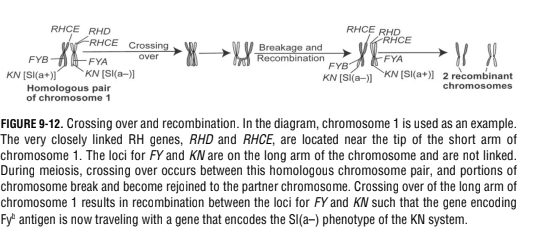
What are recombination and recombinants?
Crossing over is also called recombination because it can result in new gene combinations on the chromosomes involved; the rearranged chromosomes are called recombinants.
What does syntenic mean?
Two gene loci carried by the same chromosome that are not closely linked.
RH and FY, both on chromosome 1 — RH on the short arm and FY on the long arm, far enough apart to undergo crossing over and assort independently.
Note: Syntenic and linked both mean "same chromosome" — the difference is distance: syntenic loci are far apart and act independently, while linked loci are close together and travel together.
What does the frequency of crossing over between two genes measure?
he distance between them, measured in centimorgans (cM).1 cM roughly equals a 1% chance of recombination between the two loci — so a centimorgan is a genetic distance, not a physical length in base pairs.
The greater the distance between two loci, the greater the probability that crossing over (and recombination) will occur; genes located very close together (linked) tend to be transmitted together with no recombination.
What was the first recognized example of autosomal linkage in humans?
Linkage between Lutheran (LU) and ABH secretion (SE or FUT2).

Can recombination happen between very closely linked or adjacent genes?
Rarely, yes — documented examples include the genes encoding the MN (GYPA) and Ss (GYPB) antigens on chromosome 4.
Even very closely linked genes can occasionally undergo recombination.
What is a haplotype?
A combination of alleles at two or more closely linked loci on the same chromosome. DCe
Note: A haplotype is the set of alleles on one chromosome; a genotype is the combination across both chromosomes. DCe/DcE
What are the four MNS haplotypes?
MS, Ms, NS, Ns — in ISBT terminology: GYPA*M-GYPB*S, GYPA*M-GYPB*s, GYPA*N-GYPB*S, GYPA*N-GYPB*s.
Why do the antigens encoded by each haplotype have a different prevalence than random assortment would predict?
Because linked genes do not assort independently.
Expected 17% if M and S were not linked (from frequency calculations); observed 24% for the MS haplotype (from testing and analyzing families).
What is linkage disequilibrium?
The tendency of specific combinations of alleles at two or more linked loci to be inherited together more frequently than would be expected by chance.
Note: The 24% vs 17% gap is the disequilibrium itself — MS shows up more often than chance alone would predict.
Chimera
A chimera is an organism with cells originating from more than one genetic source.
What is mixed-field agglutination often the result of?
Artificially (acquired) induced chimerism — through the transfusion of donor red cells or hematopoietic stem cell transplantation.
Natural chimerism:
somatic mutation
true chimera
How can somatic mutations (mosaicism = same zygote) in the marrow explain mixed-field agglutination?
They can lead to the development of two different and persistent cell populations.
They can lead to the development of two different and persistent cell populations.
A somatic mutation means:
A genetic change that happens during life in a body cell, not inherited from mom or dad.Now the person has:
One population of normal cells
One population of mutated cells
Both populations continue making RBCs