X-Ray Interaction with Matter
 Call Kai
 Learn
 Practice Test
 Spaced Repetition
 Match
 Flashcards
 Knowt Play
1/68

There's no tags or description
Looks like no tags are added yet.
69 Terms
Beam quality
Penetrating power, beam energy, controlled by kVp
Beam quantity
Tube current, intensity, beam photon number, controlled by mAs
Absorption
Transfer of EM energy from photon to biologic tissue
Attenuation
Reduction of photon number in beam as partial energy is transferred to biologic tissue
Transmission
No EM transfer from photon to body
Absorbed dose (D)
Amount of EM energy absorbed per unit of body mass
Primary radiation
The x-ray beam emerging from the tube
Attenuation
Primary beam reduced by absorption or scatter
Direct transmission
Photon reaches the IR unchanged
Absorption
Total loss of energy
Scatter
Partial loss of energy and change of photon direction
Five types of interactions with matter
Coherent (classical) scatter, compton scatter, photoelectric absorption, pair production, and photodisintegration
Which two interactions with matter are important in the diagnostic range?
Compton scattering and photoelectric absorption
Coherent Scatter (Classical Scatter)
No loss of KE as photon scatters. Usually occurs at less than 10 keV. Slight change of direction (20° or less) in forward direction. Little importance in the diagnostic range.

Coherent scatter
Compton Scatter
Outer shell photon-electron interaction. Produces Compton electron & scattered photon. Does not contribute diagnostically (direction and energy change). Both can cause additional biologic interactions or reach IR.

Compton scatter
Formulas for compton scatter
Energy of Compton photon = the difference between incoming x-ray and ejected electron
Energy of the ejected electron = its binding energy plus the kinetic energy with which it leaves the atom
Ei = Es + (Eb + EKE)
What does compton scatter contribute to?
Image fog and occupational exposure
Photoelectric Absorption - Body
An inner shell photon-electron interaction created as an incoming x-ray photon knocks loose an inner-shell electron, creating a vacancy in the inner shell and leading to an electron cascade. This vacancy is filled by outer-shell electrons, causing radiation in the form of characteristic photons or an ejected electron.
What is photoelectric absorption responsible for?
Patient dose and image contrast

Photoelectric absorption
The ______the difference in the amount of photoelectric absorption, the ______ the contrast in the radiographic image will be between adjacent structures of differing atomic numbers.
greater; greater
As absorption ______, so does the potential for ______.
increases; biologic damage
How to ensure both radiographic image quality and patient safety
Choose the highest-energy x-ray beam that permits adequate radiographic contrast for computed radiography, digital radiography, or conventional radiography
Photoelectric absorption depends on _____ AND _____
incident photon energy; atomic number of tissue
Photoelectric absorption ______ as incident photon energy _______
increases; decreases
Why does photoelectric absorption have an inverse relationship with incident photon energy?
Because lower energy x-ray photons will be absorbed more easily
What is the Z# for compact bone?
Z = 13.8
What is the Z# for soft tissue?
Z = 7.4
What is the Z# of air?
Z = 7.6
Mass density
How compact the atoms in a given tissue are
What patient characteristics can cause absorption to differ on a macro scale?
Different body structures and pathology (ex. differences in chest densities or tissue density loss due to decrease in bone calcium)
How does contrast media act to increase photoelectric absorption?
Contrast media has a higher atomic number than surrounding tissue, causing more x-rays to be absorbed by contrast media. This leads to sharper outlines and better visibility in structures with contrast media.
What is the Z# for barium?
Z = 56
What is the Z# for iodine?
Z = 53
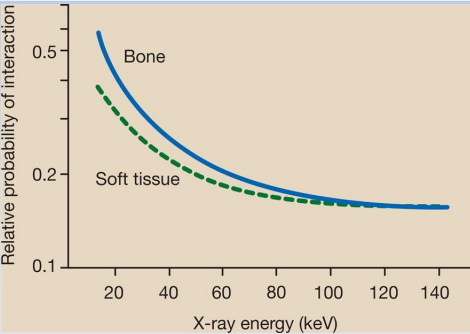
Probability of compton effect
Inversely proportional to x-ray energy. Inversely as E1 ; as kVp/keV increases, Compton interactions decrease proportionally by a power of 1.
Probability of photoelectric effect
Inversely proportional to the third power of the x-ray energy. Inversely as E^3; as kVp/keV increases, photoelectric interactions decrease proportionally by a power of 3.
Compton scattering is ———- — tissue atomic number and depends solely on ——— ——-
independent of; x-ray energy
True/False: Photoelectric effect depends on both tissue atomic number and x-ray energy
True
As kVp increases, Compton scattering _____ relative to photoelectric absorption of tissues
increases

Which interaction is this?
Photoelectric effect
Which interaction is this?
Compton
Which interaction is this?
Depends on x-ray energy & tissue atomic number
Dominates in bone
Dominates at low x-ray energies
Photoelectric absorption
Which interaction is this?
Depends on x-ray energy only
Dominates in soft tissue
Dominates at high x-ray energies
What happens as kVp is increased?
All numbers decrease, but you are left with mainly Compton (retains 2/3 original energy)
Pair production
A higher energy incident x-ray (above 1.02 MeV) interacts with nucleus (attractive force). This causes the X-ray to disappear, and two electrons are created (one positive – positron – and the other negative - electron). The electron continues to ionize & eventually will fill an empty shell. The positron unites with a free electron & converts to energy via a process called annihilation radiation.
What is annihilation radiation?
A positron, a form of antimatter that is a positive electron, interacts with an electron. The opposite charges are cancelled out, converting their matter into photons (energy) of 0.511MeV each.
In what setting does pair production and annihilation radiation occur?
Nuclear medicine or PET (positron emission tomography)
Photodisintegration
An incident x-ray energy above 10 MeV is absorbed directly by nucleus of an atom. A nucleon or nuclear fragment is then emitted by excited nucleus
In what setting does photodisintegration occur?
Radiation therapy
Which two interactions with matter are important in conventional radiology?
Compton and photoelectric
True/False: Compton Scatter is diagnostic
False
What is involved in differential absorption?
Compton scattering, photoelectric effect, and direct transmission.

What does this image show?
Differential absorption
Compton scattering causes _____
Noise
How do photons that do not reach the IR add diagnostic info to the image?
They represent anatomy with high Z# (in case of the photoelectric interaction) and are visualized via light on the image.
Direct transmission
Photons that penetrate the body, but do not interact with matter. These produce dark areas of the image.
A radiographic image is produced from the difference between _____ and _____.
Photoelectric effect; direct transmission
About __of radiation incident on the patient reaches the IR
1%
Fewer than ____ of radiation incident interact to form an image
Half
_____ kVp leads to _____ differential absorption
Increasing; reduced
What is high differential absorption best for?
Exams requiring large differences in tissue contrast (ex. extremity work, mammography)
What is low differential absorption best for?
Exams requiring small differences in tissue contrast (ex. KUB, barium studies)
____ Mass density, ____ chance of interaction
Double; double
Roughly __% of photons are attenuated for every 5 cm of tissue
50%
Photoelectric, pair production, and photodisintegration are _____ processes
absorption
Compton is a ____ ____ process
partial absorption
Attenuation
Total reduction in x-ray intensity after passing through a given tissue thickness; product of absorption and scattering