L7 - Large Intestine
 Call Kai
 Learn
 Practice Test
 Spaced Repetition
 Match
 Flashcards
 Knowt Play
1/37

There's no tags or description
Looks like no tags are added yet.
38 Terms
What is the primary site of nutrient absorption in the gastrointestinal tract?
The small intestine.
What are the primary functions of the large intestine?
active transport of sodium, coupled with osmotic absorption of water
What role do microbes in the large intestine play?
They produce vitamin K.
What is the maximum speed of semi-solid chyme progression in the large intestine
5-10 cm per hour (very slow)
What are the main types of motility in the large intestine
Segmental propulsion, kneading, and haustration
How does parasympathetic activity affect the large intestine
It increases activity
(If you’re chill, you can poo)
How often does mass movement occur in the large intestine
1-3 times per day (by peristaltic waves)
What is the main secretion of the large intestine and its function
Mucus; it acts as a protectant and adherent (protects wall of intestines from bacteria)
How does irritation of the large intestine affect water and electrolyte secretion
It increases secretion, leading to diarrhoea
What gets absorbed from the large intestines
Colon can absorb amino acids, fatty acids and peptides, Ions and water
How much water is excreted daily in faeces
50-100 mL per day
What complex carbohydrate is digested in the large intestine
Cellulose
What do bacteria in the large intestine ferment cellulose into
Short-chain fatty acids
What vitamins do gut bacteria produce
Vitamin K and vitamin B12.
What gases contribute to flatus?
Nitrogen (N₂), carbon dioxide (CO₂), hydrogen (H₂), methane (CH₄), and hydrogen sulfide
(Nasty Cats Hate Hunting Mice)
How much flatus is produced/swallowed daily
0.7 - 1 L/day
How much flatus is produced daily
400-700 mL per day
What makes up faeces content
Water, bacteria, bacterial waste, roughage, and bile pigments
(bacteria & bacterial waste since it is microorganisms (bacilli) that convert waste → faeces)
How does bacterial species abundance relate to inflammatory bowel disease (IBD)?
Differences in bacterial species abundance can differentiate IBD patients from healthy individuals.
How is secretion/absorption stimulated in the intestines
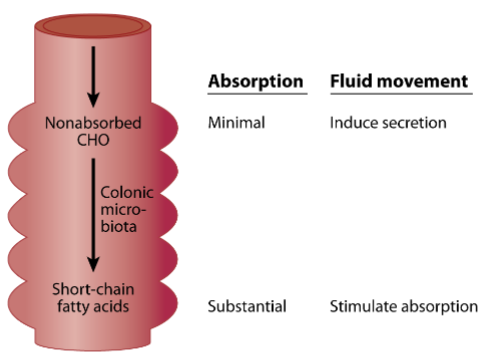
Non-absorbed CHO can’t be absorbed so it induces secretion
When colonic micro-biota breaks the CHO down into short chain FAs, absorption is stimulated to absorb the SCFAs
What is the primary function of sodium (Na⁺) absorption in the large intestine
It helps maintain electrolyte balance and water absorption
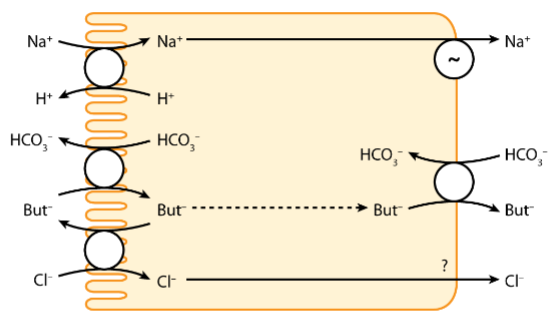
How is Na⁺ transported across the basolateral membrane
By an active sodium pump
What ion is exchanged with bicarbonate (HCO₃⁻) in the large intestine
butyrate (But⁻)
What is the significance of butyrate (But⁻) absorption in the large intestine
It serves as an energy source for colonocytes
(The But gives the colon energy!)
What bacterial byproduct is absorbed in the colon to provide energy for epithelial cells
Short-chain fatty acids (SCFAs) like butyrate
How does chloride (Cl⁻) move across the epithelial cells of the large intestine
It is absorbed through ion channels
Ampicillin is an antibiotic. How does it affect stool weight, consistency & breath H2 profile
Increases stool weight
Increase water output - can cause diarrhoea
Decreases breath H2 profile (breath hydrogen (H₂) test measures hydrogen gas (H₂) levels in exhaled breath, which is produced by gut bacteria - antibiotics would reduce gut bacteria → reduced H2 in the breath)
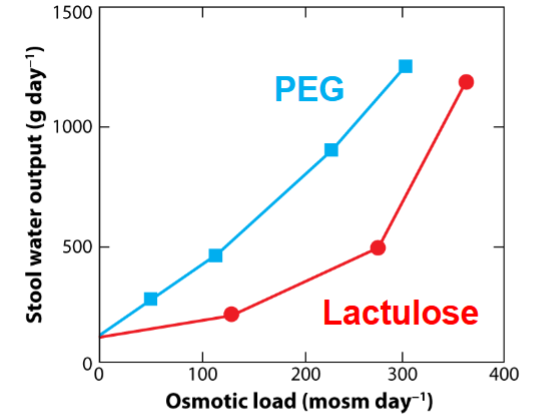
Effect of PEG (Polyethylene Glycol) & lactulose on stool water output
They both increases stool water output as they are laxatives (PEG more so than lactulose)
They can both cause osmotic diarhoea
(Put a PEG on your nose when someone takes PEG! If you Lack it you Lose!)
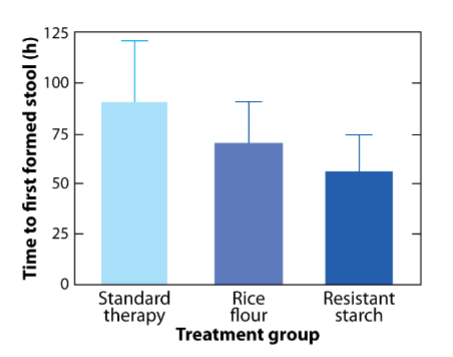
What can be added to standard therapy (rehydration solution) for diarrhoea to decrease time for the first stool to be formed
Rice flour & resistant starch would both decrease stool formation time
Is the rectum usually full/empty
empty
What happens that keep the rectum generally empty
Segmental contractions pass matter back to sigmoid colon
What triggers the urge to defecate
Mass movement filling the rectum
What is the reflex response to rectal filling
Relaxation of the internal anal sphincter and contraction of the external anal sphincters
How can defecation be voluntarily controlled
By relaxing the external anal sphincter and increasing intra-abdominal pressure
How has video endoscopy improved our understanding of the gut
It has enhanced knowledge of normal gut processes and revealed disease complications
What is the primary component of digestive secretions
water
Why do we say water absorption in the gut is highly efficient
Because most water is reabsorbed, minimizing excretion
What organ plays a primary role in osmotic homeostasis
The kidneys