Medicinal Chemistry of Diuretic Agents
 Call Kai
 Learn
 Practice Test
 Spaced Repetition
 Match
 Flashcards
 Knowt Play
1/28

There's no tags or description
Looks like no tags are added yet.
29 Terms

acetazolamide
a-suh-tuh-zow-luh-mide
(Diamox)
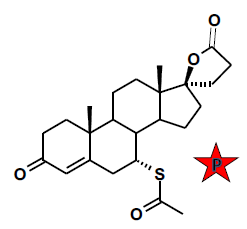
spironolactone
(Aldactone)
Diuretic def-
a substance that increases the rate of urine formation (typically via natriuretic-excretion of an abnormally large amount of sodium and water effects)
Electrolyte def-
a substance that becomes an ion in solution (e.g. sodium (Na+))
Hypokalemia def-
an abnormally low (<3.5 mEq/L) concentration of potassium (K+) in the blood; primary symptoms are muscle weakness and polyuria
Hyponatremia def-
an abnormally low (<136 mEq/L) concentration of sodium (Na+) in the blood; primary symptom is CNS dysfunction (confusion, nausea, seizures, etc.)
Mineralocorticoid def-
a type of hormone (e.g. aldosterone) that regulates the balance of water & electrolytes in the body (cf. to glucocorticoids & sex steroids)
Natriuretic def-
a substance that increases the rate & amount of sodium (Na+) elimination in the urine
Drug classes that are used for Edema and Hypertension-
Loops, Thiazides, K+-sparing
Carbonic anhydrase inhibitors
Site of action: proximal (convoluted) tubule
Mechanism of action: inhibition of carbonic anhydrase
CC- arylsulfonamide

acetaZOLAMIDE (Diamox)
MOA-
CC-
MOA- inhibition of carbonic anhydrase
CC- arylsulfonamide
Carbonic anhydrase inhibitors SAR-
(acidic) arylsulfonamide group required for interaction with the catalytic zinc atom in the active site of human carbonic anhydrase
Loop Diuretics
Site of action: ascending limb of loop of Henle (most efficacious site of action)
Mechanism of action (MOA): inhibition of the Na+/K+/2Cl- (NKCC2) cotransporter 2 (or symporter) & Na+,K+-ATPase
CC: arylsulfonamide
ethacrynic acid & ethyacrynate sodium (Edecrin)
Does not have sulfonamide. Used for Sufa allergies.

furosemide (Lasix)
furosemide (Lasix) formulations
Furoscix (SQ furosemide)
Enbumyst (IN bumetanide)
Thiazides & Derivatives
Site of action: distal (convoluted) tubule (site 3)
Mechanism of action (MOA/PC): inhibition of the Na+/Cl- cotransporter (or symporter, NCC) (also inhibition of carbonic anhydrase at higher doses)

Thiazides & Derivatives SAR-
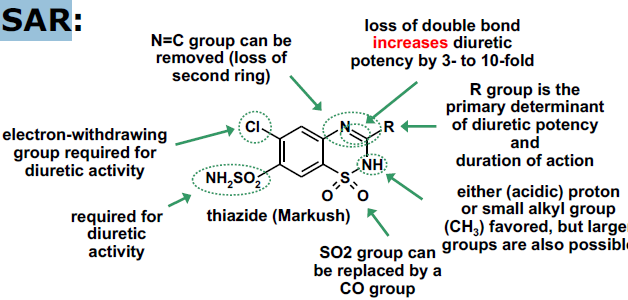

hydrochlorothiazide (HCTZ, HydroDiuril)
Thiazides & Derivatives ADR’s-
potential for volume and electrolyte disturbances (hyponatremia, hypokalemia), hyperuricemia (high level of uric acid in the blood)
Potassium-sparing agents
Site of action: the principal & intercalated cells of the connecting & cortical collecting tubule
Mechanism of action (MOA):
Aldosterone receptor antagonism (the “renones”or MRAs): spironolactone (Aldactone), eplerenone (Inspra), finerenone [(Kerendia) (does not have a Steriod SAR)]
Blockade of epithelial sodium (Na+) channels (ENaC) in the principal cells: aMILoride (as the HCl salt in Midamor) and triamterene (Dyrenium)
CC: progesterone derivatives OR diaminopyrimidine derivatives
Potassium-Sparing Agents ADR’s-
hyperkalemia, which can be fatal
sexual side effects (blocking testosterone receptors and lowering androgen activity)
Orthostatic Hypotension
Other diuretic agents
Osmotics
Xanthines
Vaptans
Thiazides & Derivatives
MOA: Na+/Cl- cotransporter (NCC) inhibitors
(also inhibition of carbonic anhydrase at higher doses)
CC: thiazides & derivatives

chlorthalidone (Hygroton)
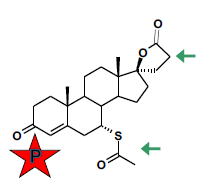
spironolactone (Aldactone)

triamterene (Dyrenium/ Maxzide)
sodium Channel (ENaC) blockers
Loop Diuretics ADR’s-
profound diuresis (Urine production) & electrolyte depletion
Carbonic anhydrase inhibitors ADR’s-
parasthesias, GI distress, taste alterations, CNS effects (e.g. drowsiness, confusion), polyuria, and hearing disturbances
Red Flags- Severe Cutaneous Adverse Reactions (SCARs)=SJS/TEN, severe abnormality or disease of the blood, kidney stones, hepatic toxicity