3-2 Lab Digestion
 Call Kai
 Learn
 Practice Test
 Spaced Repetition
 Match
 Flashcards
 Knowt Play
1/12

There's no tags or description
Looks like no tags are added yet.
13 Terms
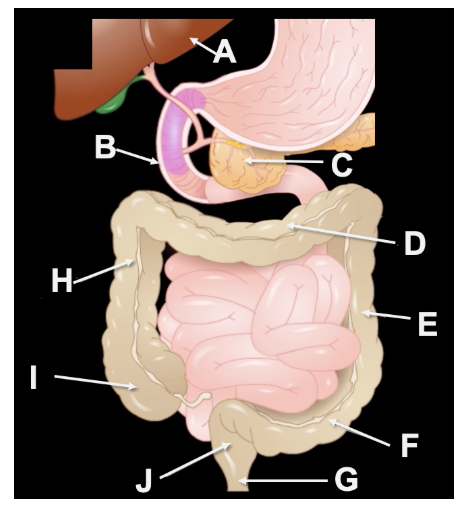
Label F, G, H, I, and J.
F. sigmoid colon
G. anal canal
H. ascending colon
I. cecum
J. rectum

Label A-G.
A. parotid gland
B. submandibular gland
C. sublingual gland
D. pharynx
E. soft palate
F. esophagus
G. epiglottis
The outer layer, the ______ peritoneum, lines the cavity wall.
parietal
The _____ peritoneum lines the outer surface of organs, and suspends and holds them in place.
visceral
____ are substances that temporarily bind to reactants, hold them in a favorable position to react with each other, and may change shapes of reactants in ways to speed up the reaction.
Catalysts
____ are proteins that function as biological catalysts that enable biochemical reactions to occur rapidly at normal body temps.
Enzymes
The substance that an enzyme acts upon is its _____.
substrate
____ are pockets on the enzyme surface to which a substrate molecule binds, often there are 2 to allow enzymes to bind to 2 different substrates.
Active sites
The fit between a particular enzyme and its substrate is similar to lock and key of which only one substrate will fit the active site. This is called ______.
enzyme-substrate specificity
_______ are the molecules that result from breakdown by an enzyme.
Reaction products
Exposing an enzyme to extreme temps or pH can change the shape of the enzyme and reduce its ability to bind to its substrate. This is called ____.
denaturation
Enzymes often require a ______, and inorganic examples include iron, copper, zinc, magnesium, and calcium ions.
cofactor
______ are organic examples usually derived from niacin, riboflavin, and other water-soluble vitamins.
Coenzymes